
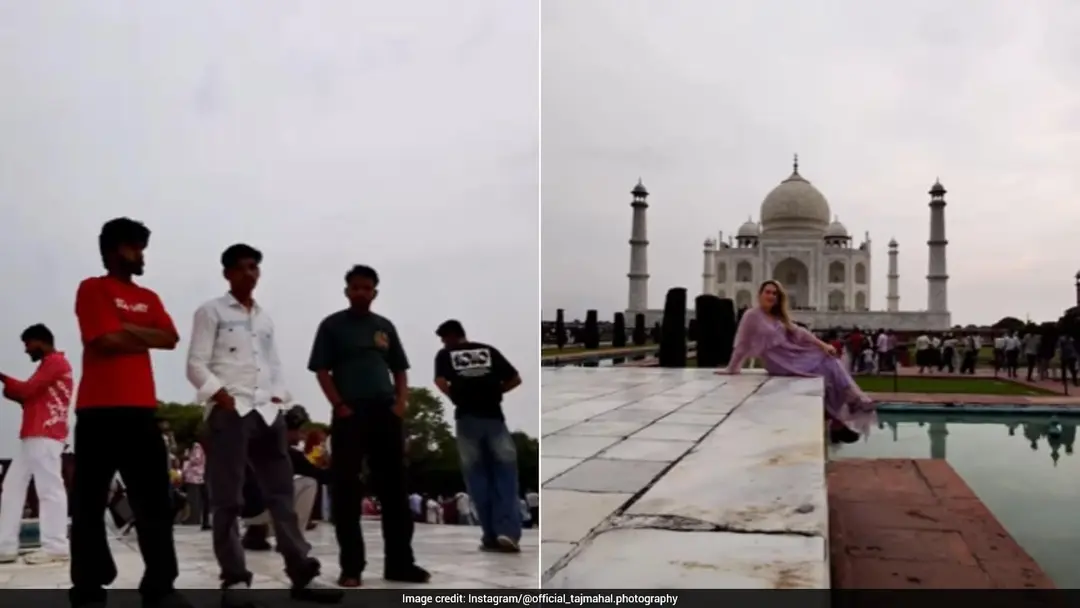
Photographer questions men staring at foreign tourist at Taj Mahal
A photographer conducting a photoshoot with a foreign woman tourist at the Taj Mahal confronted in Hindi a group of young men standing nearby and watching her. He asked, "Don't you have anything else to do? If you came to visit the Taj Mahal, go explore it. Why are you standing right here? Won't she feel uncomfortable?" The men argued they were minding their own business and left only after another man intervened. The video, posted from the Instagram account @official_tajmahal.photography, drew over 3.8 million views and more than 200,000 likes.
Source
NDTV — India · read the original report ↗
Desk check · some claims need care
What the desk checked (5)
- A photographer at the Taj Mahal confronted a group of men staring at a foreign woman tourist during a photoshoot. — Based on a video posted from the Instagram account @official_tajmahal.photography; no independent verification cited in source.
- The photographer asked in Hindi, "Don't you have anything else to do? ... Won't she feel uncomfortable?" — Quote attributed to the video in the source text.
- The caption said civic sense is needed in "the world's 6th-largest economy". — Quoted from the post caption; the economic ranking is the poster's claim, not verified in source.
- The video drew over 3.8 million views and more than 200,000 likes. — Figures appear in the source; platform metrics change over time and are unattributed to any count date.
- The men argued they were minding their own business and moved only after another man intervened. — Described in the source as seen in the video; no named witnesses.
Analysts’ view opinion
This looks like a small viral clip, but politically it touches three sensitive nerves at once: tourism, national image and women's safety in public spaces. The post's own framing — invoking "the world's 6th-largest economy" — is what shifts the conversation from individual bad manners to national prestige, and that is the politically loaded turn. Stories like this rarely become direct anti-government charges, but they can generate questions about tourism management and policing at flagship sites.
- Because the Taj Mahal is the country's tourism showpiece, any narrative about foreign visitors feeling unsafe or uncomfortable there is politically unhelpful for any government.
- No party gains here — the public sympathy is flowing to an ordinary citizen, which makes this more likely to stay a non-partisan "civic sense" debate than a partisan fight.
- Given how long governments have marketed hospitality-led tourism, the clip could be used by critics to question the gap between promotional messaging and on-the-ground experience.
- On the other side, the story says the men argued they were minding their own business, which leaves room for genuine disagreement over how the scene should be read.
- The 3.8 million views and 200,000-plus likes show how quickly social media can convert a local encounter into a national reputation debate.
What to watch — Watch for any official response from tourism authorities, local police or site administrators, and whether it is followed by announced measures on tourist safety around the monument.
The story establishes no formal complaint, police case, government reaction or comment from any political leader — for now it is a viral video and the online debate around it.
Deep dive
Research brief · 8 facts · 4 dates · exam-readyThe brief
Context
A photographer who shoots tourist portraits at the Taj Mahal filmed himself confronting, in Hindi, a group of young men who were standing near and watching a foreign woman tourist during her photoshoot. The clip, posted from the Instagram handle @official_tajmahal.photography, went viral and triggered a wider debate about public manners, civic sense and how India treats foreign visitors. The Taj Mahal in Agra is among India's most visited monuments and a major draw for international tourists, making conduct at the site a question of the country's image as a host.
Key facts
- The video was posted on Instagram from the account @official_tajmahal.photography, run by a Taj Mahal photographer identified in the post as 'Zee'.
- The photographer confronted the men in Hindi, asking: "Don't you have anything else to do? If you came to visit the Taj Mahal, go explore it. Why are you standing right here? Won't she feel uncomfortable?"
- The men initially argued that they were simply minding their own business and moved away only after another man intervened and asked them to clear the area.
- The post's caption said: "Civic sense is what we need in the world's 6th-largest economy."
- The caption added that following foreign tourists around the Taj Mahal, staring at them and making them uncomfortable "isn't the kind of hospitality we should be proud of".
- The video amassed over 3.8 million views and more than 200,000 likes.
- A majority of commenting users praised the photographer; one wrote, "Glad you raised your voice, super necessary!!"
- One user recounted taking his Spanish wife to the Taj Mahal and confronting many such men, saying "at the end of the day you get tired".
Timeline
- Date not stated in the sourceDuring a photoshoot with a foreign woman tourist at the Taj Mahal, the photographer notices several young men standing nearby and watching her.
- Same incidentHe confronts them in Hindi; they argue back, then leave after another man intervenes.
- After the incidentThe video is posted on Instagram from @official_tajmahal.photography with a caption on civic sense and hospitality.
- SubsequentlyThe clip crosses 3.8 million views and 200,000 likes, sparking online debate; the photographer thanks users in the comments.
Who has a stake
- Foreign tourists at Indian monuments — Safety, privacy and comfort while visiting; the ability to enjoy the experience without being followed or stared at.
- The photographer ('Zee', @official_tajmahal.photography) — Livelihood tied to tourist photoshoots at the Taj Mahal; took a public stand and drew widespread online praise.
- The group of young men confronted — Claimed they were minding their own business; publicly filmed and criticised online for their conduct.
- Indian tourism and the country's image abroad — Reputation for hospitality at a flagship heritage site frequented by international visitors.
- Social media users — Shaped the debate on civic sense; several shared similar personal experiences of harassment at the monument.
Why it matters
A single viral clip has turned everyday harassment of women tourists at India's most famous monument into a national conversation about civic sense and hospitality. How visitors are treated at flagship heritage sites shapes India's image as a safe destination, and the photographer's intervention shows the role ordinary citizens and bystanders play where formal enforcement is absent.
UPSC angle
Prelims pointers
- The Taj Mahal, located in Agra, is one of India's most visited monuments and a major international tourist draw.
- The viral video was posted from the Instagram account @official_tajmahal.photography, belonging to a photographer named Zee.
- The post's caption described India as "the world's 6th-largest economy" while appealing for civic sense.
- Video metrics as per the source: over 3.8 million views and more than 200,000 likes.
- The confrontation was conducted in Hindi and the men dispersed only after a third person intervened.
Mains framing
The incident at the Taj Mahal illustrates how the quality of a tourist's experience at Indian heritage sites depends not only on infrastructure and ticketing but on public behaviour and civic sense. Staring at and following foreign women tourists, as flagged in the viral video, constitutes a form of harassment that deters visitors, damages destination reputation and disproportionately affects women travellers; the source notes that even locals accompanying foreign spouses have faced the same problem repeatedly. Causes include weak norms of respecting personal space in crowded public spaces, the absence of visible deterrence at monument premises, and a bystander culture in which offenders feel emboldened, as seen when the men argued back rather than withdrawing. The episode also shows the countervailing force of citizen assertion and social media amplification: an individual intervention, backed by a third person and then by millions of viewers, can set a public standard. A way forward, consistent with what the story itself suggests, lies in sensitisation of those working around tourist sites, active bystander intervention, and treating hospitality as a shared civic responsibility rather than only a state or industry function. No official policy response is stated in the source.
Key terms
- Taj Mahal
- The Agra monument where the incident occurred; a leading destination for foreign tourists in India.
- Civic sense
- Basic public manners and consideration for others in shared spaces; the theme invoked in the post's caption.
- @official_tajmahal.photography
- The Instagram account, run by a photographer named Zee, from which the viral video was posted.
- Bystander intervention
- A third party stepping in to stop objectionable behaviour; here, another man persuaded the group to leave.
- Hospitality
- The treatment extended to guests; the caption argued that staring at and following tourists is not hospitality India should be proud of.
Practice questions
- Harassment of women tourists at heritage sites is as much a civic failure as a law-and-order problem. Discuss with reference to recent incidents.
- How does public behaviour at flagship monuments affect India's image as a tourist destination? Suggest measures to improve visitor experience.
- Examine the role of social media in enforcing norms of public conduct, using the viral Taj Mahal photographer video as an example.
Grounded only in the source report — figures and dates are the source's, not inferred.