
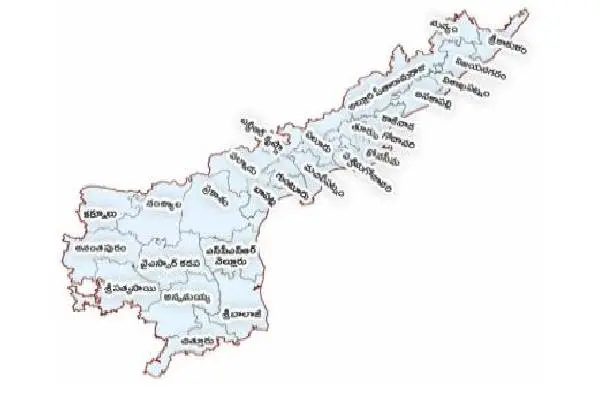
Andhra Pradesh speeds up new districts formation process
The Andhra Pradesh government has accelerated work on forming new districts, with proposals before a Cabinet subcommittee. At a meeting with Chief Minister Chandrababu Naidu, the panel discussed revenue divisions and mandal boundaries. The state has 26 districts, 77 revenue divisions and 679 mandals. Proposals include a new district centred on Markapur, making Madanapalle a separate district, shifting Annamayya headquarters from Rajampet to Rayachoti, and reorganising 86 mandals across 28 constituencies. Recommendations go to the Cabinet on November 7.
Source
Annamayya — politics · read the original report ↗
Desk check · some claims need care
What the desk checked (5)
- Andhra Pradesh currently has 26 districts, 77 revenue divisions and 679 mandals. — Figures appear in source; no department or document cited.
- The previous government raised the number of districts from 13 to 26, aligned with parliamentary constituencies. — Stated in source as background; no source given.
- A new district centred on Markapur is proposed, recommended by the Revenue Department. — Attributed in source to the Revenue Department's recommendation.
- Proposals include shifting Annamayya district headquarters from Rajampet to Rayachoti and merging Addanki segment with Prakasam district. — Presented in source as proposals under review, not approved decisions.
- Recommendations will be placed before the Cabinet meeting on November 7. — Date appears in source; described as expected, no official notification cited.
Analysts’ view opinion
District reorganisation is never purely administrative — it is about local identity, which leaders gain clout, and which election promises get cashed. Proposals for a Markapur-centred district, Madanapalle as a separate district and shifting the Annamayya headquarters to Rayachoti give the Naidu government a visible way to show it is honouring campaign commitments, while also revisiting the previous government's model of aligning 26 districts with parliamentary constituencies. Areas that gain a headquarters will credit the ruling side; areas that lose one become ready-made grievance politics for the opposition.
- A district headquarters means offices, jobs and land values, which is why these decisions are among the most locally sensitive in state politics.
- The Markapur proposal lets the ruling party frame the exercise as promise-keeping rather than map-redrawing.
- Moves like shifting Annamayya's headquarters from Rajampet to Rayachoti, or merging the Addanki segment with Prakasam, create clear losers who may mobilise in protest.
- Re-evaluating the parliamentary-constituency-based structure will inevitably be read as a political verdict on the previous government's signature decision, inviting charges of score-settling.
- The planned public consultation after the Cabinet stage can defuse pressure, but it can equally open the door to a fresh wave of district demands.
What to watch — Watch which proposals survive the November 7 Cabinet meeting, the outcome of consultations with Chittoor and Annamayya leaders, and the reaction in places set to lose status such as Rajampet.
Everything here remains at the proposal stage; the story does not establish which districts will be finalised, nor does it record any opposition or local reaction.
Deep dive
Research brief · 8 facts · 5 dates · exam-readyThe brief
Context
Andhra Pradesh is once again redrawing its administrative map. The previous government had raised the number of districts from 13 to 26 by aligning them with parliamentary constituencies; the Chandrababu Naidu-led government is now re-evaluating that structure. A Cabinet subcommittee is examining proposals on new districts, revenue divisions and mandal boundaries, partly to honour election-campaign commitments. Its recommendations are to go before the Cabinet on November 7, after which the formal district-creation process, including public consultations, will begin.
Key facts
- Andhra Pradesh currently has 26 districts, 77 revenue divisions and 679 mandals.
- The previous government increased districts from 13 to 26 by aligning them with parliamentary constituencies.
- A proposal is under review to create a new district centred around Markapur, an election promise of the Chief Minister, also recommended by the Revenue Department.
- Madanapalle, described as the state's largest revenue division, is proposed to be declared a separate district.
- Proposals seek reorganisation of 86 mandals across 28 constituencies for better governance and resource management.
- A proposal exists to shift the Annamayya district headquarters from Rajampet to Rayachoti.
- The Addanki Assembly segment of Bapatla district is proposed to be merged with Prakasam district.
- Revenue divisions may increase by four, while the total number of mandals is likely to remain unchanged.
Timeline
- Previous government's tenureNumber of districts raised from 13 to 26, aligned with parliamentary constituencies.
- RecentlyCabinet subcommittee met Chief Minister Chandrababu Naidu to discuss revenue divisions and mandal boundaries.
- Today (as reported)Cabinet subcommittee expected to meet again to finalise its recommendations.
- November 7Recommendations to be placed before the state Cabinet meeting.
- After the Cabinet meetingFormal district-creation process to begin, with public consultations before the final announcement.
Who has a stake
- Andhra Pradesh government / Chief Minister Chandrababu Naidu — Must balance administrative efficiency with election-campaign commitments on new districts.
- Cabinet subcommittee — Tasked with examining proposals on districts, revenue divisions and mandals and finalising recommendations.
- Revenue Department — Has recommended the Markapur district proposal; will implement boundary and division changes.
- People of Markapur, Madanapalle, Rayachoti, Rajampet and Addanki — Stand to gain or lose district headquarters status and nearer access to administration.
- Leaders of Chittoor and Annamayya districts — To be consulted before the Madanapalle district proposal is finalised.
- Residents of Polavaram project's submerged mandals — Their mandals may be merged with nearby districts for administrative convenience once the project is completed.
Why it matters
District boundaries decide where citizens go for revenue, police and welfare services, and where jobs, offices and funds are located, so redrawing them directly affects everyday access to the state. The exercise also tests whether reorganisation is driven by administrative logic or by electoral promises, only three years after the state's last major restructuring from 13 to 26 districts.
UPSC angle
Prelims pointers
- Andhra Pradesh: 26 districts, 77 revenue divisions, 679 mandals as per the source.
- Districts in AP were earlier raised from 13 to 26, aligned with parliamentary constituencies.
- Madanapalle is described as the state's largest revenue division.
- Annamayya district headquarters proposed to shift from Rajampet to Rayachoti.
- Cabinet subcommittee recommendations to be placed before the AP Cabinet on November 7.
- Polavaram project's submerged mandals may be merged with nearby districts after project completion.
Mains framing
Andhra Pradesh's fresh district reorganisation exercise illustrates the tension between administrative rationalisation and political commitment in India's federal sub-state governance. The earlier increase from 13 to 26 districts by mapping them onto parliamentary constituencies sought to bring administration closer to citizens, but the present government is re-evaluating that template, driven both by election promises (such as a Markapur-centred district) and by functional concerns like the size of the Madanapalle revenue division, the displacement caused by the Polavaram project's submerged mandals, and the awkward fit of segments like Addanki in Bapatla. The implications are significant: new headquarters mean new offices and recurring expenditure, shifting headquarters (Rajampet to Rayachoti) can trigger local resentment, and reorganising 86 mandals across 28 constituencies affects service delivery continuity. The source indicates a calibrated approach — revenue divisions may rise by four while the total number of mandals stays unchanged — and a process that includes consultation with district leaders and public consultations before the final announcement. The way forward lies in transparent criteria (population, area, travel distance to headquarters, revenue workload), costed proposals, and stability of boundaries so that repeated redrawing does not itself become a source of administrative disruption.
Key terms
- Mandal
- The basic revenue and administrative sub-unit below a revenue division in Andhra Pradesh, equivalent to a tehsil or block elsewhere.
- Revenue division
- An administrative tier between the district and mandals, headed by a revenue divisional officer; AP currently has 77.
- Cabinet subcommittee
- A small group of ministers set up to examine a specific issue and recommend a course of action to the full Cabinet.
- Polavaram project
- Irrigation project in Andhra Pradesh whose submerged mandals may be merged with nearby districts for administrative convenience after completion.
- Annamayya district
- One of AP's districts, currently headquartered at Rajampet, with a proposal to shift the headquarters to Rayachoti.
Practice questions
- Examine the administrative and political considerations that drive the creation of new districts in Indian states, using the recent Andhra Pradesh reorganisation as an illustration.
- Does aligning districts with parliamentary constituencies improve governance? Critically evaluate in the light of Andhra Pradesh's move from 13 to 26 districts and its current re-evaluation.
- How should states balance election commitments with fiscal and administrative costs when redrawing district, revenue division and mandal boundaries?
Grounded only in the source report — figures and dates are the source's, not inferred.