
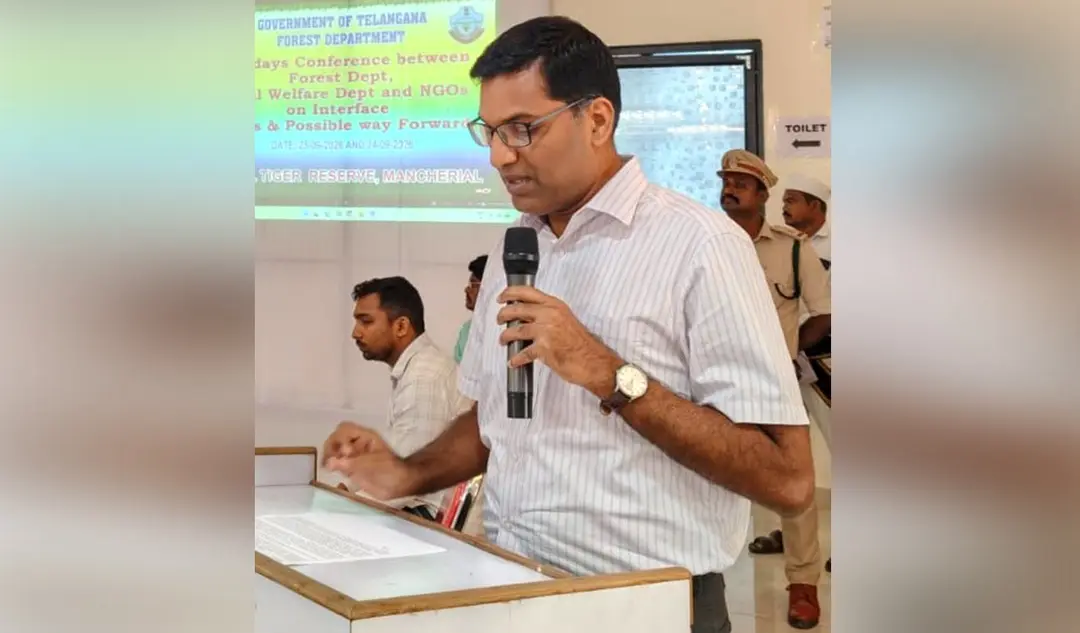
Mancherial conference on forest conservation, tribal livelihoods concludes
A two-day conference bringing together Forest and Tribal Welfare officials and NGOs concluded in Mancherial on Thursday. Collector Kumar Deepak, chief guest on the final day, stressed creating economic activities for stakeholders to protect forests and wildlife. SERP Chief Executive Officer Divya Devarajan, speaking via video call, urged setting up processing units and value addition to minor forest produce using government schemes. Speakers discussed mitigating human-animal conflict and sustainable development. Officials said an action plan was prepared for inter-departmental coordination.
Source
Telangana Today · read the original report ↗
Desk check · compared with the source
What the desk checked (5)
- A two-day conference of Forest, Tribal Welfare officials and NGOs concluded in Mancherial on Thursday. — Stated in source as event reporting; no external confirmation possible.
- Collector Kumar Deepak was chief guest on the concluding day and urged economic activities for stakeholders to protect forests and wildlife. — Attributed directly to the named Collector in the source.
- SERP CEO Divya Devarajan spoke via video call, urging processing units and value addition to minor forest produce using government schemes. — Attributed to the named official; mode of participation specified in source.
- Officials said an action plan was prepared for inter-departmental coordination. — Attributed collectively to unnamed officials in the source.
- Kawal Tiger Reserve field director Shantharam and DFOs described anti-poaching, anti-encroachment and anti-teak-felling measures. — Named speakers listed in source; figures not provided.
Analysts’ view opinion
On the surface this is an administrative conference, but politically it is an attempt to reframe a sensitive conflict in agency areas — forest conservation versus tribal livelihoods — from confrontation to partnership. The Collector framing economic activity as the instrument of protection, and the SERP CEO pushing processing units and value addition, signals a preference for the language of schemes over the language of prohibition. If delivered, the state machinery and the Tribal Welfare department gain politically; if it stays on paper, existing distrust of the Forest department only hardens.
- Bringing Forest and Tribal Welfare onto one platform is itself an implicit admission that coordination between the two has been lacking.
- Human-animal conflict is a locally combustible issue around the Kawal tiger reserve, so steering the debate toward income opportunities rather than compensation or relocation is a strategic choice.
- Routing livelihoods through SERP and government schemes means credit is likely to flow to the state's rural development machinery; no local elected representatives figure in the story.
- The presence of many NGOs and environmentalists adds legitimacy, but the story offers no clarity on the genuinely contentious political questions such as podu cultivation and forest rights.
- Action plans without budgets, staffing or timelines are an easy target for opposition charges of governance by conference.
What to watch — Watch whether the action plan attracts funding, where processing units are actually sited, how tribal organisations respond, and whether any of this becomes campaign material as elections approach.
The story establishes nothing about the action plan's contents, funding, timelines or any political party's reaction — for now it rests entirely on officials' statements.
Deep dive
Research brief · 8 facts · 3 dates · exam-readyThe brief
Context
Mancherial district in Telangana, which adjoins the Kawal Tiger Reserve, hosted a two-day conference bringing together Forest Department and Tribal Welfare officials along with NGOs to discuss "interface issues" between forest conservation and tribal livelihoods. The meeting, which ended on Thursday, focused on human-animal conflict, protection of forests and wildlife, and income generation for tribal communities from forest produce. Collector Kumar Deepak was chief guest on the concluding day, and Society for Elimination of Rural Poverty (SERP) Chief Executive Officer Divya Devarajan joined by video call. Officials said an action plan was prepared for inter-departmental coordination going forward.
Key facts
- The two-day conference of Forest officials, Tribal Welfare officials and NGOs concluded in Mancherial on Thursday; the report is dated 24 September 2026.
- Collector Kumar Deepak was chief guest on the concluding day and stressed creating economic activities for stakeholders to effectively protect forest and wildlife.
- SERP Chief Executive Officer Divya Devarajan spoke via video call, urging processing units and value addition to minor forest produce using government schemes.
- Kawal Tiger Reserve Field Director Shantharam spoke, along with DFOs Balamani, Prashanth Bobade and Rahul Kishan Jadhav, and ITDA-Utnoor project officer Manda Makarandu.
- Officials explained measures to prevent poaching, encroachment and felling of teak trees, and described income-generating initiatives for tribals using forest products.
- Speakers discussed mitigating human-animal conflict, involving tribals in forest conservation and sustainable development models tapping both State and Union government schemes.
- An action plan was prepared to take the agenda forward through coordination among various departments, officials said.
- NGOs present included Kishan Mitra, Central People Forestry, Pragathi Organic Mix, Ekalavya Foundation, Centre for Collective Development, Vijayavahini Charitable Foundation, Dhatri, Tribal United Forum and Gramin Samasya Mukthi Trust of Maharashtra.
Timeline
- Two days ending Thursday (report updated 24 September 2026)Conference of Forest, Tribal Welfare departments and NGOs held in Mancherial on interface issues and the way forward.
- Concluding day (Thursday)Collector Kumar Deepak attends as chief guest; SERP CEO Divya Devarajan addresses the meet by video call; Kawal Tiger Reserve Field Director and DFOs speak.
- After the conferenceAn action plan prepared for coordination among various departments, officials said.
Who has a stake
- Tribal communities of the Mancherial/Kawal region — Livelihoods from minor forest produce, income-generating initiatives and a role in forest conservation.
- Forest Department (Field Director Kawal Tiger Reserve, DFOs, FDOs, FROs) — Protecting forests and wildlife, preventing poaching, encroachment and teak felling while working with forest-dwellers.
- Tribal Welfare Department and ITDA-Utnoor — Delivering welfare and livelihood schemes to tribals and coordinating with the Forest Department.
- Society for Elimination of Rural Poverty (SERP) — Pushing processing units and value addition to minor forest produce through government schemes.
- District administration / Collector Kumar Deepak — Inter-departmental coordination and creating economic activities for stakeholders to protect forests.
- NGOs and environmentalists (Ekalavya Foundation, Dhatri, Centre for Collective Development and others) — Field-level implementation, advocacy for tribal rights and conservation partnerships.
Why it matters
Forest conservation and tribal livelihoods are often framed as competing goals, and conflict over forest use fuels both human-animal encounters and illegal felling or encroachment. The Mancherial conference signals an attempt to align the Forest and Tribal Welfare departments with NGOs around a shared action plan where tribals earn from value-added forest produce rather than depleting the forest. For a district bordering the Kawal Tiger Reserve, such coordination directly affects wildlife protection outcomes and the incomes of forest-dependent families.
UPSC angle
Prelims pointers
- Kawal Tiger Reserve is located in Telangana; its Field Director Shantharam addressed the Mancherial conference.
- SERP (Society for Elimination of Rural Poverty) is a rural poverty-alleviation agency; its CEO at the time of the report was Divya Devarajan.
- ITDA (Integrated Tribal Development Agency) at Utnoor was represented at the conference.
- Minor forest produce value addition and processing units were the core livelihood proposals discussed.
- Threats to forests named in the source: poaching, encroachment and felling of teak trees.
- An inter-departmental action plan was prepared covering forest conservation, tribal livelihoods and human-animal conflict.
Mains framing
The Mancherial conference illustrates the classic conservation-livelihood interface: forests that sustain tribal households are also habitats requiring protection from poaching, encroachment and illegal teak felling, while expanding wildlife populations near reserves such as Kawal raise human-animal conflict. The remedy articulated by officials is economic rather than purely regulatory — Collector Kumar Deepak's emphasis on creating economic activities for stakeholders, and SERP CEO Divya Devarajan's call for processing units and value addition to minor forest produce using existing State and Union schemes, both treat tribal income as the instrument of conservation rather than its casualty. Implementation, however, depends on institutional convergence: the Forest Department, Tribal Welfare Department, ITDA-Utnoor, SERP and a large number of NGOs each operate on separate mandates and budgets, which is why an inter-departmental action plan was prepared. The way forward suggested by the source is participatory conservation — involving tribals directly in protecting forests, coupling that with sustainable development models and market-linked value addition, and sustaining coordination beyond the conference so that conflict mitigation and livelihood generation advance together rather than in sequence.
Key terms
- Minor forest produce
- Non-timber forest products collected by forest-dwellers; the conference urged processing and value addition to raise tribal incomes.
- SERP
- Society for Elimination of Rural Poverty, whose CEO Divya Devarajan advocated processing units and scheme-linked value addition.
- ITDA
- Integrated Tribal Development Agency; the Utnoor ITDA project was represented at the Mancherial conference.
- Kawal Tiger Reserve
- Protected tiger habitat in Telangana whose Field Director spoke on forest and wildlife protection measures.
- Human-animal conflict
- Clashes between people and wild animals near forests; mitigating it was a central theme of the conference.
- DFO / FDO / FRO
- Divisional Forest Officer, Forest Development Officer and Forest Range Officer — field-level forest administration ranks present at the meet.
Practice questions
- Discuss how value addition to minor forest produce can reconcile forest conservation with tribal livelihoods, using the Mancherial conference as an illustration.
- What institutional mechanisms are needed for effective coordination between Forest and Tribal Welfare departments in mitigating human-animal conflict?
- Examine the role of NGOs and community participation in protected area management in India, with reference to tiger reserve landscapes.
Grounded only in the source report — figures and dates are the source's, not inferred.