
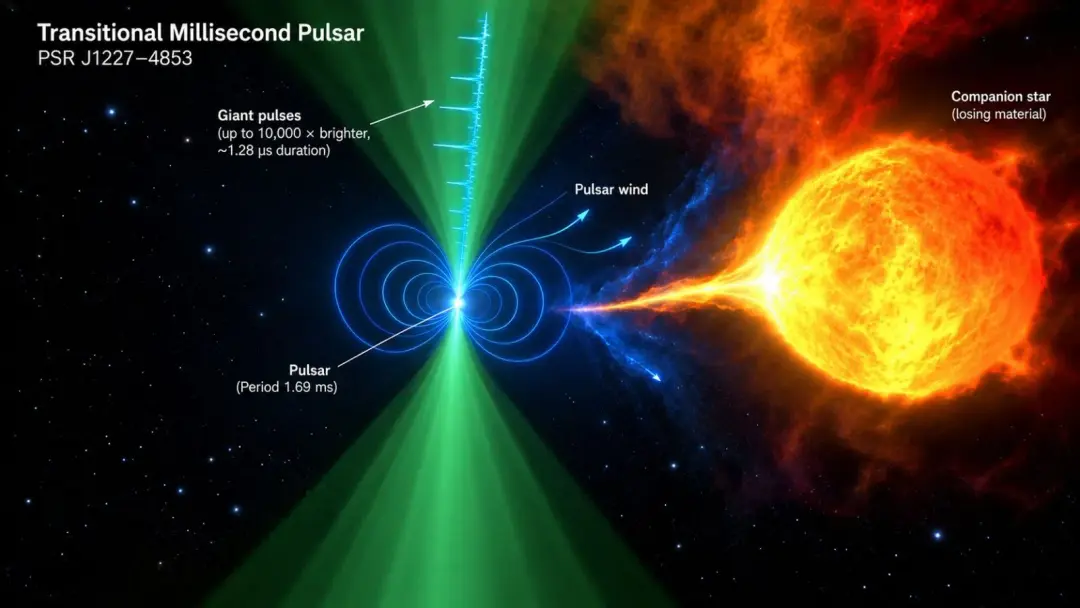
uGMRT detects giant radio flashes from rare pulsar
An international team of astronomers from India, the US, Germany and the UK has detected extraordinarily bright, microsecond-duration radio flashes from the rare neutron star PSR J1227-4853 using the upgraded Giant Metrewave Radio Telescope at Khodad, 80 km from Pune. The pulsar spins 592 times a second and was monitored for about 174 hours, yielding 235 giant pulses. Lead author Saptarshi Sarkar said some flashes were nearly 1,000 times brighter than normal emission, the shortest lasting 1.28 microseconds. The study appeared in The Astrophysical Journal.
Source
Indian Express — Cities · read the original report ↗
Desk check · compared with the source
What the desk checked (5)
- Astronomers using the uGMRT at Khodad, 80 km from Pune, detected microsecond-duration giant radio pulses from PSR J1227-4853. — Attributed to an international team from India, the US, Germany and the UK; study said to be published in The Astrophysical Journal.
- PSR J1227-4853 is one of only three known transitional millisecond pulsars among more than 3,000 known pulsars. — Attributed to lead author Saptarshi Sarkar in comments to The Indian Express.
- The pulsar spins 592 times a second; 235 giant pulses were found in about 174 hours of monitoring. — Figures appear in the source text as reported by the research team.
- Some flashes were nearly 1,000 times brighter than normal emission and the shortest lasted 1.28 microseconds. — Direct quote attributed to Sarkar; not independently verifiable here.
- The discovery is credited to the uGMRT's sensitivity, microsecond time resolution and long-term monitoring ability. — Attributed to co-author Jayanta Roy, Associate Professor at NCRA.
Analysts’ view opinion
This is as much a technology story as an astronomy one. Catching pulses that last microseconds requires sensitivity, fine time resolution and a back end able to sift an enormous data stream — and this result suggests the upgraded GMRT holds its own on all three. Extracting 235 giant pulses from roughly 174 hours of monitoring is a data-pipeline achievement as much as a hardware one.
- Recording a 1.28-microsecond flash from a star spinning 592 times a second is only possible with extremely fast timing electronics, not routine observing.
- It underlines the value of upgrading rather than rebuilding: modernised receivers, bandwidth and processing can keep existing infrastructure at the research frontier.
- The real bottleneck in rare-event science is observing time and data handling, and the ability to run multi-year monitoring campaigns is now a key competitive trait for telescopes.
- That this is one of only three transitional millisecond pulsars among more than 3,000 known fits a familiar pattern: as sensitivity rises, new sub-classes of objects emerge.
- The India-US-Germany-UK authorship reflects how big scientific instruments increasingly deliver results through international collaboration rather than single-nation effort.
What to watch — Watch whether this pulsar becomes a comparison laboratory for other extreme emissions such as fast radio bursts, and how microsecond-timing techniques spread to next-generation radio arrays.
The story does not establish what physical mechanism produces these flashes or how they relate to other cosmic radio bursts — that remains an open research question.
Deep dive
Research brief · 8 facts · 3 dates · exam-readyThe brief
Context
Astronomers using the upgraded Giant Metrewave Radio Telescope (uGMRT) at Khodad, 80 km from Pune, have detected extremely bright, microsecond-long radio flashes — "giant pulses" — from PSR J1227−4853, a rare kind of neutron star. Neutron stars are the ultra-dense collapsed cores of exploded giant stars; a pulsar is a fast-spinning, highly magnetised neutron star whose radio beams sweep past Earth like a lighthouse beam. PSR J1227−4853 is a "transitional millisecond pulsar", one of only three known among more than 3,000 known pulsars, making it a rare window into how neutron stars evolve. The finding, by an international team from India, the US, Germany and the UK, was published in The Astrophysical Journal.
Key facts
- Giant radio pulses were discovered from a transitional millisecond pulsar system for the first time, using the uGMRT at Khodad, 80 km from Pune.
- PSR J1227−4853 spins 592 times a second — described as almost twice as fast as a regular kitchen blender.
- The pulsar was monitored for about 174 hours over several years, yielding 235 individual giant radio pulses.
- Some flashes were nearly 1,000 times brighter than the pulsar's normal emission.
- The shortest pulse lasted just 1.28 microseconds — about 100,000 times shorter than an eye blink.
- PSR J1227−4853 is one of only three known transitional millisecond pulsars among more than 3,000 known pulsars.
- Only about 20 pulsars, including this one, are known to produce giant pulses.
- The study was published in The Astrophysical Journal; lead author Saptarshi Sarkar is a PhD student at NCRA-TIFR.
Timeline
- Over several years (exact dates not stated in the source)The team monitored PSR J1227−4853 with the uGMRT for about 174 hours.
- Not dated in the sourceAnalysis of the data yields 235 giant radio pulses, including one lasting only 1.28 microseconds.
- Not dated in the sourceFindings published in The Astrophysical Journal, establishing PSR J1227−4853 as a new laboratory for studying extreme radio flashes.
Who has a stake
- NCRA-TIFR (National Centre for Radio Astrophysics, Tata Institute of Fundamental Research) — Runs the uGMRT; its scientists led the discovery, strengthening India's standing in low-frequency radio astronomy.
- Department of Atomic Energy (DAE) — TIFR is an aided institute under DAE, which underpins funding and governance of the facility behind the discovery.
- Saptarshi Sarkar, lead author and NCRA-TIFR PhD student — Led the observations and analysis; describes the pulses as extreme in both brightness and brevity.
- Jayanta Roy, co-author and Associate Professor, NCRA — Credits the discovery to uGMRT's high sensitivity, microsecond time resolution and long-term monitoring ability.
- International collaborators from the US, Germany and the UK — Partners in the study; benefit from access to uGMRT data on a rare class of neutron star.
- Global astronomy community studying fast radio bursts and neutron stars — Gains a new laboratory to test mechanisms behind the universe's brightest, shortest radio bursts.
Why it matters
Giant pulses are among the brightest and shortest radio emissions known, and detecting them from a transitional millisecond pulsar gives astronomers a rare laboratory to probe how rapidly rotating neutron stars generate such extreme bursts. The result also demonstrates that an Indian facility — the uGMRT — can deliver the sensitivity and microsecond timing precision needed for frontier discoveries, anchoring India in global radio astronomy.
UPSC angle
Prelims pointers
- uGMRT: upgraded Giant Metrewave Radio Telescope at Khodad, 80 km from Pune; a low-frequency radio telescope.
- uGMRT is operated by NCRA, a unit of TIFR, an aided institute under the Department of Atomic Energy.
- PSR J1227−4853: transitional millisecond pulsar spinning 592 times per second; one of only three such known objects.
- 235 giant pulses detected in about 174 hours of monitoring; shortest pulse 1.28 microseconds; some nearly 1,000 times brighter than normal emission.
- About 20 pulsars in all are known to emit giant pulses.
- Pulsar: rapidly spinning, highly magnetised neutron star emitting radio waves from regions around both magnetic poles.
Mains framing
The detection of giant radio pulses from PSR J1227−4853 illustrates how national research infrastructure translates into globally significant science. Neutron stars are the dense remnants of exploded giant stars, and pulsars — their rapidly spinning, highly magnetised versions — act as natural laboratories for extreme physics; transitional millisecond pulsars, of which only three are known among over 3,000 pulsars, additionally capture neutron stars mid-evolution. Catching microsecond-scale flashes nearly 1,000 times brighter than normal emission required three capabilities that the uGMRT uniquely combines, as co-author Jayanta Roy noted: high sensitivity, microsecond time resolution, and the institutional ability to sustain long-term monitoring campaigns — about 174 hours spread over several years. The implications run in two directions: astrophysically, the source becomes a new laboratory for understanding the diverse mechanisms behind the universe's brightest and shortest radio bursts; institutionally, it shows the value of patient, long-baseline observing programmes and of international collaboration (India, the US, Germany, the UK) hosted on Indian facilities. The way forward lies in sustaining such observing time, training doctoral researchers as first authors, and leveraging the uGMRT's sensitivity for follow-up on rare transient phenomena.
Key terms
- Neutron star
- Extremely dense leftover core of a giant star that has exploded.
- Pulsar
- A rapidly spinning, highly magnetised neutron star emitting radio waves from regions around both its magnetic poles.
- Transitional millisecond pulsar
- A rare pulsar caught changing state; only three are known among more than 3,000 known pulsars.
- Giant pulse
- An exceptionally bright, very short radio flash from a pulsar; known from only about 20 pulsars.
- uGMRT
- Upgraded Giant Metrewave Radio Telescope at Khodad near Pune, among the world's most sensitive low-frequency radio telescopes.
- NCRA-TIFR
- National Centre for Radio Astrophysics, a unit of TIFR — an aided institute under the Department of Atomic Energy — which runs the uGMRT.
Practice questions
- What are giant radio pulses, and why does their detection from a transitional millisecond pulsar such as PSR J1227−4853 matter for understanding neutron star evolution?
- Discuss the role of the upgraded Giant Metrewave Radio Telescope in India's astronomy research ecosystem, with reference to its institutional linkages and technical capabilities.
- Long-term monitoring campaigns are essential for detecting rare astronomical transients. Examine this statement in the light of the 174-hour observation that yielded 235 giant pulses.
Grounded only in the source report — figures and dates are the source's, not inferred.