
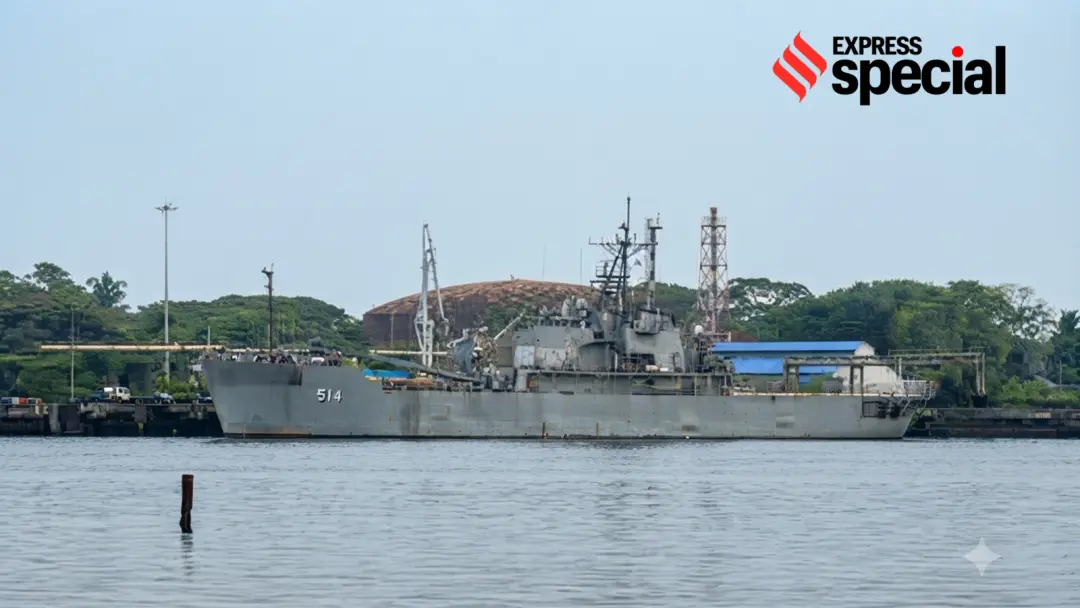
Iranian navy ship IRIS Lavan still docked in Kochi after six months
Six months after the West Asia war broke out, Iranian Navy landing ship IRIS Lavan remains at Kochi with part of its crew. India allowed it to dock on March 4 on humanitarian grounds after it reported technical issues. The ship had 183 crew members then, and non-essential personnel were repatriated a month later. Sources said over 50 crew remain in Kochi and the vessel's guardianship has been transferred to the Cochin Port Authority.
Source
Indian Express — India · read the original report ↗
Desk check · some claims need care
What the desk checked (5)
- IRIS Lavan docked in Kochi on March 4 on humanitarian grounds after reporting technical issues. — Stated in source and corroborated by quoted remarks of External Affairs Minister S Jaishankar on March 7.
- The frigate IRIS Dena was sunk by a US submarine in waters near Sri Lanka on March 4. — Asserted in the source without attribution to any named official or agency.
- Over two dozen essential crew members remain in Kochi; elsewhere the source says over 50 crew members are still there. — Both figures attributed only to 'it is learnt'; the two numbers are internally inconsistent.
- Guardianship of the vessel has been transferred to the Cochin Port Authority. — Attributed to unnamed sources; the Port Authority PRO declined to share details, citing Indian Navy directions.
- The Lavan had 183 crew on board in March and non-essential crew were repatriated a month later. — Figure appears in source; no official attribution given.
Analysts’ view opinion
This is not really a story about a ship with technical trouble — it is a test of the fine balance in India's foreign policy. By letting the Iranian vessel dock at Kochi on the very day the war broke out, and by framing it strictly as a humanitarian decision, Delhi tried to protect its ties with Tehran without complicating its strategic partnership with Washington. That the ship is still there six months on, with guardianship shifted from the Navy to the Cochin Port Authority, suggests a temporary gesture is quietly hardening into a long-term diplomatic liability.
- The "humanitarian grounds" framing is a deliberate political choice — language that preserves neutrality without signalling support for either side in the conflict.
- Repatriating non-essential crew let Delhi shrink the politically visible footprint, while the more than 50 who remain show the issue is far from closed.
- Transferring guardianship from the Navy to the port authority can be read as an attempt to strip the situation of its military colour and recast it as an administrative matter.
- The port authority's refusal to comment, citing Navy directions, signals a government keen to keep this out of open public debate.
- A second Iranian vessel taking refuge in Sri Lanka shows this pressure is not India's alone — regional states are facing similar choices.
What to watch — Watch for how and when the ship finally leaves, whether the remaining crew are repatriated, whether questions are raised in Parliament or by the opposition, and whether Washington or Tehran comment publicly.
The story does not establish how long the vessel will stay, what diplomatic negotiations are under way behind it, or whether any external pressure is being applied on India.
Deep dive
Research brief · 8 facts · 8 dates · exam-readyThe brief
Context
Iranian Navy landing ship IRIS Lavan and frigate IRIS Dena came to India in February to take part in the International Fleet Review and the MILAN 2026 multilateral naval exercises at Visakhapatnam. As the ships headed home after the exercises, war broke out in West Asia. The Lavan reported technical issues and India permitted it to dock at Kochi on March 4 on humanitarian grounds — the same day the Dena was sunk by a US submarine in waters near Sri Lanka. Six months on, the vessel and part of its crew remain in Kochi, with guardianship of the ship now transferred to the Cochin Port Authority.
Key facts
- IRIS Lavan, an Iranian Navy landing ship, docked in Kochi on March 4 after reporting technical issues; India cleared the entry on humanitarian grounds.
- The Iranian frigate IRIS Dena was sunk by a US submarine in waters near Sri Lanka on March 4, the same day the Lavan docked at Kochi.
- The Lavan had 183 crew members on board when it arrived in Kochi in March; non-essential crew were repatriated by India a month later.
- Sources say over 50 crew members are still in Kochi, including over two dozen essential crew with the ship.
- A third Iranian Navy ship, fleet supply vessel IRIS Bushehr, sought refuge in Sri Lanka on March 5.
- Guardianship of IRIS Lavan has been transferred to the Cochin Port Authority, according to sources.
- The Cochin Port Authority PRO said that, as per Indian Navy directions, no information on IRIS Lavan can be disclosed at this stage.
- Lavan and Dena had come to India in February for the International Fleet Review and MILAN 2026 exercises in Visakhapatnam.
Timeline
- FebruaryIRIS Lavan and IRIS Dena arrive in India for the International Fleet Review and MILAN 2026 multilateral naval exercises at Visakhapatnam.
- February 28 (per Jaishankar's recollection)India receives a message from the Iranian side that one ship, closest to Indian waters, wanted to enter an Indian port citing problems.
- March 1India conveys permission to the Iranian ship to come in.
- March 4IRIS Lavan docks at Kochi; the same day IRIS Dena is sunk by a US submarine in waters near Sri Lanka.
- March 5Iranian fleet supply vessel IRIS Bushehr seeks refuge in Sri Lanka.
- March 7EAM S Jaishankar publicly says India allowed the Lavan to dock in Kochi on humanitarian grounds.
- About a month after docking (April)India repatriates the non-essential crew members of the Lavan.
- Six months after the outbreak of the West Asia warLavan remains at Kochi with over 50 crew in the city; guardianship shifts to Cochin Port Authority.
Who has a stake
- Government of India / Ministry of External Affairs — Balancing humanitarian assistance to an Iranian warship against the diplomatic optics of hosting a belligerent's vessel during the West Asia war.
- Indian Navy — Hosted the crew at naval facilities and now directs that no information on the vessel be disclosed; manages security and operational sensitivities.
- Cochin Port Authority — Now holds guardianship of IRIS Lavan and must berth and account for a foreign warship indefinitely; declined comment citing Navy directions.
- Iranian Navy and its crew — 183 crew arrived; over 50, including essential crew, remain stranded in Kochi with the ship, unable to sail home.
- Iran — Retention of a naval asset and personnel in a third country during an ongoing war.
- Sri Lanka — Gave refuge to IRIS Bushehr on March 5 and lies near the waters where IRIS Dena was sunk.
- United States — A US submarine sank IRIS Dena near Sri Lanka, making the Indian Ocean region part of the conflict theatre.
Why it matters
A foreign warship of a country at war sitting for six months in an Indian commercial port tests India's balancing act between humanitarian obligation, neutrality and relations with both Iran and the United States. The sinking of IRIS Dena near Sri Lanka shows the West Asia conflict has spilled into Indian Ocean waters, with direct implications for regional maritime security. The transfer of guardianship to the Cochin Port Authority and the clampdown on information point to an unresolved legal and diplomatic question over the vessel's future.
UPSC angle
Prelims pointers
- IRIS Lavan is an Iranian Navy landing ship; IRIS Dena a frigate; IRIS Bushehr a fleet supply vessel.
- MILAN 2026 multilateral naval exercise and the International Fleet Review were held at Visakhapatnam.
- IRIS Lavan docked at Kochi on March 4 on humanitarian grounds; it had 183 crew on board.
- IRIS Dena was sunk by a US submarine in waters near Sri Lanka on March 4; IRIS Bushehr took refuge in Sri Lanka on March 5.
- EAM S Jaishankar explained the humanitarian docking decision on March 7.
- Guardianship of IRIS Lavan now rests with the Cochin Port Authority.
Mains framing
The continued presence of Iranian Navy landing ship IRIS Lavan at Kochi, six months after the outbreak of the West Asia war, illustrates how quickly naval diplomacy can become a strategic liability. Two Iranian warships were in India in February for the International Fleet Review and MILAN 2026 at Visakhapatnam; on their voyage home the war began, the frigate IRIS Dena was sunk by a US submarine near Sri Lanka on March 4, IRIS Bushehr sought refuge in Sri Lanka on March 5, and the Lavan — reporting technical problems — was cleared into Kochi on humanitarian grounds. As External Affairs Minister S Jaishankar framed it, the ships were "caught on the wrong side of events" and letting a vessel in difficulty enter port was "the humane thing to do." The unresolved questions are institutional and legal: guardianship has passed from the Navy to the Cochin Port Authority, over 50 crew including essential personnel remain in Kochi after non-essential crew were repatriated a month later, and the Port Authority has been directed not to disclose details. The way forward, on the source's evidence, lies in diplomatic clarity on the vessel's eventual disposition and crew repatriation, transparent handling of a foreign military asset in a civilian port, and preparedness for Indian Ocean spillover from distant conflicts — the source does not state what India intends to do next.
Key terms
- IRIS Lavan
- Iranian Navy landing ship that docked at Kochi on March 4 and remains there six months later with part of its crew.
- MILAN 2026
- Multilateral naval exercise held at Visakhapatnam, which the Iranian ships had come to India to attend.
- International Fleet Review
- Naval gathering in Visakhapatnam that the Iranian vessels Lavan and Dena travelled to India for in February.
- Cochin Port Authority
- Kochi port body to which guardianship of IRIS Lavan has been transferred; it declined comment citing Indian Navy directions.
- Humanitarian grounds (port entry)
- Basis cited by India for allowing the Lavan, which reported technical problems, to enter Kochi during the war.
- Non-essential crew repatriation
- India sent back the Lavan's non-essential personnel about a month after docking, out of the original 183 on board.
Practice questions
- Discuss the diplomatic and legal challenges India faces in hosting a warship of a country at war in a domestic commercial port, with reference to the IRIS Lavan case.
- How does the spillover of the West Asia conflict into Indian Ocean waters affect India's maritime security calculus? Illustrate with recent developments.
- Naval diplomacy exercises like MILAN build goodwill but can create unforeseen obligations. Examine in the light of the IRIS Lavan's extended stay at Kochi.
Grounded only in the source report — figures and dates are the source's, not inferred.