
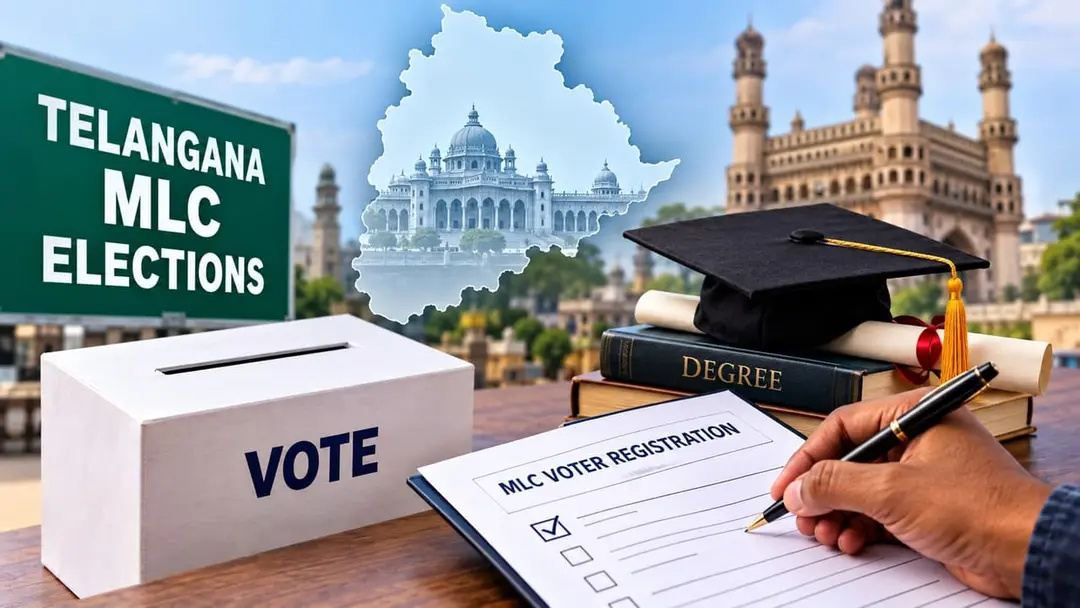
Telangana graduate MLC voter registration process begins
Fresh electoral roll collection has begun for the Mahbubnagar-Rangareddy-Hyderabad and Warangal-Khammam-Nalgonda graduate MLC constituencies in Telangana. Indian citizens holding a bachelor's degree obtained on or before November 1, 2023 and residing in the constituency are eligible, with November 1, 2026 as the qualifying date. Existing voters must re-apply through Form-18. Applications may be filed online at ceotelangana.nic.in or at MRO, RDO and ERO offices. The last date is November 6, 2026; the final roll comes on December 30.
Source
తెలంగాణ వార్తలు — Telangana · read the original report ↗
Desk check · some claims need care
What the desk checked (5)
- Fresh voter list collection has begun for two graduate MLC constituencies: Mahbubnagar-Rangareddy-Hyderabad and Warangal-Khammam-Nalgonda. — Attributed generally to the Election Commission; no order number or named official given in source.
- Eligibility requires a bachelor's degree from a recognised university, passed on or before November 1, 2023, with November 1, 2026 as the qualifying date. — Figures appear in source as stated rules; not attributed to a specific notification document.
- Existing graduate MLC voters must re-apply through Form-18 as a fresh electoral roll is prepared each time. — Stated in source without attribution to an official source.
- Timeline: notification September 28, 2026; last date for applications November 6, 2026; draft roll November 25, 2026; claims and objections November 25-December 10, 2026; final roll December 30, 2026. — Source says these are per the Election Commission's official timeline; no document cited, and dates should be verified.
- Applications can be filed online at ceotelangana.nic.in or offline at Tahsildar, RDO or ERO/AERO offices. — Procedural detail appears in source; website and offices named, no official quoted.
Analysts’ view opinion
The graduates' MLC electoral roll exercise is not merely administrative — it is an early political workout that tests each party's organisational reach. In these seats the roll is half the election, because a fresh list is drawn up each cycle and even existing voters must reapply through Form-18. Whichever party mobilises its student, youth and employee networks fastest to enrol graduates gains the first advantage.
- Because the roll is built from scratch, the real contest between parties begins at the enrolment stage itself.
- The two sprawling constituencies — Mahabubnagar–Rangareddy–Hyderabad and Warangal–Khammam–Nalgonda — mix urban and rural graduates, so no party enjoys an automatic edge.
- Issues such as unemployment and job notifications are likely to dominate the conversation among a graduate electorate.
- Documentation hurdles like gazetted-officer attestation reward parties with strong ground-level worker networks.
- The objections window after the draft roll is the classic stage for political claims and counter-claims about inclusions and exclusions.
What to watch — Watch the number of graduates actually enrolled once the draft roll is published, and the nature of objections parties file during the claims period — that will signal the political direction of this contest.
The story only sets out the enrolment process and timeline; it establishes nothing about party strength, likely candidates or the polling date.
Deep dive
Research brief · 8 facts · 7 dates · exam-readyThe brief
Context
Telangana's Legislative Council (Vidhan Parishad) includes seats elected by registered graduates in designated graduate constituencies. The Election Commission has begun fresh electoral roll preparation for two such seats — Mahbubnagar-Rangareddy-Hyderabad and Warangal-Khammam-Nalgonda. Unlike assembly or Lok Sabha rolls, the graduate MLC roll is prepared afresh each cycle, so even past MLC voters must apply again through Form-18. A separate assembly voter ID does not automatically confer an MLC vote.
Key facts
- Fresh voter roll collection has started for two Telangana graduate MLC constituencies: Mahbubnagar-Rangareddy-Hyderabad and Warangal-Khammam-Nalgonda.
- Qualifying (eligibility reckoning) date is November 1, 2026; applicants must have passed their degree on or before November 1, 2023 — a three-year gap requirement.
- Eligibility: Indian citizen, bachelor's degree or equivalent from a university recognised by the Government of India, and ordinary residence in the constituency.
- Existing graduate MLC voters must re-apply afresh via Form-18 because a fresh electoral roll is prepared every time.
- Documents needed: degree certificate (provisional, convocation or marks memo) attested by a gazetted officer or notary, address proof (Aadhaar, voter ID, driving licence or passport), and a recent passport-size photo.
- Online applications: ceotelangana.nic.in, under 'Council Constituency'/'Form-18'; applicants must save the Acknowledgement ID after submission.
- Offline applications: Form-18 can be collected and submitted at Tahsildar (MRO), RDO or ERO/AERO offices with photocopies attached.
- Official timeline: notification September 28, 2026; last date for applications November 6, 2026; draft roll November 25, 2026; objections November 25–December 10, 2026; final roll December 30, 2026.
Timeline
- November 1, 2023Cut-off by which the bachelor's degree must have been passed to qualify as a graduate MLC voter.
- September 28, 2026Election Commission notification released for the graduate MLC electoral roll revision.
- November 1, 2026Qualifying date for reckoning eligibility.
- November 6, 2026Last date for receipt of applications (Form-18).
- November 25, 2026Publication of the draft electoral roll.
- November 25 – December 10, 2026Window for filing claims and objections.
- December 30, 2026Publication of the final electoral roll.
Who has a stake
- Graduates in the two constituencies — Must apply afresh by November 6, 2026 to secure the right to vote in the graduate MLC election; an assembly vote does not count.
- Election Commission / Telangana CEO office — Responsible for notification, Form-18 collection, draft and final roll publication and disposal of objections.
- MRO (Tahsildar), RDO and ERO/AERO offices — Front-line offices distributing and receiving offline Form-18 applications and supporting documents.
- Telangana Legislative Council — Composition of its graduate-constituency seats depends on the accuracy and size of this fresh electoral roll.
- Political parties and aspiring MLC candidates — The size and spread of the enrolled graduate electorate directly shapes their campaign base in the two seats.
Why it matters
Graduate constituency MLC seats are decided by a small, self-registered electorate, so enrolment drives effectively determine who gets a say. Because the roll is rebuilt from scratch each cycle, lakhs of eligible graduates can silently lose their vote simply by assuming their old MLC or assembly registration carries over. The dates and document norms therefore decide both individual franchise and the political arithmetic of two large Telangana seats.
UPSC angle
Prelims pointers
- Two Telangana graduate MLC constituencies in the current revision: Mahbubnagar-Rangareddy-Hyderabad and Warangal-Khammam-Nalgonda.
- Form-18 is the application form for enrolment as a graduate constituency (Legislative Council) voter.
- Qualifying date: November 1, 2026; degree must be passed on or before November 1, 2023.
- Official portal for online application: ceotelangana.nic.in ('Council Constituency'/'Form-18').
- Offline submission points: Tahsildar (MRO), RDO and ERO/AERO offices.
- Draft roll November 25, 2026; objections till December 10, 2026; final roll December 30, 2026.
Mains framing
Graduate constituencies of State Legislative Councils rest on a functional electorate — voters who must actively register, unlike the universal adult franchise rolls of the assembly and Lok Sabha. The Telangana exercise illustrates the practical consequences: a fresh roll is prepared each cycle, so prior MLC voters must re-apply via Form-18, degree proof must be attested by a gazetted officer or notary, and eligibility hinges on a three-year gap between graduation (on or before November 1, 2023) and the qualifying date (November 1, 2026). The risk is systematic under-enrolment through information asymmetry — graduates who assume their assembly voter card suffices, or who cannot easily produce attested convocation or marks-memo copies, drop out of the electorate, narrowing an already small voter base and amplifying the influence of organised groups such as employee and teacher associations. The way forward, as suggested by the process itself, lies in wide publicity before the November 6, 2026 deadline, dual online-offline access through ceotelangana.nic.in and MRO/RDO/ERO offices, and effective use of the November 25–December 10 claims-and-objections window to correct omissions before the December 30 final roll.
Key terms
- Graduate MLC constituency
- A Legislative Council seat elected only by registered graduates residing in a defined area, not by all adult voters.
- Form-18
- The prescribed application form for enrolment as a voter in a graduate (Council) constituency electoral roll.
- Qualifying date
- The reference date, here November 1, 2026, on which a person's eligibility to be enrolled is judged.
- ERO/AERO
- Electoral Registration Officer and Assistant ERO — officials who receive applications and prepare the electoral roll.
- MRO / RDO
- Mandal Revenue Officer (Tahsildar) and Revenue Divisional Officer — revenue offices where Form-18 can be obtained and submitted.
- Draft electoral roll
- The provisional voter list published on November 25, 2026 against which claims and objections can be filed till December 10.
Practice questions
- Graduate and teachers' constituencies give State Legislative Councils a distinct character. Examine their rationale and the problems posed by a self-registered, narrow electorate.
- Why must graduate MLC electoral rolls be prepared afresh each cycle, and what administrative safeguards can reduce the risk of eligible graduates being left out?
- Discuss the role of the Election Commission and state revenue machinery (ERO, MRO, RDO) in electoral roll preparation for Legislative Council constituencies.
Grounded only in the source report — figures and dates are the source's, not inferred.