
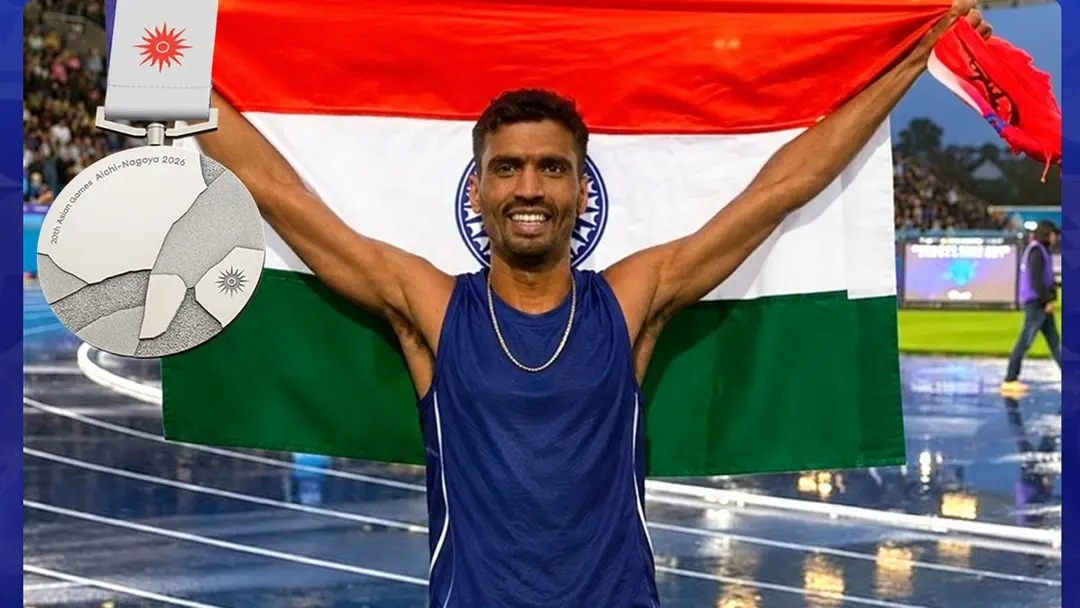
Gulveer Singh takes 1500m silver at Asian Games
Indian runner Gulveer Singh won silver in the men's 1500m final at the Asian Games athletics competition in Nagoya, finishing second in a time of 3:36.72. He led until the closing stage before Japan's Kazuto Izawa surged near the finish line to take gold, edging the Indian by 0.37 seconds. Nagiya Mori of Japan claimed bronze in 3:37.92. Gulveer had earlier won silver in the 10,000m at the same Games.
Source
Namasthe Telangana · read the original report ↗
Desk check · compared with the source
What the desk checked (5)
- Gulveer Singh won silver in the men's 1500m final at the Asian Games in Nagoya. — Stated in source and supported by the quoted Athletics Federation of India post.
- Gulveer Singh clocked 3:36.72 in the final. — Figure appears in source; AFI post in the same text calls it a personal best.
- Japan's Kazuto Izawa won gold, finishing 0.37 seconds ahead of Gulveer. — Figure appears in source; no official result document cited.
- Nagiya Mori of Japan took bronze with 3:37.92. — Figure appears in source; name transliterated from Telugu, spelling unverified.
- Gulveer had earlier won silver in the 10,000m at the same Games. — Stated in source as previously reported, no separate attribution given.
Analysts’ view opinion
Gulveer Singh's silver in the 1500m at the Nagoya Asian Games, coming on top of his 10,000m silver, is the more striking of his two medals precisely because of the distance gap it bridges. A 3:36.72 clocking — flagged as a personal best by the Athletics Federation of India — from an athlete who also medals over 25 laps points to an unusually broad range for an Indian distance runner. Losing gold by 0.37 seconds to Japan's Kazuto Izawa on the line is the fine margin that separates a strong closer from a decisive one.
- Two silvers in the same Games across 1500m and 10,000m is rare range: the events reward very different physiologies, and doing both at podium level suggests strong aerobic base plus usable top-end speed.
- The 3:36.72 is competitive by continental standards and, being a personal best, indicates form peaking at the right moment rather than a one-off tactical result.
- The race pattern matters more than the margin: leading into the closing stage and being passed near the line points to a kick that was strong but slightly early or slightly short.
- Japan taking gold and bronze (Izawa, and Nagia Mori in 3:37.92) shows depth in the host nation's middle-distance group, which shapes how any Indian challenger must race these finals.
- For India's athletics programme, a runner delivering medals from 1500m to 10,000m widens selection options, though doubling up carries recovery costs across a multi-day meet.
What to watch — Watch whether Gulveer commits to 1500m speed work or returns to the 5,000m/10,000m block as his primary focus, and how Japan's middle-distance pack develops as a benchmark for him.
The story does not establish his lap-by-lap tactics, his race schedule or recovery between events, or whether he had any injury or pacing plan — and the personal-best claim comes from a federation social post rather than confirmed official records in this report.
Deep dive
Research brief · 7 facts · 3 dates · exam-readyThe brief
Context
India's middle- and long-distance runner Gulveer Singh added a second medal at the Asian Games athletics competition in Nagoya, Japan, winning silver in the men's 1500m final. He had already taken silver in the 10,000m at the same Games. In the 1500m he led almost to the finish before Japan's Kazuto Izawa surged past him in the closing metres. The Athletics Federation of India described his timing of 3:36.72 as a personal best.
Key facts
- Gulveer Singh won silver in the men's 1500m final at the Asian Games in Nagoya, clocking 3:36.72.
- Japan's Kazuto Izawa won gold, beating Gulveer by just 0.37 seconds with a late surge near the finish line.
- Nagiya Mori of Japan took bronze with a time of 3:37.92.
- This was Gulveer Singh's second medal of these Games; he had earlier won silver in the men's 10,000m.
- The Athletics Federation of India (@afiindia) called the 3:36.72 a personal best for Gulveer.
- AFI described the race as a tactical final featuring 12 men, with Gulveer unleashing a big kick in the last lap.
- The report is dated September 28, 2026, 05:05 PM IST, and the AFI post used the hashtag #AsianGames2026.
Timeline
- Earlier at the same Asian Games (exact date not stated in the source)Gulveer Singh wins silver in the men's 10,000m event.
- September 28, 2026Gulveer Singh finishes second in the men's 1500m final in Nagoya in 3:36.72; Kazuto Izawa takes gold, Nagiya Mori bronze.
- September 28, 2026Athletics Federation of India posts on social media hailing the silver and calling the time a personal best.
Who has a stake
- Gulveer Singh — Indian runner; adds a 1500m silver to his 10,000m silver and sets a personal best of 3:36.72.
- Athletics Federation of India (AFI) — National federation governing athletics; publicised the result and confirmed the personal best.
- Kazuto Izawa (Japan) — Won the 1500m gold with a closing surge, 0.37 seconds ahead of Gulveer.
- Nagiya Mori (Japan) — Took bronze in 3:37.92, completing a two-medal haul for Japan in the event.
- India's athletics contingent at the Asian Games — Gulveer's two silvers contribute to India's medal tally in track events at Nagoya.
Why it matters
Gulveer Singh's double silver shows an Indian distance runner competing at the front in both the 1500m and 10,000m, events long dominated by others in Asia. Losing gold by 0.37 seconds after leading until the closing metres underlines how tactical finishing speed, not just endurance, decides medals at this level.
UPSC angle
Prelims pointers
- Gulveer Singh won silver in the men's 1500m at the Asian Games in Nagoya with a personal best of 3:36.72.
- He also won silver in the men's 10,000m at the same Games — two medals in all.
- Gold in the 1500m went to Kazuto Izawa of Japan; bronze to Nagiya Mori of Japan (3:37.92).
- The winning margin over Gulveer was 0.37 seconds.
- Host city of the Asian Games athletics competition in the report: Nagoya, Japan; report dated September 28, 2026.
- Athletics Federation of India (AFI) is the national body that announced the result.
Mains framing
Gulveer Singh's two silvers at the Nagoya Asian Games — the 10,000m and a personal-best 3:36.72 in the 1500m — mark India's growing presence in Asian distance running, but the 0.37-second defeat to Japan's Kazuto Izawa also exposes the decisive gap: the closing kick in a tactical final. As the AFI's own description notes, the 1500m was a 12-man tactical race in which position, pace judgement and last-lap speed mattered as much as aerobic strength; Japan's one-two (gold and bronze) suggests depth built through systematic middle-distance development. The implication for Indian athletics is that endurance athletes need race-craft training — sustained speed endurance, finishing-speed work and exposure to competitive tactical fields — alongside the volume-based preparation that already yields podium finishes. The way forward, on the evidence of this result alone, lies in giving athletes like Gulveer more high-quality international racing so that silver-by-milliseconds converts into gold; beyond that, the source offers no policy detail.
Key terms
- 1500m
- A middle-distance track race, roughly three and three-quarter laps of a 400m track, usually decided by tactics and a final-lap sprint.
- 10,000m
- A long-distance track event of 25 laps; Gulveer Singh won silver in it at the same Asian Games.
- Athletics Federation of India (AFI)
- The national governing body for athletics in India, which announced Gulveer's silver and his personal best.
- Personal best (PB)
- An athlete's fastest-ever time in an event; AFI recorded 3:36.72 as Gulveer's PB in the 1500m.
- Tactical final
- A race where runners focus on positioning and pace rather than an all-out time, with the result settled by a late surge.
Practice questions
- Gulveer Singh's performance at the Nagoya Asian Games highlights both progress and gaps in Indian distance running. Discuss with reference to his 1500m and 10,000m results.
- What does a 0.37-second defeat in a tactical 1500m final reveal about the training needs of Indian middle-distance athletes?
- Which medals did Gulveer Singh win at the Asian Games in Nagoya, and who won gold and bronze in the men's 1500m final?
Grounded only in the source report — figures and dates are the source's, not inferred.