
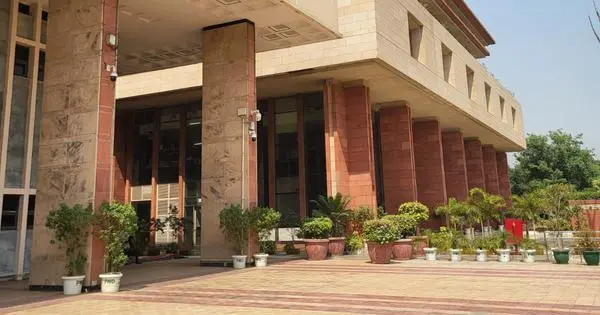
Delhi High Court grants bail to UAPA accused after eight years
The Delhi High Court on Monday granted bail to Mohammad Saqib, arrested in December 2018 under the UAPA, the Explosive Substances Act and the Indian Penal Code. Noting that only 40 of 120 prosecution witnesses had been examined, the bench of Justices Navin Chawla and Ravinder Dudeja said it was moved by his long incarceration. The NIA had alleged he belonged to Islamic State-inspired Harkat-ul-Harb-e-Islam. He must stay in Hapur and report to the NIA's Lucknow office fortnightly.
Source
Scroll.in · read the original report ↗
Desk check · compared with the source
What the desk checked (5)
- Delhi High Court granted bail to Mohammad Saqib after eight years in jail — Attributed to Bar and Bench; bench of Justices Navin Chawla and Ravinder Dudeja named in source.
- Only 40 of 120 prosecution witnesses have been examined so far — Figures appear in the source, attributed to the court's observation via ANI.
- NIA alleged Saqib was a member of Harkat-ul-Harb-e-Islam and procured arms — Presented in source as agency allegation, not proven fact.
- Bail conditions include reporting to NIA Lucknow office every 15 days and surrendering passport — Detailed in source, attributed to Bar and Bench.
- Patiala House courts rejected his bail plea on May 27, 2024 — Date appears in source, attributed to ANI.
Analysts’ view opinion
This is a judicial order, but its political resonance is unmistakable — delayed trials and prolonged detention under the UAPA feed directly into an already heated national argument. The bench's observation that only 40 of 120 witnesses have been examined gives opposition voices and civil liberties groups a concrete peg for their claim that under stringent laws the process itself becomes the punishment. At the same time, the gravity of the NIA's allegations and the stiff conditions imposed — travel restrictions, fortnightly reporting — allow the government's side to argue that no security ground has been conceded.
- Bail is not acquittal, and both sides are likely to exploit that distinction for their own framing.
- The court's note that barely a third of witnesses have been examined revives political questions about the pace of UAPA trials.
- Civil liberties bodies and opposition leaders will probably cite this as an illustration of how stringent laws operate in practice.
- Since the NIA opposed bail, whether it escalates to a higher court matters both legally and politically.
- The wide-ranging conditions — passport surrender, single phone, social media curbs — signal the court did not dismiss the security concerns.
What to watch — Watch whether the NIA challenges the order, and how far the debate over long pre-trial detention under the UAPA travels inside and outside Parliament.
The story does not establish that Saqib is innocent or that the allegations are baseless — the trial is still under way — nor does it record any political party's formal reaction.
Deep dive
Research brief · 8 facts · 4 dates · exam-readyThe brief
Context
Mohammad Saqib was arrested in December 2018 under the Unlawful Activities (Prevention) Act, the Explosive Substances Act and the Indian Penal Code, with the National Investigation Agency alleging he belonged to Harkat-ul-Harb-e-Islam, an Islamic State-inspired group. After a Patiala House court rejected his bail plea on May 27, 2024, he appealed to the Delhi High Court. On Monday, a bench of Justices Navin Chawla and Ravinder Dudeja granted him bail, citing his eight years of incarceration and the fact that only 40 of 120 prosecution witnesses had been examined. UAPA cases carry stringent bail restrictions, making prolonged pre-trial detention a recurring issue.
Key facts
- Mohammad Saqib had spent eight years in jail after his arrest in December 2018 under the UAPA, the Explosive Substances Act and the Indian Penal Code.
- Only 40 out of 120 prosecution witnesses had been examined so far, the Delhi High Court noted.
- The bench of Justices Navin Chawla and Ravinder Dudeja said it was "moved, particularly by the long period of incarceration".
- The NIA alleged Saqib was a member of the Islamic State-inspired terrorist group Harkat-ul-Harb-e-Islam.
- The NIA also alleged he facilitated meetings with Jaish-e-Mohammed militants for training and procured arms for "waging war" against the government.
- The Patiala House courts had rejected Saqib's bail petition on May 27, 2024; the High Court set aside that order.
- Bail conditions: he cannot leave Hapur in Uttar Pradesh except to travel to Delhi for trial or to report to the NIA, and must report to the NIA's Lucknow office once every 15 days.
- He must surrender his passport to the trial court, use only one mobile phone or landline, and give seven days' prior notice of any change in contact details or residence.
Timeline
- December 2018Mohammad Saqib arrested under the UAPA, the Explosive Substances Act and the Indian Penal Code.
- May 27, 2024Patiala House courts reject Saqib's bail petition.
- After May 27, 2024Saqib moves the Delhi High Court against the trial court's rejection.
- Monday (date not stated in the source)Delhi High Court grants bail, setting aside the Patiala House courts' order.
Who has a stake
- Mohammad Saqib — Accused under UAPA; released on bail after eight years in jail, but bound by movement, phone, passport and social media conditions.
- Delhi High Court (Justices Navin Chawla and Ravinder Dudeja) — Balanced the gravity of terror allegations against prolonged incarceration and slow trial progress.
- National Investigation Agency — Prosecuting agency; opposed bail, argued delay in trial alone cannot justify release; must now monitor fortnightly reporting at its Lucknow office.
- Patiala House courts (trial court) — Its May 27, 2024 order denying bail was set aside; will hold the surrendered passport and be informed of address changes.
- Undertrial prisoners in UAPA cases — Ruling reinforces that long incarceration with slow witness examination can support a bail claim despite stringent provisions.
Why it matters
Terror-law prosecutions in India often stretch for years, and with only 40 of 120 witnesses examined after eight years, the case shows how pre-trial detention can itself become punishment. The High Court's reasoning — that the witness statements so far were not grave enough to prolong detention even though the phone material was serious — signals judicial willingness to weigh delay against allegation. At the same time, the stringent bail conditions show courts trying to balance liberty with national-security concerns.
UPSC angle
Prelims pointers
- UAPA: Unlawful Activities (Prevention) Act, the principal anti-terror law under which Saqib was arrested in December 2018.
- Case investigated by the National Investigation Agency (NIA); Saqib to report fortnightly to its Lucknow office.
- Harkat-ul-Harb-e-Islam described in the source as an Islamic State-inspired terrorist group.
- Jaish-e-Mohammed: militants with whom Saqib allegedly facilitated meetings for training.
- Bail granted by Delhi High Court bench of Justices Navin Chawla and Ravinder Dudeja, setting aside the Patiala House courts' May 27, 2024 order.
- Other laws invoked: Explosive Substances Act and the Indian Penal Code.
Mains framing
The case illustrates the tension between stringent anti-terror legislation and the constitutional value of personal liberty. Under the UAPA, bail is hard to obtain, and here the accused remained in custody for eight years while the prosecution examined only 40 of its 120 witnesses — evidence of structural delay in terror trials arising from large witness lists, voluminous digital evidence and crowded court dockets. The NIA's argument that trial delay alone cannot justify bail was met by the Delhi High Court's assessment that the witness statements recorded so far were not grave enough to prolong detention, and that even serious material recovered from the accused's phone did not warrant continued incarceration. The implication is that courts may increasingly treat the pace of trial as a material factor in bail under special statutes, while managing risk through conditions — restriction to Hapur, fortnightly reporting to the NIA at Lucknow, passport surrender, a single phone line, advance notice of address change and a bar on circulating "anti-national material". The way forward lies in faster trial management — pruning witness lists, time-bound examination and adequate special courts — so that liberty is not lost to procedural drift, while safeguards against absconding and evidence tampering remain intact.
Key terms
- Unlawful Activities (Prevention) Act (UAPA)
- India's principal anti-terror law, with stringent bail provisions; Saqib was arrested under it in 2018.
- National Investigation Agency (NIA)
- Central agency that investigated the case, alleged Saqib's terror links and opposed his bail.
- Harkat-ul-Harb-e-Islam
- Islamic State-inspired terrorist group of which the NIA alleged Saqib was a member.
- Jaish-e-Mohammed
- Militant group whose members Saqib allegedly helped meet for training, per the NIA.
- Explosive Substances Act
- Law dealing with offences involving explosives, invoked alongside the UAPA and the IPC in Saqib's arrest.
- Patiala House courts
- Delhi trial court complex whose May 27, 2024 order rejecting Saqib's bail was set aside by the High Court.
Practice questions
- Prolonged incarceration of undertrials under special security laws raises constitutional concerns. Examine with reference to recent judicial reasoning on bail in UAPA cases.
- Discuss how courts balance national security and personal liberty while imposing bail conditions in terror-related prosecutions.
- What structural reforms can reduce delay in terror trials where prosecution witness lists run into the hundreds? Analyse.
Grounded only in the source report — figures and dates are the source's, not inferred.