
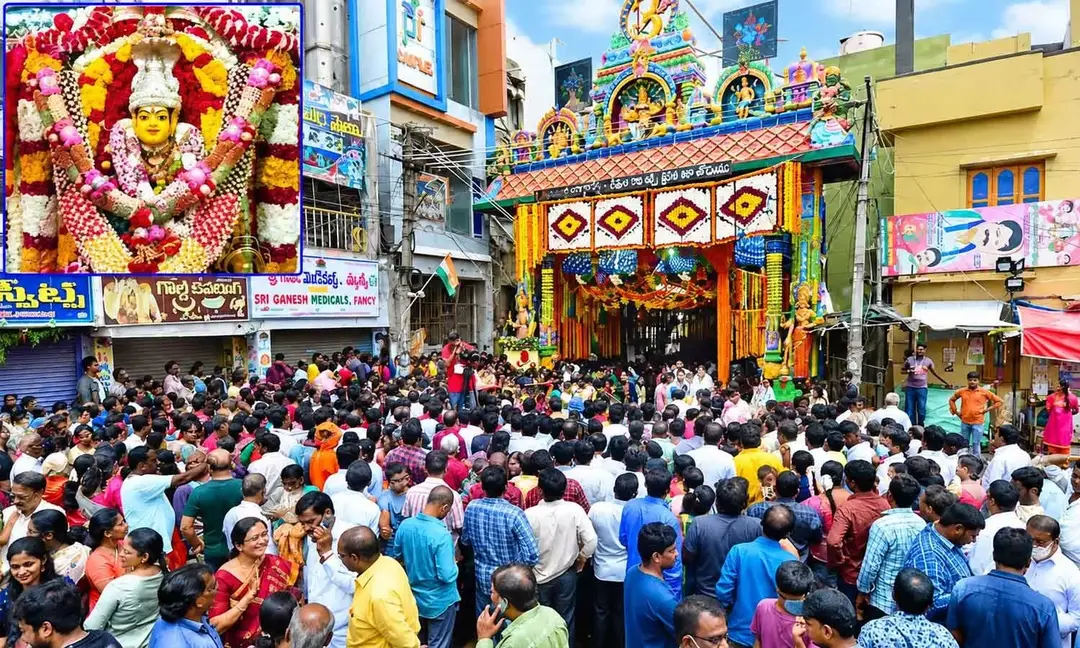
Poleramma Jatara begins in Venkatagiri amid tight security
The Sri Poleramma Jatara, one of Venkatagiri's major religious festivals, began on Wednesday with the ceremonial preparation of the deity's clay idol. The idol was made at a potter's house in Kummari Veedhi, considered the deity's maternal home, and completed around 6pm, after which devotees offered prayers. It will be taken to Chakali Chavadi in Jeenigala Vari Veedhi, decorated and carried in procession to the temple. Tirupati district SP Subbarayudu said four-tier security, rope parties, QRTs, drones and over 70 CCTV cameras had been deployed.
Source
Tirupati — news · read the original report ↗
Desk check · compared with the source
What the desk checked (5)
- Sri Poleramma Jatara began in Venkatagiri on Wednesday with the ceremonial clay idol preparation. — Stated in source as fact; no individual source named for the timing.
- The idol was made at a potter's house in Kummari Veedhi and the idol-making was completed around 6pm. — Figure and location appear in source; presented as traditional practice without named attribution.
- A four-tier security system, rope parties, QRTs and drones have been deployed. — Attributed to Tirupati district SP Subbarayudu.
- More than 70 CCTV cameras installed around the temple with round-the-clock command-centre monitoring. — Figure appears in source, within the SP's account of arrangements.
- The idol will be taken to Chakali Chavadi in Jeenigala Vari Veedhi before a procession to the temple. — Described as tradition in source; no source given.
Analysts’ view opinion
The Poleramma Jatara at Venkatagiri is not only a religious occasion — it is also a stage on which local administration demonstrates its competence. A four-tier security grid, drones, QRTs and more than 70 CCTV cameras suggest the district machinery treats a trouble-free jatara as a matter of institutional prestige. At mass-gathering festivals, any mishap converts almost instantly into political criticism, while a smooth event yields credit to the administration and, by extension, local representatives. The centrality of the potter and washer communities' traditional roles also matters in a setting where social representation is closely watched.
- The SP personally detailing the arrangements signals administrative alertness to the political cost of crowd incidents at large festivals.
- The instruction to treat devotees courteously while acting firmly against violations reflects a familiar balancing act between public goodwill and law-and-order optics.
- Coordination across revenue, endowments and electricity departments spreads ownership — success becomes shared credit, failure shared blame.
- The ritual route through Kummari Veedhi, Jeenigala Vari Veedhi and Chakali Chavadi ties the festival to occupational communities, a locally sensitive matter of social inclusion.
- No party or political leader is named in the story, so on the record this remains a purely administrative exercise for now.
What to watch — Watch how crowd management holds up during the procession and temple darshan, and whether any lapse is picked up by local leaders as a political issue.
The story does not establish any political involvement, leaders' roles, or a specific reason behind the scale of the security deployment.
Deep dive
Research brief · 8 facts · 3 dates · exam-readyThe brief
Context
The Sri Poleramma Jatara is one of the major religious festivals of Venkatagiri town, held in honour of Poleramma, a village (gramadevata) deity. The festival traditionally opens with the ceremonial moulding of the deity's idol in clay at a potter's house, followed by ritual movement of the idol through designated houses before a procession to the temple. Such jataras draw large crowds, making crowd regulation and policing a central administrative concern. This year the festival began on a Wednesday with the idol-making ritual, and Tirupati district police announced a multi-layered security plan.
Key facts
- The Sri Poleramma Jatara began in Venkatagiri town on Wednesday with the ceremonial preparation of the village deity's clay idol.
- The Poleramma idol was made with clay at a potter's house in Kummari Veedhi, which tradition regards as the deity's maternal home.
- The idol-making ceremony was completed around 6pm, after which devotees queued up to offer prayers.
- The idol will later be taken to Chakali Chavadi in Jeenigala Vari Veedhi, considered the home of the deity's in-laws, for decoration before the procession to the temple.
- Tirupati district SP Subbarayudu said a four-tier security system, rope parties, Quick Reaction Teams (QRTs) and drones have been deployed to regulate crowds and monitor the procession.
- More than 70 CCTV cameras have been installed in and around the temple, monitored round the clock through a command and control centre.
- Police identified sensitive and congested points and arranged barricading, traffic diversions, lighting and additional forces.
- The SP directed personnel to deal courteously with devotees while taking firm action against law violations, and to coordinate with revenue, endowments and electricity departments.
Timeline
- Wednesday (day of festival's start)Poleramma Jatara begins in Venkatagiri with ceremonial clay idol-making at a potter's house in Kummari Veedhi.
- Around 6pm the same dayIdol-making ceremony completed; devotees queue up at the potter's house to offer prayers.
- Later (date not stated in the source)Idol to be taken to Chakali Chavadi in Jeenigala Vari Veedhi, decorated, and carried in procession to the temple.
Who has a stake
- Devotees attending the jatara — Safe, orderly access to rituals and the procession without inconvenience; courteous treatment by police.
- Tirupati district police, led by SP Subbarayudu — Crowd regulation, surveillance and peaceful conduct of the festival through four-tier security, QRTs, drones and CCTV.
- Potter community of Kummari Veedhi — Custodians of the ritual of moulding the clay idol at the deity's traditional maternal home.
- Residents of Jeenigala Vari Veedhi / Chakali Chavadi — Host the deity's ritual 'in-laws' home' where the idol is decorated before the temple procession.
- Revenue, endowments and electricity departments — Directed to coordinate with police for smooth conduct of the festival, including lighting and civic arrangements.
Why it matters
Village-deity jataras like Poleramma's are large, community-owned festivals where ritual and civic administration meet, and where crowd surges can quickly become a safety risk. The layered police plan — four-tier security, QRTs, drones and 70-plus CCTV cameras linked to a command and control centre — shows how technology-aided crowd management is now standard for local religious gatherings. It also illustrates the coordination demanded of police, revenue, endowments and electricity departments in managing such events.
UPSC angle
Prelims pointers
- Sri Poleramma Jatara is a major religious festival of Venkatagiri town, in Andhra Pradesh's Nellore region.
- Poleramma is a gramadevata (village deity); the jatara opens with a clay idol made at a potter's house in Kummari Veedhi, seen as her maternal home.
- Chakali Chavadi in Jeenigala Vari Veedhi is treated as the deity's in-laws' home, where the idol is decorated before the temple procession.
- Tirupati district SP Subbarayudu announced four-tier security, rope parties, QRTs and drones for the jatara.
- More than 70 CCTV cameras installed around the temple, with 24x7 monitoring via a command and control centre.
- Police to coordinate with revenue, endowments and electricity departments for the festival.
Mains framing
Local jataras centred on village deities such as Poleramma combine deep community ritual — the clay idol moulded at a potter's house treated as the goddess's maternal home, then moved to a symbolic in-laws' home before the temple procession — with the modern challenge of managing mass gatherings. The Venkatagiri arrangements described by the Tirupati district SP show the emerging template: four-tier security, rope parties, Quick Reaction Teams, drone surveillance, over 70 CCTV cameras feeding a round-the-clock command and control centre, plus identification of sensitive and congested points with barricading, traffic diversions, lighting and additional forces. The implications are twofold: such measures reduce stampede and law-and-order risk, but they also require police to balance firmness against violations with courteous handling of devotees, as the SP directed. The way forward, as reflected in the instructions issued, lies in inter-departmental coordination among police, revenue, endowments and electricity departments, continuous monitoring of arrangements, and planning that protects ritual traditions while ensuring devotees face no inconvenience.
Key terms
- Jatara
- A traditional village or town religious fair-festival centred on a local deity, marked by rituals and processions.
- Poleramma
- The village deity whose festival is celebrated at Venkatagiri; her idol is made afresh in clay to begin the jatara.
- Kummari Veedhi
- The potters' street in Venkatagiri where the clay idol is made; regarded as the deity's maternal home.
- Chakali Chavadi, Jeenigala Vari Veedhi
- Site considered the home of the deity's in-laws, where the idol is decorated before the procession to the temple.
- Quick Reaction Team (QRT)
- A specially trained police unit kept on standby for rapid response to emergencies or crowd incidents.
- Command and control centre
- Centralised facility where police monitor CCTV and drone feeds round the clock to manage crowds and incidents.
Practice questions
- Discuss how village-deity festivals such as the Poleramma Jatara reflect the social organisation of local communities, using the ritual roles assigned to different streets and occupational groups.
- Examine the role of technology-aided crowd management — CCTV, drones, QRTs and command and control centres — in ensuring safety at mass religious gatherings in India.
- What administrative coordination is required between police, revenue, endowments and electricity departments for the peaceful conduct of large local festivals? Illustrate with the Venkatagiri example.
Grounded only in the source report — figures and dates are the source's, not inferred.