
AI farming pilot doubles chilli growers' income in Khammam
The AI4AI initiative, launched by the World Economic Forum India's Centre for the Fourth Industrial Revolution with the Union Ministry of Agriculture and Telangana, was piloted among 7,000 farmers in Khammam district. Known locally as Saagu Baagu, it ran 18 months across three crop cycles using bot advisory services, soil testing, AI-based quality testing and a digital buyer-seller platform. Farmers reported $800 net income per acre in a six-month cycle, double the average, with yields up 21%. In October 2023 it was expanded to 500,000 farmers across 10 districts and five crops.
Source
Krishna — agriculture · read the original report ↗
Desk check · compared with the source
What the desk checked (5)
- Saagu Baagu pilot covered 7,000 farmers in Khammam district over 18 months and three crop cycles. — Figure appears in source, attributed to the World Economic Forum India Centre for the Fourth Industrial Revolution's pilot account.
- Farmers reported net income of $800 per acre in one six-month crop cycle, double the average. — Self-reported by participating farmers as stated in source; no independent verification cited.
- Chilli yield per acre rose 21%, pesticide use fell 9%, fertilizer use fell 5%, unit prices rose 8%. — Figures appear in source without external audit reference.
- Telangana government expanded Saagu Baagu in October 2023 to 500,000 farmers, five crops, 10 districts. — Attributed in source to the state government; date and scale stated but no order or document cited.
- India has roughly 125 million smallholding farmers; 500 million smallholder farms worldwide support nearly 2 billion people. — Presented in source as estimates with no originating dataset named.
Analysts’ view opinion
The real economic lesson from the Khammam Saagu Baagu pilot is that higher yield alone does not double a farmer's income — lower input costs and better realised prices have to arrive at the same time. The reported $800 net income per acre over a six-month cycle and a 21% yield gain point to gains stacking from three directions at once: productivity, input savings and market price. The value here sits less in the technology itself than in the institutional arrangement that put that technology in a smallholder's hands at no cost to him.
- This is not a pure productivity story: a 9% fall in pesticide use and 5% in fertiliser is a direct cost saving, while an 8% price uplift from better quality is the margin lever that makes doubling plausible.
- A buyer-seller digital platform is, in economic terms, disintermediation — a larger share of the value chain accruing to the farmer, which means trader margins are the side that gives up ground.
- Who pays is not spelled out in the story; advisory, soil testing and quality testing appear to be carried by a government-industry partnership, and the income arithmetic could shift if farmers must fund these services themselves.
- Scaling from 7,000 farmers to 500,000 across five crops is the genuine economic test, since the intensive handholding and selection effects typical of pilots usually dilute at scale.
- Chilli is a high-value, export-linked crop where quality premiums show up quickly; lower-value food grains may not deliver the same income uplift.
What to watch — Watch whether the per-acre income gain holds up at the 500,000-farmer, 10-district stage, and who ends up carrying the recurring cost of these services.
The income and yield figures are as reported by farmers, with no independent verification or control-group comparison in this story, so how much of the gain is attributable to AI rather than favourable weather or chilli price movements is not established.
Deep dive
Research brief · 8 facts · 4 dates · exam-readyThe brief
Context
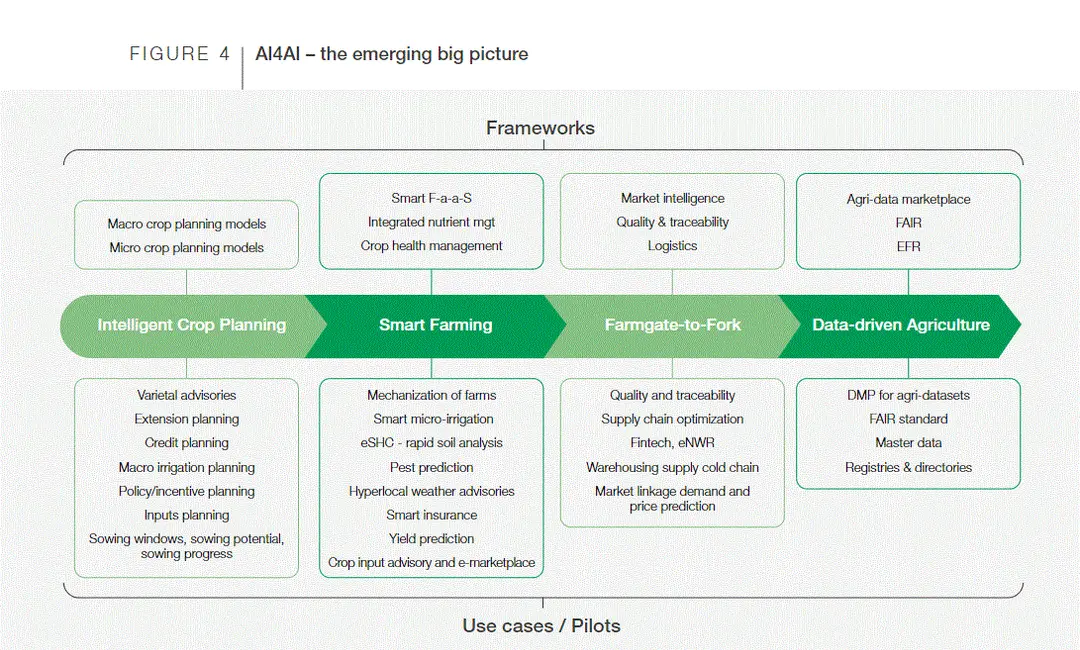
India has roughly 125 million smallholding farmers who face erratic monsoons, droughts, pest attacks, poor soil health, costly informal credit and up to 40% post-harvest wastage in parts of the supply chain. To address this, the World Economic Forum India's Centre for the Fourth Industrial Revolution, with the Union Ministry of Agriculture and the state of Telangana, launched the AI4AI (AI for Agriculture Innovation) initiative, built through workshops with farmers, industry, startups and farmer cooperatives. The AI4AI framework was field-tested in Khammam district of Telangana among 7,000 chilli farmers under the local name Saagu Baagu, using bot advisory services, soil testing, AI-based quality testing and a digital buyer-seller platform.
Key facts
- Saagu Baagu was piloted among 7,000 farmers in Khammam district, Telangana, running 18 months across three crop cycles.
- Participating farmers reported net income of $800 per acre in a single six-month crop cycle, effectively double the average income.
- Digital advisory services drove a 21% increase in chilli yield per acre.
- Pesticide use fell 9% and fertiliser use fell 5%; quality improvements raised unit prices by 8%.
- In October 2023 the Telangana government expanded Saagu Baagu to 500,000 farmers, five crops and 10 districts.
- AI4AI held more than 45 workshops over eight months starting June 2020, leading to the AI4AI plan harnessing AI, drones and blockchain.
- The pilot used state-government data tools: the agriculture data exchange and the agriculture data management framework.
- India has about 125 million smallholding farmers; globally about 500 million smallholder farms support nearly 2 billion people and produce about 80% of food consumed in Asia and sub-Saharan Africa.
Timeline
- June 2020 onwards (eight months)AI4AI holds more than 45 workshops with farmers, industry, startups and cooperatives on smallholder challenges and 4IR solutions.
- March 2021AI4AI Community Paper sets out the framework for using AI across planning to selling of crops.
- 18 months, three crop cycles (dates not stated in the source)Saagu Baagu pilot runs in Khammam district among 7,000 chilli farmers.
- October 2023Telangana expands Saagu Baagu to 500,000 farmers across five crops and 10 districts.
Who has a stake
- Smallholder chilli farmers of Khammam — Reported doubling of net income to $800 per acre per six-month cycle and 21% higher yields; escape from the low-investment subsistence cycle.
- World Economic Forum India's Centre for the Fourth Industrial Revolution — Launched AI4AI and tested its framework; credibility of AI-led agriculture models for the global south.
- Union Ministry of Agriculture — Partner in AI4AI; national replication of digital agriculture frameworks for food security and sustainability.
- Government of Telangana — Provided the agriculture data exchange and data management framework; expanded the scheme to 500,000 farmers in 10 districts.
- Industry, startups and farmer cooperatives — Agri-input, food processing, finance, insurance and technology firms deliver advisory, quality testing and market linkage at scale.
- Traders and processors — Strict quality requirements are hard for farmers to meet; AI-based quality testing and digital platforms ease matching of supply and demand.
Why it matters
Smallholders grow much of the developing world's food yet capture the least value, and technologies like precision farming or drones have remained unaffordable for them. Saagu Baagu shows that bundled digital services — advisory bots, soil and AI quality testing, and market platforms — can raise incomes and yields while cutting pesticide and fertiliser use. Its expansion to 500,000 farmers tests whether such gains survive scale, a question central to food security and climate resilience across the global south.
UPSC angle
Prelims pointers
- AI4AI = AI for Agriculture Innovation, by WEF India's Centre for the Fourth Industrial Revolution with the Union Ministry of Agriculture and Telangana.
- Saagu Baagu is the local name of the AI4AI pilot in Khammam district, Telangana, focused on chilli.
- Pilot scale: 7,000 farmers, 18 months, three crop cycles; income $800/acre per six-month cycle.
- Outcomes: yield +21%, unit price +8%, pesticide use -9%, fertiliser use -5%.
- October 2023: scaled to 500,000 farmers, five crops, 10 districts in Telangana.
- Enablers: agriculture data exchange and agriculture data management framework of the Telangana government.
Mains framing
Indian smallholder agriculture is trapped in a low-return, high-risk equilibrium: fragmented holdings, climate shocks, pest infestations, dependence on informal moneylenders at crippling interest rates, unreliable input availability, up to 40% wastage in parts of the supply chain, and exacting quality norms set by traders and processors. Low revenues leave little to invest in the next cycle, and Fourth Industrial Revolution tools such as precision farming, drones or digital market access stay out of reach because of cost, access and the time needed to change practices. The AI4AI response was not a single technology but a public-private framework — built through 45-plus workshops from June 2020 — combining bot advisory services, soil testing, AI-based quality testing and a buyer-seller platform, riding on state data infrastructure like the agriculture data exchange. The Khammam evidence is suggestive: incomes doubled to $800 per acre per cycle, yields up 21%, input use down, prices up 8%. The way forward, as the source argues, lies in collaboration among governments, industry, philanthropists, innovators and farmers to build national digital agriculture frameworks aligned with food security, sustainability and the SDGs, and in sharing lessons so that evidence-based practices spread beyond pilot districts.
Key terms
- AI4AI
- AI for Agriculture Innovation — a WEF-led initiative with India's agriculture ministry and Telangana to apply AI, drones and blockchain across the crop cycle.
- Saagu Baagu
- Local name of the AI4AI pilot in Khammam, Telangana, that transformed chilli farming through digital advisory, testing and market linkage.
- Centre for the Fourth Industrial Revolution (C4IR) India
- World Economic Forum centre in India that launched AI4AI in collaboration with government partners.
- Bot advisory services
- Automated digital advisory delivered to farmers; credited with the 21% rise in chilli yield per acre in the pilot.
- Agriculture data exchange / data management framework
- Telangana government data tools used to scale AI4AI services to large groups of farmers.
- Smallholder farmer
- Small-plot cultivator; about 125 million in India, and 500 million such farms worldwide support nearly 2 billion people.
Practice questions
- Examine how digital and AI-based interventions can address the structural constraints faced by Indian smallholder farmers, using the Saagu Baagu experience in Telangana.
- "Technology adoption in agriculture fails not for lack of tools but for lack of institutional bundling." Discuss with reference to the AI4AI framework.
- What challenges are likely to arise in scaling a 7,000-farmer pilot to 500,000 farmers across five crops and 10 districts? Suggest safeguards.
Grounded only in the source report — figures and dates are the source's, not inferred.