
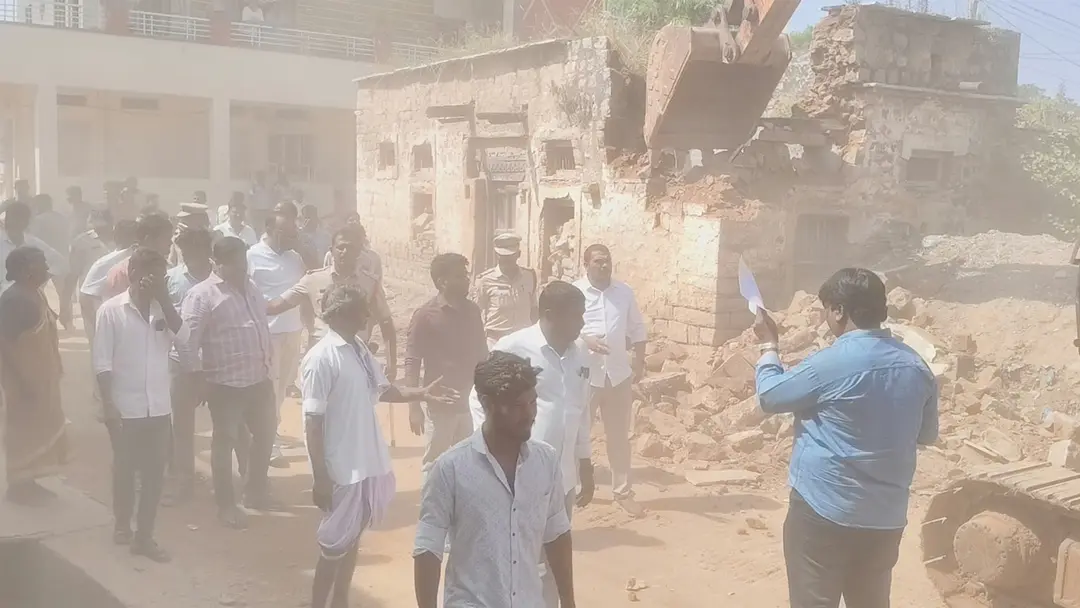
84 houses, shops demolished in Kodangal for road widening
Bulldozers demolished 84 houses and shops at Kodangal, the assembly constituency of Chief Minister Revanth Reddy, as part of a road widening exercise. Affected families said the demolitions were carried out under police protection without any compensation being paid. Residents are demanding compensation, alternative house sites and Indiramma houses. Police took BRS leaders preparing to protest into preventive custody. Former MLA Patnam Narender Reddy said an agitation would be launched if compensation and plots are not provided.
Source
Kodangal — MLA & నియోజకవర్గం · read the original report ↗
Desk check · some claims need care
What the desk checked (5)
- 84 houses and shops were demolished in Kodangal for road widening — Figure appears in the source headline but is not attributed to any official or department in the body text.
- Demolitions were carried out without paying any compensation, under police protection — Attributed to affected residents/locals; no government or official response included in the source.
- BRS leaders preparing to protest were taken into preventive custody by police — Stated in the source without police attribution or named officer.
- Former MLA Patnam Narender Reddy demanded compensation and alternative plots and threatened an agitation — Directly attributed to the named former MLA in the source.
- Kodangal is Chief Minister Revanth Reddy's constituency — Stated in the source as background; internally consistent.
Analysts’ view opinion
Demolitions in a chief minister's own constituency are politically combustible in a way that identical action anywhere else would not be, because Kodangal is the seat that carries Revanth Reddy's personal development promise. The story presents an aggressive infrastructure push colliding with an unanswered compensation question, and the opposition BRS has moved quickly to occupy that gap. Pre-emptive arrests of BRS leaders may have kept the site quiet for a day, but they also hand the opposition a grievance narrative that is easier to sustain than a single protest would have been.
- Kodangal is the CM's home seat, so any image of bulldozers against small houses and shops carries outsized symbolic cost for the ruling Congress.
- The government's political case rests on road widening as visible development; the political risk is that 84 displaced families become the face of that development.
- The compensation demand — cash, alternative plots, Indiramma houses — is a welfare-scheme framing that puts the ruling party's own housing promise on trial.
- Preventive arrests of BRS leaders shift the story from a local land dispute to a law-and-order and free-protest argument, which usually widens rather than narrows opposition mobilisation.
- Former MLA Patnam Narender Reddy's warning of an agitation signals BRS intends to make this a sustained constituency-level campaign rather than a one-day photo event.
What to watch — Watch whether the government announces a compensation or resettlement package quickly — a rapid package would defuse the issue, while continued demolitions without one give BRS a ready-made local agitation in the CM's own seat.
The story does not establish the government's or district administration's side — no official explanation of notices, legal status of the structures, or any compensation policy is recorded here, nor is the wider public support or opposition to the road project independently established.
Deep dive
Research brief · 8 facts · 3 dates · exam-readyThe brief
Context
Kodangal, a mandal headquarters town in Telangana and the assembly constituency of Chief Minister A. Revanth Reddy, has seen bulldozers move in for a road widening project. According to the source, 84 houses and shops were demolished under heavy police protection without any compensation being paid to the affected families. Residents are demanding compensation, alternative house sites and Indiramma houses, while BRS leaders who prepared to protest were taken into preventive custody. Locals also question the need for a wide road in a small mandal centre, suggesting a bypass road instead.
Key facts
- 84 houses and shops were demolished at Kodangal for a road widening exercise, as reported on September 28, 2026.
- Kodangal is the assembly constituency of Telangana Chief Minister Revanth Reddy.
- Affected families said not a single rupee of compensation was paid before the demolitions.
- Demolitions were carried out amid heavy police deployment (bandobast) at the site.
- BRS leaders who were preparing to protest demanding compensation, house sites and Indiramma houses were taken into preventive custody by police.
- Residents are demanding three things: cash compensation, alternative house sites, and sanction of Indiramma houses.
- Locals argue that a bypass road would have been sufficient instead of widening the road through the small mandal centre.
- Former MLA Patnam Narender Reddy demanded compensation and alternative plots for the poor and said an agitation would be launched if these are not given.
Timeline
- September 28, 2026 (report dated 12:00 PM IST)Bulldozers demolish 84 houses and shops at Kodangal for road widening; demolitions reported as continuing under police guard.
- Same period, before/during demolitionsBRS leaders preparing to protest are taken into preventive custody; heavy police bandobast set up at the demolition site.
- After the demolitionsFormer MLA Patnam Narender Reddy demands compensation and plots, warns of an agitation if demands are not met.
Who has a stake
- Affected families of Kodangal — Lost houses and shops built with lifetime savings; left without shelter and without compensation or alternative arrangements.
- Chief Minister Revanth Reddy — The demolitions are in his own assembly constituency, making it politically sensitive.
- State government / civic authorities — Executing the road widening project; faces demands for compensation, house sites and Indiramma houses.
- Police — Provided bandobast for the demolitions and made preventive arrests of protesting BRS leaders.
- BRS leaders and former MLA Patnam Narender Reddy — Leading the opposition to the demolitions; threatening an agitation over compensation and plots.
- Local shopkeepers — Loss of business premises without rehabilitation or alternative sites.
Why it matters
The case shows how infrastructure projects can displace poor households when compensation and rehabilitation are not settled before demolition. That it is happening in the Chief Minister's own constituency, with preventive arrests of protesters, raises questions about due process, consent and the political costs of urban road widening.
UPSC angle
Prelims pointers
- Kodangal is the assembly constituency of Telangana Chief Minister Revanth Reddy.
- 84 houses and shops were demolished at Kodangal for road widening (report of September 28, 2026).
- Indiramma Houses (Indiramma Illu) is the Telangana housing scheme residents want sanctioned as relief.
- Patnam Narender Reddy, former MLA, is the BRS leader demanding compensation and alternative plots.
- Preventive custody was used against BRS leaders planning to protest against the demolitions.
- Residents proposed a bypass road as an alternative to widening the road through the mandal centre.
Mains framing
Road widening in Kodangal illustrates the recurring tension between infrastructure expansion and the housing rights of the urban poor. As per the source, 84 houses and shops were razed under police protection without a rupee of compensation, leaving families without shelter and shopkeepers without livelihoods; residents argue the project is disproportionate for a small mandal centre and that a bypass road would have served the purpose. The use of preventive custody against protesting BRS leaders shifts a rehabilitation dispute into a law-and-order and political contest, particularly because the town falls in the Chief Minister's own constituency. The way forward suggested by the affected people themselves is sequencing: assess and pay compensation, allot alternative house sites, sanction Indiramma houses, and consider less disruptive alignment options such as a bypass before bulldozers move in. Beyond this case, it points to the need for transparent survey and notice procedures, grievance redress before demolition, and rehabilitation-first practice in state road projects so that public works do not transfer their costs on to the poorest.
Key terms
- Kodangal
- A mandal centre in Telangana and the assembly constituency of Chief Minister Revanth Reddy, where the demolitions took place.
- Indiramma Houses
- Telangana housing scheme; affected residents are demanding that such houses be sanctioned to them as rehabilitation.
- Bandobast
- Heavy police deployment for security; here used to enable the demolitions to proceed.
- Preventive custody / preventive arrest
- Detaining persons in advance to stop an anticipated protest; used against BRS leaders at Kodangal.
- BRS
- Bharat Rashtra Samithi, the opposition party whose leaders protested the demolitions and threatened an agitation.
- Bypass road
- A road built around a town instead of through it; residents say this would have avoided demolishing homes.
Practice questions
- Should compensation and rehabilitation be legally mandatory before demolition in road widening projects? Discuss with reference to the Kodangal case.
- Examine the tension between infrastructure development and the housing rights of the urban poor, using recent examples from Telangana.
- Evaluate the use of preventive arrests to manage protests against government projects. What safeguards are necessary?
Grounded only in the source report — figures and dates are the source's, not inferred.