
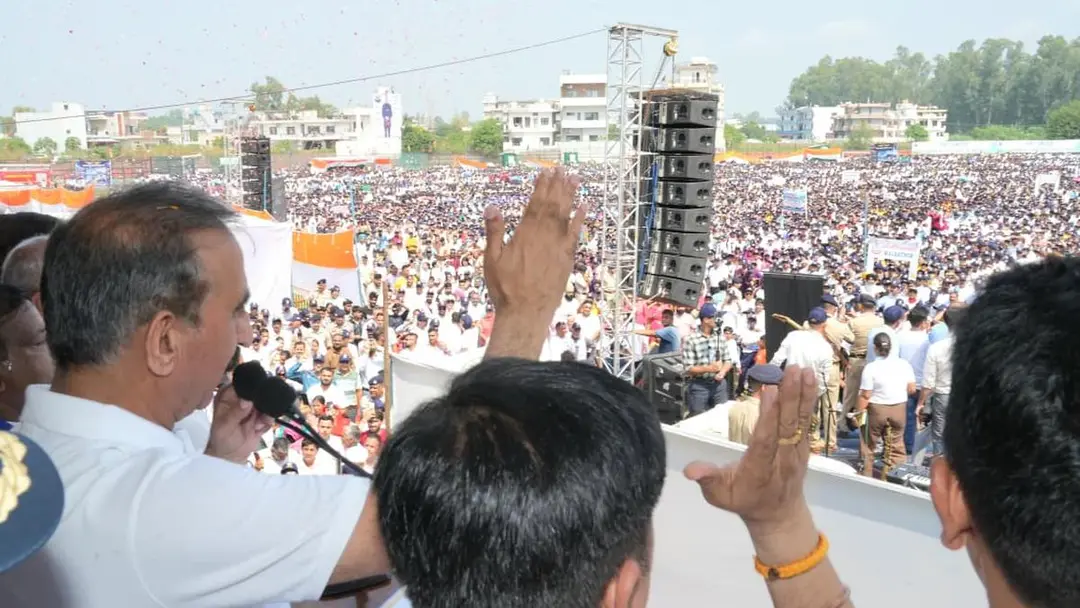
No place for drug sellers in Himachal, says CM Sukhu
Himachal Pradesh Chief Minister Sukhvinder Singh Sukhu said on Wednesday there is no place in the State for those who sell 'chitta' (heroin) and ruin young lives for money. Addressing an 'anti-chitta' awareness walkathon in Una district, he said the government's policy on illegal drug trade was clear and uncompromising, while a compassionate approach would be taken toward addicted youth. He said police alone cannot win the battle; families, teachers and society must participate.
Source
The Hindu — National · read the original report ↗
Desk check · compared with the source
What the desk checked (4)
- CM Sukhvinder Singh Sukhu said the government's policy is clear and uncompromising toward those in the illegal drug trade. — Directly quoted and attributed to the Chief Minister at the Una walkathon in the source.
- The government will adopt a compassionate approach to youth already addicted and support their recovery. — Attributed to CM Sukhu in the source as a quoted statement.
- Police are taking continuous action to dismantle drug networks and traffickers. — Stated by the Chief Minister; no independent data or figures given in the source.
- PIB, with NCB, held a 'Vartalap' event in Chandigarh on the 2026-29 vision document for a drug-free India by 2029. — Appears in source with named participants and an official statement cited; no document text provided.
Analysts’ view opinion
A Chief Minister walking a district road under an 'anti-chitta' banner is doing politics as much as policy — drugs are one of the few issues in Himachal that cut cleanly across party lines, and Sukhu is planting his flag on it. The framing is deliberately two-track: hard on sellers, compassionate towards addicted youth, which lets him look tough without appearing to criminalise a generation of voters' children. That the parallel Centre-led 'Drug-free India 2029' push is unfolding in the same week is politically convenient for both sides — and also sets up a quiet contest over who owns the credit.
- Choosing Una — a border district in the Punjab-facing belt — signals the government is answering local anxiety about heroin flows rather than making an abstract policy statement.
- The 'strict action for traffickers, compassion for addicts' formula is classic risk management: it insulates the CM from both the law-and-order critique and the charge of punishing victims.
- By stressing that police alone cannot win and invoking family, teachers and society, Sukhu spreads responsibility outward — morally sound, but also a hedge if enforcement results disappoint.
- With the Centre pushing its own 2029 drug-free roadmap through NCB and PIB outreach, expect a credit-and-blame dynamic in which the State claims delivery and critics ask why the menace persists.
- Framing youth as 'soldiers' of the campaign is an attempt to build a constituency of goodwill among first-time and young voters at low political cost.
What to watch — Watch whether the rhetoric is followed by measurable enforcement and rehabilitation capacity — arrests, network takedowns, treatment beds — because the Opposition's most effective line will be the gap between the speech and the ground.
The story establishes what the Chief Minister said, not the actual scale of the drug problem, the results of enforcement so far, the resources committed to rehabilitation, or any Opposition response.
Deep dive
Research brief · 8 facts · 4 dates · exam-readyThe brief
Context
Himachal Pradesh has been battling the spread of 'chitta', a street form of heroin, among its youth. On September 16, 2026, Chief Minister Sukhvinder Singh Sukhu addressed an 'anti-chitta' awareness walkathon in Una district, declaring an uncompromising policy against drug sellers and traffickers while promising a compassionate, rehabilitative approach for those already addicted. Separately, in Chandigarh, the Press Information Bureau and the Narcotics Control Bureau held a 'Vartalap' event on the Centre's vision document 2026-29 for a 'Drug-free India' by 2029.
Key facts
- Himachal CM Sukhvinder Singh Sukhu addressed an 'anti-chitta' awareness walkathon in Una district on September 16, 2026 (Wednesday).
- He said there is 'no place in Himachal for those who sell chitta' and that government policy is 'clear and uncompromising' on illegal drug trade.
- 'Chitta' refers to heroin, per the source.
- Sukhu said strict action would be taken against chitta sellers and drug traffickers in accordance with the law.
- He promised a compassionate approach and 'every possible support' for youth already addicted, to help them return to normal life.
- He said police alone cannot win the battle: family, friends, teachers and society can stop a child from taking drugs the first time.
- In Chandigarh, PIB with the Narcotics Control Bureau (NCB) held an event, 'Vartalap', on the vision document 2026-29 for a 'Drug-free India' by 2029.
- Participants at 'Vartalap' included NCB Chandigarh zonal director Amanjit Singh, MHA Additional Director General (Media) Raj Kumar and PIB Chandigarh deputy director Sapna.
Timeline
- September 16, 2026 (Wednesday)CM Sukhu addresses 'anti-chitta' awareness walkathon in Una district, Himachal Pradesh.
- Around the same period, in ChandigarhPIB with NCB holds 'Vartalap' event on the vision document 2026-29 for a 'Drug-free India' by 2029.
- September 17, 2026Report published (05:00 am IST).
- 2026-29Period covered by the central government's vision document roadmap, targeting a drug-free India by 2029.
Who has a stake
- Himachal Pradesh government / CM Sukhvinder Singh Sukhu — Committed to an 'uncompromising' anti-trafficking policy plus rehabilitation support for addicted youth.
- Himachal Pradesh Police — Tasked with continuous action to dismantle drug networks and arrest traffickers.
- Youth of Himachal Pradesh — Primary victims of chitta addiction; urged to become 'soldiers' of the anti-drug campaign and to report drug sales.
- Families, friends, teachers and wider society — Identified by the CM as the actors who can prevent first-time drug use.
- Narcotics Control Bureau (NCB) — Partnered with PIB on awareness for the 2026-29 vision document; enforcement against synthetic drugs and darknet trafficking.
- Press Information Bureau (PIB), Chandigarh — Conducted the 'Vartalap' outreach event to publicise the 'Drug-free India' campaign.
Why it matters
Drug abuse among young people in Himachal Pradesh has become a governance and public-health concern serious enough for the Chief Minister to lead a public awareness walkathon. The State's twin-track message — strict criminal action against sellers, compassion and rehabilitation for users — mirrors the Centre's 2026-29 roadmap that combines network-centric enforcement with prevention and treatment ahead of a 'Drug-free India by 2029' target.
UPSC angle
Prelims pointers
- 'Chitta' is the local street term for heroin, as used in Himachal Pradesh.
- Sukhvinder Singh Sukhu is the Chief Minister of Himachal Pradesh; the walkathon was held in Una district.
- Narcotics Control Bureau (NCB) functions under the Union Ministry of Home Affairs; its Chandigarh zonal director is Amanjit Singh.
- 'Vartalap' is a Press Information Bureau outreach event; it was held in Chandigarh with NCB.
- The Centre's vision document 2026-29 targets a 'Drug-free India' by 2029.
- The vision document's roadmap covers network-centric enforcement, synthetic drugs, darknet-enabled trafficking, youth prevention and rehabilitation access.
Mains framing
The spread of 'chitta' (heroin) among youth in a small hill State like Himachal Pradesh illustrates how narcotics networks have penetrated beyond metropolitan and border corridors, aided, as the Centre's 2026-29 vision document notes, by synthetic drugs and darknet-enabled trafficking. The State's response, articulated by CM Sukhu, rests on two pillars: uncompromising legal action against sellers and traffickers, and a compassionate, support-based approach to those already addicted — an acknowledgement that criminalising users alone does not reduce demand. Crucially, the CM concedes the limits of enforcement: police can arrest and governments can legislate, but only families, friends, teachers and communities can prevent first-time use, which makes social mobilisation (walkathons, youth as 'soldiers' of the campaign, refusal to stay silent about drug sales) integral rather than incidental. The way forward suggested by the source is convergence — network-centric enforcement by agencies like the NCB, expanded access to treatment and rehabilitation centres, sustained awareness through platforms such as PIB's 'Vartalap', and coordinated Centre-State action over the three-year horizon to 2029.
Key terms
- Chitta
- Local street name for heroin, widely used in Himachal Pradesh and neighbouring regions.
- Narcotics Control Bureau (NCB)
- Central drug law enforcement agency; its Chandigarh zone participated in the awareness event.
- Press Information Bureau (PIB)
- Government's nodal publicity agency; organised the 'Vartalap' outreach event in Chandigarh.
- Vision document 2026-29
- Central roadmap for a 'Drug-free India' by 2029 covering enforcement, prevention, treatment and rehabilitation.
- Network-centric enforcement
- Approach of targeting entire trafficking networks rather than isolated seizures or individual arrests.
- Darknet-enabled trafficking
- Drug trade conducted through anonymised online marketplaces, flagged as a challenge in the vision document.
Practice questions
- Enforcement alone cannot end drug abuse. Critically examine the role of family, school and community in demand reduction, with reference to recent State-level anti-drug campaigns in India.
- Discuss the challenges posed by synthetic drugs and darknet-enabled trafficking to India's narcotics enforcement architecture, and evaluate the 'network-centric' approach as a response.
- How can a balance be struck between strict criminal action against drug traffickers and a rehabilitative approach towards drug users? Illustrate with the Himachal Pradesh example.
Grounded only in the source report — figures and dates are the source's, not inferred.