
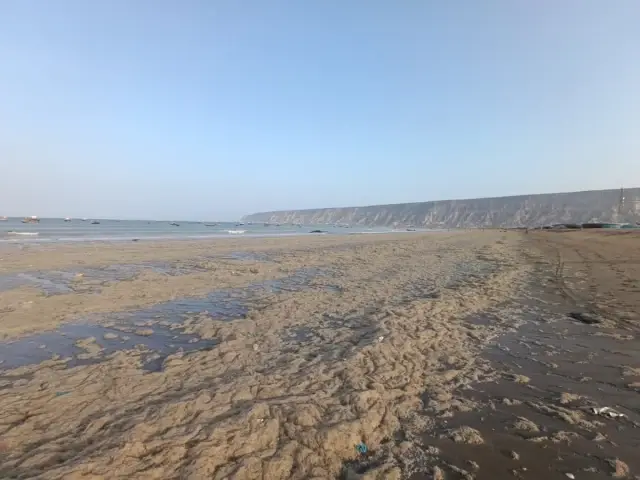
Decomposing phytoplankton behind foul smell across Karachi
A pungent smell spread across Karachi on Wednesday morning, reaching Clifton, DHA, Korangi, PECHS and areas around MA Jinnah Road. Marine experts said the cause was phytoplankton dying and decomposing after multiplying in coastal waters during the monsoon. WWF-Pakistan Technical Adviser Muhammad Moazzam Khan called it a natural seasonal cycle. The Pakistan Meteorological Department said weak sea breezes from Tuesday night allowed the odour to drift inland.
Source
The Express Tribune (Pakistan) · read the original report ↗
Desk check · compared with the source
What the desk checked (5)
- The foul smell across Karachi was caused by phytoplankton dying and decomposing after monsoon proliferation. — Attributed to marine experts, including WWF-Pakistan Technical Adviser Muhammad Moazzam Khan.
- Sea breezes remained unusually weak from Tuesday night into Wednesday morning, letting the odour linger inland. — Attributed to the Pakistan Meteorological Department.
- Southwesterly sea breezes strengthened in the evening, reaching up to 22 km/h. — Figure appears in source, attributed to PMD.
- A similar occurrence was observed along the Gwadar coast about three days earlier. — Attributed to Muhammad Moazzam Khan; no independent data given.
- PMD expects the sea breeze to become fully active from Thursday, dispersing the odour. — Forecast attributed to PMD; inherently predictive.
Analysts’ view opinion
This is at heart a natural marine event, but its strategic interest lies in information management: when a strong, unexplained odour sweeps a major port city, the public's first instinct is to suspect a chemical leak, an industrial accident or sabotage. With both Karachi and Gwadar central to Pakistan's maritime economy and naval infrastructure, the ability to produce a fast, credible official explanation is itself a test of crisis-communication capacity. In this case, marine experts and the met department converging quickly on a benign cause is a positive signal.
- Unexplained odour incidents in coastal cities carry real potential for public alarm, and any delay in official explanation tends to be filled by rumour and misinformation.
- The story notes a similar occurrence along the Gwadar coast about three days earlier, indicating a coastline-wide seasonal cycle rather than a single-city local problem.
- Attributing the inland spread to unusually weak sea breezes underlines how central meteorological agencies are to coastal environmental monitoring and situational awareness.
- Because Karachi and Gwadar anchor maritime trade and port infrastructure, sustained monitoring of coastal water conditions has strategic as well as environmental value.
- That a technical adviser from a non-governmental conservation body featured prominently in the explanation shows the practical value of independent expert credibility in such episodes.
What to watch — Watch whether the strengthening sea breeze from Thursday clears the odour as forecast, or whether it persists and pushes authorities towards sampling, inspections and questions about industrial discharge.
The story does not establish any security threat, industrial leak or toxic exposure, and offers no confirmed findings on health effects, water sampling results or any official investigation.
Deep dive
Research brief · 8 facts · 5 dates · exam-readyThe brief
Context
On Wednesday morning, a pungent odour spread across large parts of Karachi, including coastal areas like Clifton and DHA as well as inland localities such as Korangi, PECHS, MA Jinnah Road, Tower and Kharadar. Marine experts attributed it not to a leak, dump or pollution incident but to phytoplankton — microscopic marine plants — dying and decomposing after proliferating in coastal waters during the monsoon. The Pakistan Meteorological Department said unusually weak sea breezes from Tuesday night into Wednesday morning allowed the coastal odour to drift inland and linger instead of dispersing.
Key facts
- The odour spread on Wednesday morning across Clifton, DHA, Korangi, PECHS and the older quarters around MA Jinnah Road, Tower and Kharadar in Karachi.
- Marine experts said the cause was phytoplankton dying and decomposing after proliferating in Karachi's coastal waters during the monsoon season.
- WWF-Pakistan Technical Adviser Muhammad Moazzam Khan said the phenomenon is a natural seasonal cycle that generally occurs towards the end of the several-month monsoon period.
- Phytoplankton can multiply so rapidly during the monsoon that seawater takes on a greenish appearance, according to Khan.
- Other forms of marine vegetation also flourish during the monsoon and decompose, adding to the smells carried from the coast.
- Khan said a similar occurrence had been observed along the Gwadar coast about three days earlier.
- PMD said sea breezes remained unusually weak from Tuesday night into Wednesday morning, leaving little wind to disperse the odour.
- Southwesterly sea breezes strengthened on Wednesday evening, reaching up to 22 kilometres per hour; PMD expected the sea breeze to become fully active from Thursday.
Timeline
- About three days before the Karachi episodeA similar phytoplankton decomposition phenomenon observed along the Gwadar coast, per WWF-Pakistan's Muhammad Moazzam Khan.
- Tuesday nightSea breezes over Karachi became unusually weak, according to the Pakistan Meteorological Department.
- Wednesday morningKarachi residents woke to a pungent smell spreading from coastal to far inland neighbourhoods.
- Wednesday eveningSouthwesterly sea breezes strengthened, reaching up to 22 km per hour.
- Thursday (expected)PMD expected the sea breeze to become fully active, helping clear the air and disperse the odour.
Who has a stake
- Karachi residents — Faced an inescapable pungent smell across neighbourhoods from Clifton and DHA to Korangi, PECHS and Kharadar, with uncertainty about its source.
- WWF-Pakistan (Technical Adviser Muhammad Moazzam Khan) — Provided the scientific explanation, identifying the odour as a natural seasonal marine cycle rather than a pollution event.
- Pakistan Meteorological Department (PMD) — Explained the atmospheric cause — weak sea breezes — and forecast when winds would disperse the odour.
- Coastal communities along Gwadar — Experienced a similar phytoplankton decomposition phenomenon about three days earlier, indicating a coastline-wide cycle.
Why it matters
The episode shows how ordinary ocean biology, combined with a temporary lull in sea breezes, can affect the daily life of millions in a coastal megacity. It also underlines the value of timely scientific and meteorological communication in preventing panic about a suspected leak or pollution event. For readers, it is a reminder that phytoplankton blooms and their decay are routine yet visible markers of monsoon-driven changes in coastal waters.
UPSC angle
Prelims pointers
- Phytoplankton are microscopic marine plants and a normal, essential part of the ocean ecosystem.
- Dense phytoplankton proliferation can turn seawater greenish; their decay can produce a strong foul odour.
- WWF-Pakistan Technical Adviser Muhammad Moazzam Khan explained the Karachi odour as a natural seasonal cycle.
- Pakistan Meteorological Department (PMD) attributed the odour's inland spread to unusually weak sea breezes.
- Southwesterly sea breezes over Karachi strengthened to up to 22 km/h on Wednesday evening.
- A similar phenomenon was reported along the Gwadar coast about three days before the Karachi event.
Mains framing
The Karachi odour episode illustrates the interaction between marine biological cycles and local meteorology in a densely populated coastal city. The monsoon creates conditions in which phytoplankton and other marine vegetation multiply rapidly in coastal waters; as winds and water conditions shift towards the end of the monsoon, these organisms die and decompose, releasing a strong smell. Ordinarily, sea breezes carry and disperse such coastal air, but the unusually weak breezes from Tuesday night into Wednesday morning allowed the odour to penetrate deep inland, reaching neighbourhoods far from the shoreline and prompting speculation about leaks or dumping. The reported occurrence along the Gwadar coast about three days earlier suggests the cycle plays out along stretches of the coastline rather than at a single site. The implication is twofold: coastal cities need routine monitoring and clear public communication so natural phenomena are not mistaken for industrial accidents, and meteorological forecasting of wind patterns becomes a practical public-information tool. The way forward, as indicated in the source, rests on scientific explanation by bodies such as WWF-Pakistan and PMD, and on the return of active sea breezes expected to disperse the odour.
Key terms
- Phytoplankton
- Microscopic marine plants that are a normal and essential part of the ocean ecosystem but can smell foul when they multiply and then decay.
- Sea breeze
- Wind blowing from sea towards land that normally carries coastal air away and disperses odours; it was unusually weak over Karachi.
- WWF-Pakistan
- Conservation organisation whose Technical Adviser Muhammad Moazzam Khan explained the odour as a natural seasonal marine cycle.
- Pakistan Meteorological Department (PMD)
- National weather agency that reported the weak sea breezes and forecast their strengthening from Thursday.
- Monsoon proliferation
- Rapid multiplication of phytoplankton and marine vegetation during the monsoon, sometimes turning seawater greenish.
Practice questions
- Explain how monsoon-driven phytoplankton blooms and their decomposition can affect air quality perception in coastal cities, using the Karachi episode as an example.
- Discuss the role of sea breezes in dispersing coastal pollutants and odours, and the consequences when such breezes weaken over a megacity.
- How can meteorological and scientific agencies improve public communication during unexplained environmental events? Illustrate with the roles of PMD and WWF-Pakistan in the Karachi odour incident.
Grounded only in the source report — figures and dates are the source's, not inferred.