
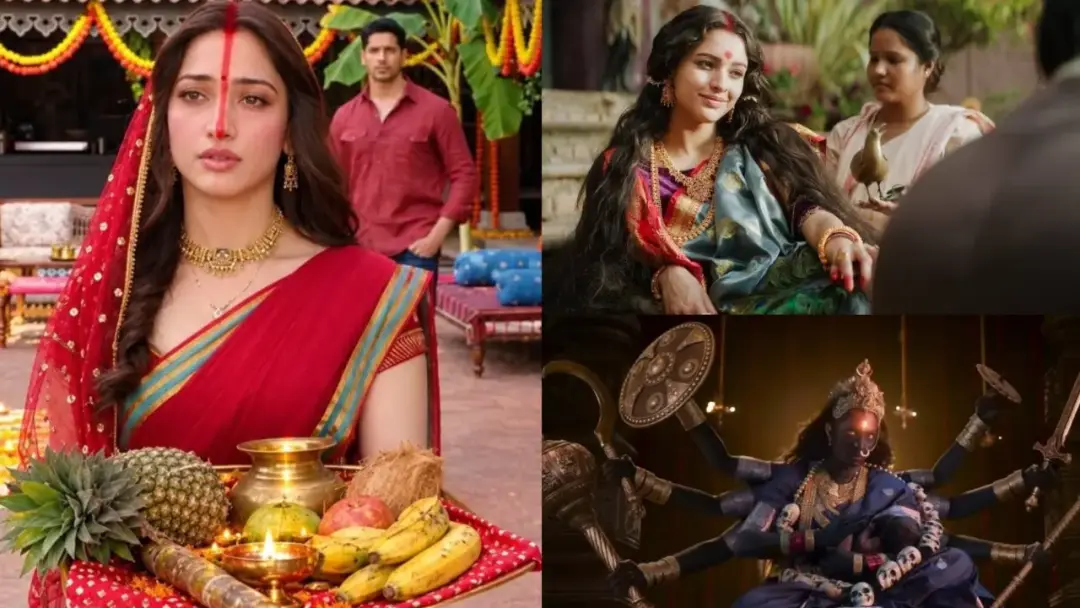
Indian films and series inspired by powerful goddesses
A roundup lists Indian films and series that draw on mythology and folklore to portray divine feminine figures. They include The Vvaan: Force of the Forrest, based on Van Devi folklore and starring Tamannaah Bhatia and Sidharth Malhotra; Mookuthi Amman (2020) with Nayanthara; Maa (2025) with Kajol; Kumari (2022) with Aishwarya Lekshmi; Tumbbad (2018); Suzhal; Inspector Rishi; the upcoming Mahakali; Bulbbul (2020); and Bhaagamathie (2018) with Anushka Shetty.
Source
Cinema · read the original report ↗
Desk check · compared with the source
What the desk checked (5)
- 'The Vvaan: Force of the Forrest' is based on the folklore of Van Devi and stars Tamannaah Bhatia and Sidharth Malhotra. — Figure appears in source; no external attribution given, actor surname spelt 'Mlahotra' in source text.
- 'Mookuthi Amman' (2020) is a Tamil fantasy comedy starring Nayanthara and RJ Balaji. — Year and cast appear in source; no source cited.
- 'Maa' (2025) stars Kajol as Ambika, who channels the power of Goddess Kali. — Appears in source as plot description; unattributed.
- 'Tumbbad' (2018) centres on the fictional goddess Hastar, firstborn of Goddess Earth; 'Bhaagamathie' (2018) stars Anushka Shetty. — Both details appear in source; internally consistent, no external sourcing.
- 'Mahakali' is an upcoming film from the Prasanth Varma Cinematic Universe with Bhoomi Shetty and Akshaye Khanna. — Stated in source as upcoming; no release date or official announcement cited.
Analysts’ view opinion
The divine feminine is quietly hardening into a full-fledged commercial genre on Indian screens, where devotion, dread and folklore combine into a formula that travels across languages. The fact that this round-up spans Tamil, Malayalam, Telugu and Hindi titles as well as streaming series suggests this is a pan-Indian appetite rather than one regional fad. For producers it is an attractive risk profile: familiar mythological imagery lowers the marketing lift, while the horror element pulls younger audiences into theatres.
- The genre has become a reliable route to female-led films, with Nayanthara, Kajol, Anushka Shetty, Aishwarya Lekshmi and Triptii Dimri all carrying title roles.
- The same goddess premise stretches across horror, fantasy comedy, period drama and crime thriller, giving studios unusual tonal flexibility.
- The presence of Suzhal and Inspector Rishi shows these myths also scale into long-form streaming, not just two-hour features.
- Titles like Tumbbad illustrate that this space can reward craft and cult longevity more than a big opening weekend, making budget discipline central.
- Depicting deities remains sensitive terrain, and films like Kumari that probe the darker side of goddess worship can split public reception.
What to watch — Watch whether bigger-ticket entries such as the upcoming Mahakali and The Vvaan can lift the genre from niche folk-horror into mainstream tentpole territory.
This is a curated list, not a performance report — it offers no box-office figures, budgets, critical scores or release dates, so nothing here establishes how commercially successful these titles actually were.
Deep dive
Research brief · 8 facts · 5 dates · exam-readyThe brief
Context
Indian cinema and streaming series have repeatedly turned to mythology and folklore to depict divine feminine figures, mixing faith, horror, mystery and the supernatural with contemporary storytelling. A roundup of such titles spans Hindi, Tamil, Telugu and Malayalam productions, from folk horror like Tumbbad and Kumari to fantasy comedy like Mookuthi Amman. The list also includes crime series such as Suzhal: The Vortex and Inspector Rishi, which place village goddess traditions at the centre of murder investigations, and upcoming mythological films like Mahakali. The newest entry, The Vvaan: Force of the Forrest, is built on Van Devi folklore and Bihar's culture.
Key facts
- The Vvaan: Force of the Forrest is based on the folklore of Van Devi, the Goddess of the Forest, stars Tamannaah Bhatia and Sidharth Malhotra, and celebrates Bihar's culture.
- Mookuthi Amman (2020) is a Tamil fantasy comedy with Nayanthara as the titular goddess and RJ Balaji as TV news reporter Engels Ramasamy, who together expose a fraudulent godman.
- Maa (2025) stars Kajol as Ambika, who channels the power of Goddess Kali in a mythological horror set in her husband's cursed ancestral village.
- Kumari (2022) is a Malayalam folk horror directed by Nirmal Sahadev, starring Aishwarya Lekshmi, drawing on Kerala folklore and the darker side of goddess worship.
- Tumbbad (2018) is a Hindi folk horror directed by Rahi Anil Barve, starring Sohum Shah, centred on the fictional goddess Hastar, firstborn child of Goddess Earth.
- Suzhal: The Vortex is a Tamil crime thriller set against a village festival dedicated to Goddess Angalamman.
- Inspector Rishi, a Tamil horror-crime series set in the town of Thaenkaadu, links mysterious murders to Vanaratchi, a mythical forest goddess.
- Mahakali, from the Prasanth Varma Cinematic Universe and directed by Puja Aparna Kolluru, stars Bhoomi Shetty as Mahakali and Akshaye Khanna as Shukracharya.
Timeline
- 2018Tumbbad (Hindi folk horror, goddess Hastar) and Bhaagamathie (Telugu horror thriller with Anushka Shetty) release.
- 2020Mookuthi Amman (Tamil, Nayanthara) and Bulbbul (Hindi period horror, Triptii Dimri) release.
- 2022Kumari, Malayalam folk horror with Aishwarya Lekshmi, releases.
- 2025Maa, mythological horror starring Kajol as Ambika, releases.
- UpcomingMahakali and The Vvaan: Force of the Forrest are listed as forthcoming/new titles in the roundup.
Who has a stake
- Lead actresses (Tamannaah Bhatia, Nayanthara, Kajol, Aishwarya Lekshmi, Triptii Dimri, Anushka Shetty, Bhoomi Shetty) — Carry female-led, goddess-centred narratives that place women at the narrative and commercial centre of these films.
- Directors (Nirmal Sahadev, Rahi Anil Barve, Anvita Dutt, Puja Aparna Kolluru) — Translate regional folklore and mythology into cinematic genre storytelling.
- Prasanth Varma Cinematic Universe — Expanding a mythological fantasy franchise with Mahakali.
- Regional film industries (Tamil, Telugu, Malayalam, Hindi) — Draw on local folklore - Kerala, Bengali, Bihar and Tamil village traditions - as distinctive creative capital.
- Audiences and faith communities — See goddess worship, superstition and ancestral belief depicted, sometimes critically, as with the fraudulent godman in Mookuthi Amman.
Why it matters
Folklore and goddess worship are being used as a storytelling engine across Indian languages, producing commercially visible female-led films in genres - horror, crime, fantasy - traditionally dominated by male leads. These works also mediate how audiences view faith, superstition and ritual, with some titles celebrating divine energy and others probing the darker side of goddess worship or exposing religious fraud.
UPSC angle
Prelims pointers
- The Vvaan: Force of the Forrest is based on Van Devi, the Goddess of the Forest, and celebrates Bihar's culture.
- Tumbbad (2018) features the fictional goddess Hastar, described as the firstborn child of Goddess Earth.
- Suzhal: The Vortex is set around a village festival for Goddess Angalamman; Inspector Rishi invokes the forest goddess Vanaratchi.
- Mahakali belongs to the Prasanth Varma Cinematic Universe; Akshaye Khanna plays Shukracharya, guru of the Asuras.
- Bulbbul (2020) draws on Bengali folklore and Kali imagery, though not on a specific Hindu goddess.
- Bhaagamathie (2018) is based on folklore about a queen who fought a tyrannical general before taking her own life.
Mains framing
Indian cinema's recurring turn to the divine feminine shows how mythology and regional folklore function as both cultural memory and commercial genre material. The causes are visible in the source: folklore offers ready-made, locally rooted narratives - Van Devi in Bihar, Angalamman and Vanaratchi in Tamil village and forest traditions, Bengali folklore in Bulbbul, Kerala's ancestral beliefs in Kumari - that can be fused with horror, crime thriller or fantasy comedy formats. The implications are twofold: such films foreground women protagonists with agency and power, as when Kajol's Ambika channels Goddess Kali in Maa (2025), and they also open space for social critique, as in Mookuthi Amman (2020), where a goddess in human form helps expose a fraudulent godman, or in Kumari (2022), which examines the darker side of goddess worship and superstition. At the same time, representing living faith traditions through horror imagery raises questions of sensitivity and authenticity. The way forward lies in research-grounded adaptation that credits regional sources, distinguishes documented mythology from invention (Tumbbad's Hastar is explicitly fictional), and treats belief communities as subjects rather than spectacle, while sustaining the genre diversity across Hindi, Tamil, Telugu and Malayalam cinema that the roundup documents.
Key terms
- Van Devi
- The Goddess of the Forest in folklore, the basis of the film The Vvaan: Force of the Forrest.
- Folk horror
- A horror genre rooted in local folklore, rural settings and ancestral belief, as in Tumbbad (2018) and Kumari (2022).
- Hastar
- A fictional goddess in Tumbbad, described in the film as the firstborn child of Goddess Earth.
- Angalamman
- The goddess whose village festival forms the backdrop of the Tamil series Suzhal: The Vortex.
- Vanaratchi
- A mythical forest goddess and protector in local folklore, central to the series Inspector Rishi, set in Thaenkaadu.
- Prasanth Varma Cinematic Universe
- A shared film universe of mythological fantasy titles, which includes the upcoming Mahakali.
Practice questions
- Discuss how Indian cinema's use of folklore and goddess worship shapes popular understanding of faith and superstition, with examples from recent films and web series.
- Female-led mythological and folk horror films have grown in prominence across Indian languages. Examine the cultural and commercial factors behind this trend.
- To what extent can cinematic adaptation of living religious traditions balance creative freedom with cultural sensitivity? Illustrate with examples.
Grounded only in the source report — figures and dates are the source's, not inferred.