
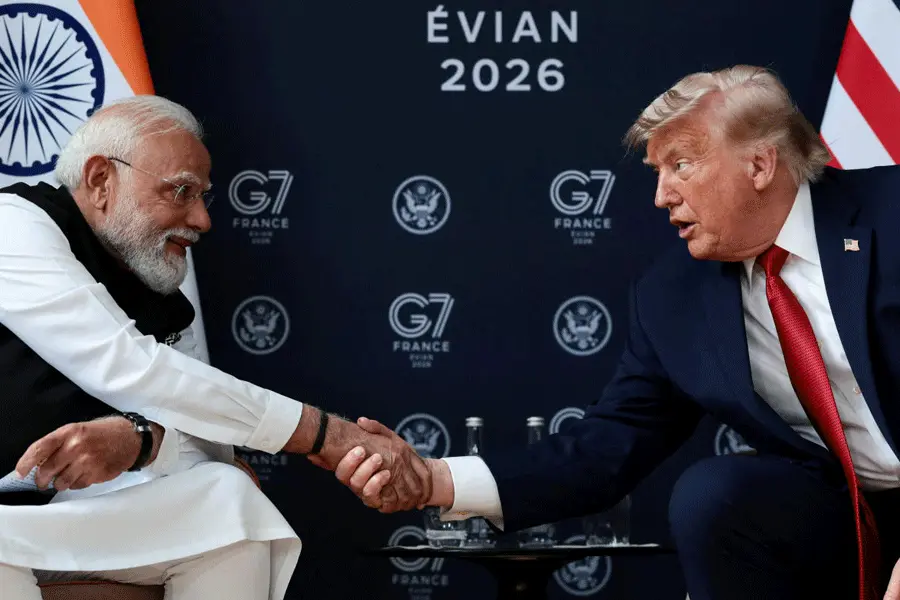
Opposition slams Centre after Trump signs Russia sanctions law
Opposition leaders criticised the Modi government after US President Donald Trump assented to the Sanctioning Russia and Iran Act, which seeks tariffs of up to 100 per cent on Russian energy buyers such as India and China. Congress general secretary Jairam Ramesh said on X that a bully must be resisted forcefully. NCP (SP) leader Mahesh Tapase called the Modi-Trump 'personal chemistry' hollow and asked the prime minister, finance and external affairs ministries to clarify the impact.
Source
Prime Minister Narendra Modi · read the original report ↗
Desk check · compared with the source
What the desk checked (5)
- Trump signed the Lindsey O. Graham Sanctioning Russia and Iran Act of 2026 (H.R. 5334) on Friday, September 18, 2026 — Attributed to a White House statement quoted in the source; date appears in source as given.
- The law requires tariffs of up to 100 per cent on goods from the top five purchasers of Russian crude oil or natural gas, and takes effect within 30 days — Stated in the source without named official attribution; figure appears in source.
- Jairam Ramesh said the only way to counter a 'bully' is to resist him forcefully — Attributed to a post on X by the Congress general secretary.
- Mahesh Tapase said the Modi-Trump 'personal chemistry' stands exposed as hollow and sought a contingency plan on crude imports — Directly quoted and attributed to the NCP (SP) leader and spokesperson.
- The House of Representatives passed the Act on Wednesday — Stated in the source with no further sourcing given.
Analysts’ view opinion
This is less a foreign-policy row than an attack on the political narrative the Modi government has built around personal diplomacy. The Opposition's charge that the Modi-Trump "chemistry" is hollow goes straight at the BJP's core asset — the image of a strong leader who commands respect abroad. By framing the issue around fuel prices and exporters' jobs, the Opposition is trying to shift it from a diplomatic debate to a kitchen-table one.
- Congress and the NCP (SP) striking the same note on the same day suggests an Opposition attempt to lock in a shared economic narrative.
- Jairam Ramesh's "resist the bully forcefully" line is a trap-setting formulation: speak tough and risk negotiations, stay quiet and invite charges of weakness.
- The law's wide discretion for Trump on tariffs, rates and waivers gives New Delhi diplomatic room — any exemption or lower rate could be presented as a win.
- The 30-day window is politically significant; silence through that period will strengthen the "keeping the country in the dark" charge.
- The government faces risk on both flanks — cutting Russian crude invites fuel-cost anger, not cutting it leaves exporters exposed to duties.
What to watch — Watch whether the PM and the finance and external affairs ministries offer a public, sector-wise assessment within the 30-day window, or hold back until talks with Washington conclude.
The story does not establish whether India will actually face tariffs, at what rate, or what the government's response is — what is reported here are Opposition allegations, not verified economic estimates.
Deep dive
Research brief · 8 facts · 4 dates · exam-readyThe brief
Context
US President Donald Trump has signed into law the "Lindsey O. Graham Sanctioning Russia and Iran Act of 2026" (H.R. 5334), which expands sanctions on Russia's leadership, energy sector, defence collaborators and its "shadow fleet", and extends existing sanctions on Iran. Crucially for India, the law requires tariffs of up to 100 per cent on goods imported from countries that are among the top five purchasers of Russian crude oil or natural gas — a group that includes India and China. Indian Opposition leaders have attacked the Modi government over the development, arguing that the much-publicised personal rapport between Modi and Trump has not translated into a binding trade understanding.
Key facts
- Trump signed H.R. 5334, the 'Lindsey O. Graham Sanctioning Russia and Iran Act of 2026', into law on Friday, September 18, 2026, per the White House.
- The law requires the President to impose duties of up to 100 per cent on goods from countries that are the top five purchasers of Russian crude oil or natural gas.
- The US House of Representatives passed the Sanctioning Russia and Iran Act on Wednesday (week of the signing).
- The law takes effect within 30 days of the President signing it.
- The Act targets Russia's leadership and energy sector, entities collaborating with Moscow's defence industry, and its so-called 'shadow fleet', and extends existing Iran sanctions.
- The law gives Trump wide discretion over implementation — which countries face tariffs, the rates imposed, and whether measures are waived.
- Congress general secretary Jairam Ramesh said on X that the only way to counter a 'bully' is to resist him 'forcefully'.
- NCP (SP) spokesperson Mahesh Tapase said the Modi-Trump 'personal chemistry' stands 'exposed as hollow' and sought clarification from the PM and the finance and external affairs ministries.
Timeline
- Wednesday (week of signing)The US House of Representatives passes the Sanctioning Russia and Iran Act.
- Friday, September 18, 2026President Trump signs H.R. 5334 into law, per the White House.
- SaturdayJairam Ramesh posts on X that a 'bully' must be resisted 'forcefully'; Mahesh Tapase demands government clarification.
- Within 30 days of signingThe law comes into effect.
Who has a stake
- Government of India (PM, Finance Ministry, Ministry of External Affairs) — Asked by the Opposition to clarify the impact, disclose sector-wise exposure and outline time-bound steps; faces pressure over trade talks with Washington.
- Indian exporters and US-market-dependent jobs — Face a 'sword of up to 100 per cent duties', in Tapase's words, if tariffs are applied.
- Indian consumers — Tapase warns that scaling back Russian oil imports under US pressure would mean higher fuel costs.
- US President Donald Trump — Holds wide discretion over which countries are tariffed, at what rates, and whether measures are waived.
- China — Named alongside India as a major buyer of Russian energy exposed to the tariff provision.
- Congress and NCP (SP) — Using the law to question the government's foreign policy and trade negotiation record with Washington.
Why it matters
A statutory tariff of up to 100 per cent on goods from top buyers of Russian crude would hit Indian exporters to the US and the jobs tied to that market, while any forced cut in discounted Russian oil could raise domestic fuel costs. Because the law leaves the choice of countries, rates and waivers to the US President, India's exposure now depends on executive discretion in Washington rather than on a settled trade agreement. The row also turns leader-level personal diplomacy into a domestic political test.
UPSC angle
Prelims pointers
- H.R. 5334 is the 'Lindsey O. Graham Sanctioning Russia and Iran Act of 2026', signed by Trump on September 18, 2026.
- The Act mandates duties of up to 100 per cent on goods from the top five purchasers of Russian crude oil or natural gas.
- The law comes into effect within 30 days of presidential signing.
- It covers Russia's leadership, energy sector, defence-industry collaborators and the 'shadow fleet'; it also extends Iran sanctions.
- Jairam Ramesh is Congress general secretary; Mahesh Tapase is an NCP (SP) leader and spokesperson.
- The US House of Representatives passed the Bill before presidential assent.
Mains framing
The signing of the Sanctioning Russia and Iran Act of 2026 illustrates how third-party sanctions law can convert India's energy sourcing choices into a trade-policy vulnerability. The statute requires tariffs of up to 100 per cent on goods from the top five buyers of Russian crude or gas — a category that, per the source, includes India and China — while simultaneously granting the US President wide discretion over country coverage, rates and waivers. That discretion is the core problem: India's exposure becomes a matter of negotiation and goodwill rather than rule-bound predictability, which is precisely the Opposition's charge that 'personal chemistry' has substituted for a durable, binding trade understanding. The domestic trade-offs are sharp — Russian crude forms a large share of India's oil basket, so reducing it under external pressure risks higher fuel costs for citizens, while continuing purchases risks duties on exporters and the jobs dependent on the US market. The way forward suggested within the story is largely informational and precautionary: government clarity on sector-wise exposure, concrete time-bound protection for exporters, and a contingency plan for affordable alternative crude sources, so that public understanding is not left to foreign media reporting.
Key terms
- Sanctioning Russia and Iran Act of 2026 (H.R. 5334)
- US law authorising and expanding sanctions, tariffs and prohibitions on Russia and extending existing sanctions on Iran.
- Shadow fleet
- Term used in the law for vessels associated with Moscow's sanctioned oil trade, now targeted by US measures.
- Secondary/third-party tariffs
- Duties imposed on other countries for their trade with a sanctioned state — here, up to 100 per cent on top buyers of Russian energy.
- Presidential discretion/waiver
- The law lets Trump decide which countries face tariffs, at what rate, and whether the measures are waived.
- India's oil basket
- The mix of crude sources India imports; Tapase notes Russian crude makes up a large share of it.
- NCP (SP)
- Nationalist Congress Party (Sharadchandra Pawar), whose spokesperson Mahesh Tapase demanded government clarity on the law's impact.
Practice questions
- Examine how third-country sanctions legislation, such as the US Sanctioning Russia and Iran Act of 2026, constrains India's strategic autonomy in energy sourcing and trade policy.
- 'Leader-level personal diplomacy is no substitute for binding institutional agreements.' Discuss with reference to India-US trade relations in light of recent developments.
- What options does India have to cushion exporters and consumers if tariffs of up to 100 per cent are imposed on buyers of Russian crude? Discuss.
Grounded only in the source report — figures and dates are the source's, not inferred.