
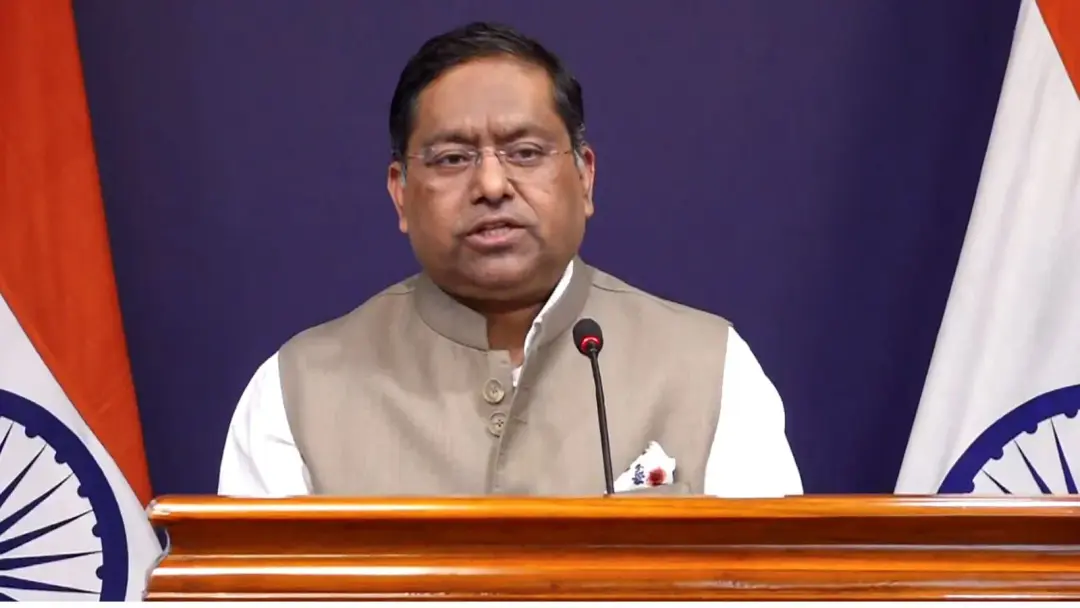
India rejects Pakistan-China boundary joint commission
India on Wednesday rejected the boundary joint commission set up by Pakistan and China, saying it has no legal basis to decide arrangements on Indian territory under illegal occupation. The reaction followed the commission's first meeting in Islamabad. MEA spokesperson Randhir Jaiswal said there is no boundary between Pakistan and China, and that India never recognised the 1963 China-Pakistan Boundary Agreement. He said Jammu & Kashmir and Ladakh remain integral parts of India, and asked Pakistan to vacate occupied areas.
Source
Indian Express — India · read the original report ↗
Desk check · compared with the source
What the desk checked (4)
- India rejected the Pakistan-China boundary joint commission as having no legal basis. — Attributed to MEA spokesperson Randhir Jaiswal with direct quotes.
- The commission's first meeting was held in Islamabad. — Stated in source; no separate source cited.
- India never recognised the 1963 China-Pakistan Boundary Agreement. — Direct quote attributed to Jaiswal; year appears in source.
- India opposes CPEC as part of it passes through PoK. — Reported as India's long-standing position, consistent internally.
Analysts’ view opinion
This is less a fresh diplomatic move than a firmly worded political reassertion of a position India has held for decades. By calling the Pakistan-China joint commission one "without any legal basis", New Delhi is pre-emptively locking in its refusal to recognise any bilateral arrangement touching territory it considers occupied. Domestically, the language on Jammu & Kashmir and Ladakh as "integral and inalienable" is politically well-trodden and dependable ground for the government.
- Restating that the 1963 agreement was never recognised keeps India's legal claim intact for any future negotiation.
- The demand that Pakistan vacate occupied areas is not new, but its sharp framing also plays as a nationalist signal at home.
- From Delhi's vantage point, institutionalising a boundary commission is an attempt to lend legitimacy to occupation — hence the rapid response.
- In fairness to the other side, Islamabad and Beijing are likely to present this as routine bilateral boundary management, while India recasts it as a sovereignty question.
- The statement is essentially declaratory: no new countermeasures or actions are indicated in it.
What to watch — Watch for formal responses from Beijing and Islamabad, whether the commission holds further meetings, and if India escalates diplomatically on CPEC-linked concerns.
The story does not establish what concrete steps India will take beyond this statement, nor the commission's actual mandate or scope.
Deep dive
Research brief · 8 facts · 4 dates · exam-readyThe brief
Context
India has rejected a newly created Pakistan-China Boundary Joint Commission after its first meeting was held in Islamabad. The Ministry of External Affairs said there is no boundary between Pakistan and China because the territory involved is Indian land under illegal occupation. The dispute traces back to the 1963 China-Pakistan Boundary Agreement, under which Pakistan handed over territories such as the Shaksgam Valley to China — a transfer India has always called illegal and invalid. India has similarly opposed the China-Pakistan Economic Corridor because part of it passes through Pakistan-occupied Kashmir.
Key facts
- India on Wednesday rejected the "so-called" boundary joint commission set up by Pakistan and China, saying it has no legal basis to decide arrangements on Indian territory under illegal occupation.
- The Indian reaction followed the first meeting of the Pakistan-China Boundary Joint Commission held in Islamabad.
- MEA spokesperson Randhir Jaiswal said: "There is no boundary between Pakistan and China. We reject the so-called Joint Commission, which is without any legal basis."
- India says it has never recognised the 'China-Pakistan Boundary Agreement' of 1963 and maintains it is illegal and invalid.
- Pakistan handed over certain territories such as the Shaksgam Valley to China in 1963, a move India calls illegal and unacceptable.
- Jaiswal said the entire Union Territories of Jammu & Kashmir and Ladakh "have been, are and will always remain integral and inalienable parts of India".
- India has opposed the China-Pakistan Economic Corridor as part of it passes through Pakistan-occupied Kashmir (PoK).
- India called on Pakistan to "immediately vacate areas under its illegal and forcible occupation", terming the commission's proceedings "theatrics".
Timeline
- 1963Pakistan hands over certain territories, such as the Shaksgam Valley, to China under the 'China-Pakistan Boundary Agreement'; India never recognises it.
- Not dated in the sourceIndia opposes the China-Pakistan Economic Corridor as part of it passes through Pakistan-occupied Kashmir.
- Recently (date not stated in the source)First meeting of the Pakistan-China Boundary Joint Commission held in Islamabad.
- WednesdayIndia rejects the joint commission; MEA spokesperson Randhir Jaiswal issues detailed statement on sovereignty over J&K and Ladakh.
Who has a stake
- Ministry of External Affairs, India — Asserting India's legal and diplomatic position that no boundary exists between Pakistan and China and that the commission is without legal basis.
- Randhir Jaiswal, MEA spokesperson — Articulated India's rejection of the commission and the 1963 agreement, and the demand that Pakistan vacate occupied areas.
- Pakistan — Seeks to institutionalise boundary arrangements with China over territory India claims; accused by India of illegal and forcible occupation.
- China — Party to the 1963 agreement and the new joint commission; holds Shaksgam Valley territory handed over by Pakistan in 1963.
- Union Territories of Jammu & Kashmir and Ladakh — Territorial status and sovereignty at issue; India calls them integral and inalienable parts of the country.
Why it matters
Any bilateral China-Pakistan mechanism over territory India claims risks creating a paper trail that appears to legitimise occupation of Indian land, which is why New Delhi responded formally and immediately. The position also ties into India's long-standing objection to the China-Pakistan Economic Corridor running through Pakistan-occupied Kashmir. It underlines that India treats questions of sovereignty over Jammu & Kashmir and Ladakh as non-negotiable, whatever arrangements third parties reach among themselves.
UPSC angle
Prelims pointers
- The China-Pakistan Boundary Agreement of 1963 transferred territories such as the Shaksgam Valley to China; India calls it illegal and invalid.
- Pakistan-China Boundary Joint Commission held its first meeting in Islamabad; India rejects it as without legal basis.
- Randhir Jaiswal is the Ministry of External Affairs spokesperson who issued India's rejection.
- India opposes the China-Pakistan Economic Corridor (CPEC) because part of it passes through Pakistan-occupied Kashmir.
- India maintains that the entire Union Territories of Jammu & Kashmir and Ladakh are integral and inalienable parts of India.
- India's demand: Pakistan should immediately vacate areas under its illegal and forcible occupation.
Mains framing
India's rejection of the Pakistan-China Boundary Joint Commission is best read as a continuation of a doctrinal position rather than a fresh dispute: since 1963, when Pakistan transferred territories including the Shaksgam Valley to China, New Delhi has held that no legitimate boundary can exist between the two countries because the land involved is Indian territory under illegal occupation. The immediate trigger — the commission's first meeting in Islamabad — matters because institutional mechanisms, joint bodies and formal agreements can, over time, be cited as evidence of settled arrangements; hence India's insistence that such cooperation "would have no bearing whatsoever" on its sovereignty. The same logic underlies India's objection to the China-Pakistan Economic Corridor passing through Pakistan-occupied Kashmir. The implication is a two-front sovereignty challenge in which bilateral China-Pakistan understandings intersect with India's claims over Jammu & Kashmir and Ladakh, both now Union Territories. The way forward, on the source's own terms, lies in consistent and prompt legal-diplomatic rejection of every instrument that seeks to alter the status of occupied territories, alongside the standing demand that Pakistan vacate areas under its illegal and forcible occupation.
Key terms
- Pakistan-China Boundary Joint Commission
- A body set up by Pakistan and China whose first meeting was held in Islamabad; India rejects it as having no legal basis.
- China-Pakistan Boundary Agreement, 1963
- Agreement under which Pakistan handed over territories such as the Shaksgam Valley to China; India has never recognised it and calls it illegal and invalid.
- Shaksgam Valley
- Territory transferred by Pakistan to China in 1963, which India regards as its own and the transfer as illegal and unacceptable.
- China-Pakistan Economic Corridor (CPEC)
- Connectivity project opposed by India because part of it passes through Pakistan-occupied Kashmir.
- Pakistan-occupied Kashmir (PoK)
- Areas India describes as under Pakistan's illegal and forcible occupation, which it asks Pakistan to vacate.
- Ministry of External Affairs (MEA)
- India's foreign ministry, whose spokesperson Randhir Jaiswal issued the rejection of the joint commission.
Practice questions
- Why does India hold that there is no boundary between Pakistan and China? Discuss with reference to the 1963 China-Pakistan Boundary Agreement.
- Examine how China-Pakistan bilateral mechanisms and connectivity projects such as CPEC intersect with India's concerns about sovereignty and territorial integrity.
- "Formal joint bodies can be used to normalise contested territorial arrangements." Critically analyse India's diplomatic response to the Pakistan-China Boundary Joint Commission.
Grounded only in the source report — figures and dates are the source's, not inferred.