
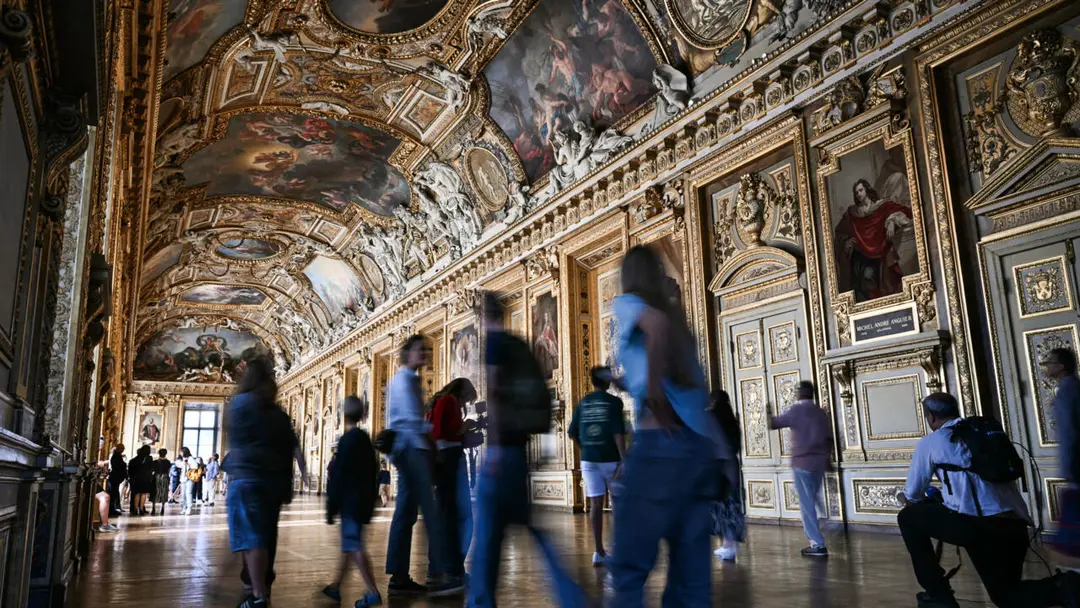
Two arrested after taping own paintings in Louvre's Mona Lisa hall
Two men used sticky tape to fix two paintings measuring 30 by 40 cm to a wall in the Louvre hall where visitors gather to see Leonardo Da Vinci's Mona Lisa. One painting showed one of the men in armour, the other portrayed both men with a woman. Security officers detained them and police arrested them for minor damage to the wall. They told police they did it for fun. The Mona Lisa, behind protective glass, was undamaged.
Source
France 24 · read the original report ↗
Desk check · compared with the source
What the desk checked (5)
- Two men taped two paintings measuring 30 by 40 cm in the Louvre hall housing the Mona Lisa. — Described in source as fact; no named official attribution given.
- Police arrested the men for minor damage to the wall and they said they did it for fun. — Attributed in source to police interview and police sources.
- The men will be summoned to court once the museum files a formal complaint. — Explicitly attributed to police sources in the source text.
- Eight jewellery items worth millions of dollars were stolen from the Louvre last October; four suspects arrested, items not recovered. — Figures appear in source as background; no investigating agency named.
- The Louvre received around nine million visitors last year, above intended capacity. — Figure appears in source without a cited source document.
Analysts’ view opinion
On the surface this is a prank; through a security lens it reads as a probe. Two men were able to tape their own artworks to the wall of arguably the most closely watched gallery on earth before staff intervened — and that gap in time is the real finding. Set against last October's daylight jewellery heist at the Louvre, the still-unrecovered loot and the museum's dated CCTV, this becomes another data point in a pattern of protective failure that has turned cultural-property security into a matter of national prestige for France.
- The Mona Lisa was unharmed — but because of thick protective glass, not human vigilance, meaning the hardware held while procedural surveillance looked porous.
- If someone can affix an object to a gallery wall, the same window of opportunity is in principle available to actors with far more serious intent.
- The fact that flaws flagged in a 2019 audit were never acted on strengthens doubts that the post-heist fixes are yet complete.
- Roughly nine million visitors a year, well above intended capacity, is a structural security problem: more crowding means less scrutiny and more openings.
- A run of thefts at French museums feeds the perception that they are soft targets, and major museums elsewhere may quietly review their own protocols.
What to watch — Watch whether the museum files its formal complaint and how the court process unfolds, and how much of Macron's announced overhaul — a new space for the Mona Lisa and a new entrance — is weighted towards security modernisation rather than visitor flow alone.
The story establishes no link between these two men and any organised gang or the October heist; their stated motive of "fun" is the only explanation on record and has not been independently verified.
Deep dive
Research brief · 8 facts · 4 dates · exam-readyThe brief
Context
Two men taped two of their own paintings, each measuring 30 by 40 cm, to a wall in the Louvre hall where crowds gather to view Leonardo Da Vinci's Mona Lisa. Museum security detained them and police arrested them for minor damage to the wall; the men said they did it for fun. The episode comes as French museums face heightened scrutiny after a spate of heists, including a daylight jewellery robbery at the Louvre last October, and as the museum prepares a major overhaul announced by President Emmanuel Macron.
Key facts
- The two paintings taped to the wall measured 30 by 40 cm each.
- One painting showed one of the men wearing armour; the other was a portrait of the two men with a woman.
- Police arrested the two men for minor damage to the wall; they told police they acted 'for fun'.
- The men will be summoned to court once the museum files a formal complaint, according to police sources.
- The Mona Lisa, now behind a thick layer of protective glass, suffered no damage.
- In a daylight heist last October, eight items of jewellery worth millions of dollars were stolen from the Louvre.
- Four suspects have been arrested in the jewellery heist, but the stolen items have not been found.
- The Louvre received around nine million visitors last year, far above its intended capacity.
Timeline
- 2019An audit ordered by the Louvre highlighted many of the museum's security flaws; its findings were never acted on.
- October (last year)Eight items of jewellery worth millions of dollars stolen from the Louvre in a daylight heist; four suspects later arrested, items still missing.
- MayPresident Emmanuel Macron announced a major overhaul of the Louvre, including a new space for the Mona Lisa and a new museum entrance.
- Recent incident (date not stated in the source)Two men taped their own paintings in the Mona Lisa hall; detained by security, arrested by police for minor damage.
Who has a stake
- Louvre Museum — Must file a formal complaint for the wall damage; faces reputational and security pressure after repeated incidents and overcrowding.
- The two arrested men — Arrested for minor damage to the wall; face court summons once the museum complains.
- French police and investigators — Handling the arrest and still searching for jewellery stolen in the October heist despite four arrests.
- French President Emmanuel Macron — Announced the Louvre overhaul in May, including a new space for the Mona Lisa and a new entrance.
- Museum visitors (around nine million last year) — Face overcrowding beyond intended capacity and the risk of disruption in the Mona Lisa hall.
- Other French museums and galleries — Under scrutiny after a spate of heists that exposed inadequate security and fears of being seen as soft targets.
Why it matters
The incident, though minor in damage terms, shows how easily visitors can breach display space around the world's most-watched painting at a time when French museums are already reeling from thefts. It sharpens questions about whether heritage institutions with outdated systems, such as the Louvre's old-fashioned CCTV, are soft targets for both pranksters and criminal gangs. It also ties into the larger debate on overcrowding at museums drawing far more visitors than their intended capacity.
UPSC angle
Prelims pointers
- The Mona Lisa is by Leonardo Da Vinci and is displayed at the Louvre behind a thick layer of protective glass.
- Louvre visitors last year: around nine million, far above intended capacity.
- October heist at the Louvre: eight jewellery items worth millions of dollars stolen in daylight; four suspects arrested, items not recovered.
- A 2019 Louvre-ordered audit flagged security flaws; findings were never acted on.
- In May, French President Emmanuel Macron announced a Louvre overhaul with a new space for the Mona Lisa and a new entrance.
- The two men who taped 30x40 cm paintings in the Mona Lisa hall were arrested for minor damage to the wall.
Mains framing
The taping of two amateur paintings in the Louvre's Mona Lisa hall is a small act with large institutional implications. Its causes lie in a combination of extreme visitor density around a single iconic object, with the museum receiving roughly nine million visitors last year against a lower intended capacity, and security systems that a 2019 internal audit had already found wanting but whose recommendations were never implemented. The October daylight jewellery heist, in which eight items worth millions of dollars were stolen and remain unrecovered despite four arrests, exposed lapses including an old-fashioned CCTV system and fed fears that museums are viewed as soft targets by criminal gangs. Implications extend beyond France: heritage institutions must balance mass access and revenue against conservation and physical protection, since even a prank causing only minor damage to a wall signals how close the public can get to priceless works. The way forward, as indicated by the overhaul announced in May, involves dedicated display space for the Mona Lisa, a new museum entrance to manage flows, and acting on audit findings rather than shelving them; deterrence also depends on prompt legal follow-up, such as the court summons that will follow the museum's formal complaint.
Key terms
- Louvre
- The Paris museum that houses the Mona Lisa; it drew about nine million visitors last year, beyond its intended capacity.
- Mona Lisa
- Leonardo Da Vinci's masterpiece, displayed at the Louvre behind a thick layer of protective glass; undamaged in this incident.
- Daylight heist (October)
- Theft of eight jewellery items worth millions of dollars from the Louvre; four suspects arrested, loot not found.
- 2019 audit
- A security review ordered by the Louvre that highlighted flaws; its findings were never acted upon.
- Soft targets
- Term used for museums and galleries seen by criminal gangs as easy to rob due to inadequate security.
Practice questions
- Mass tourism at iconic heritage sites creates both revenue and risk. Discuss with reference to overcrowding and security lapses at the Louvre.
- Why do internal security audits at cultural institutions often go unimplemented, and what mechanisms can ensure follow-through?
- Examine how the protection of priceless artworks must balance public access, conservation and physical security.
Grounded only in the source report — figures and dates are the source's, not inferred.