
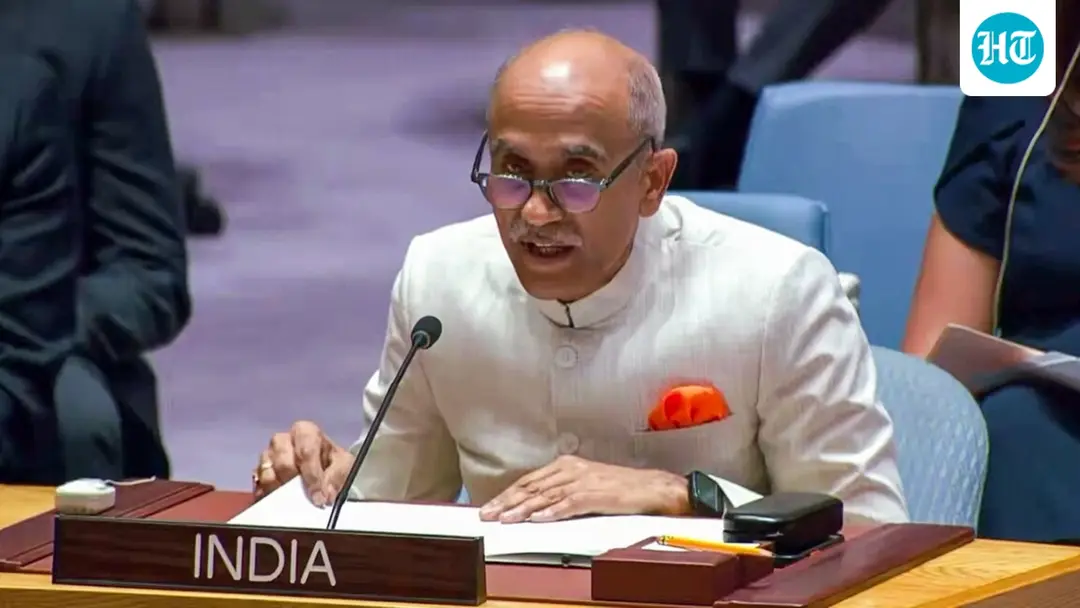
India tells UNSC 9/11 architects did not hide in caves
India's Permanent Representative to the UN, Harish Parvathaneni, criticised Pakistan indirectly at a UN Security Council meeting on Afghanistan, saying the architects of the 9/11 attacks did not hide in caves or badlands but in populated areas. He noted Osama bin Laden, Khalid Sheikh Mohammed, Ramzi Binalshibh, Walid bin Attash and Mustafa Ahmed al-Hawsawi were traced in Pakistani cities. He said the same permissive environment continues to shelter Lashkar-e-Taiba and Jaish-e-Mohammed.
Source
Hindustan Times — India · read the original report ↗
Desk check · compared with the source
What the desk checked (5)
- India's Permanent Representative Harish Parvathaneni said al-Qaeda leaders behind 9/11 were not hiding in caves or badlands but in populated areas. — Directly quoted and attributed to Parvathaneni at a UNSC meeting on Afghanistan, sourced to PTI.
- A 'permissive environment' that sheltered 9/11 planners continues to support Lashkar-e-Taiba and Jaish-e-Mohammed. — Attributed statement by India's envoy; source notes it was a thinly-veiled reference to Pakistan, not an independently verified claim.
- Osama bin Laden was killed in Abbottabad in 2011; Khalid Sheikh Mohammed was arrested in Rawalpindi in March 2003; Binalshibh and bin Attash were captured in Karachi; al-Hawsawi was arrested in Pakistan in March 2003. — Figures and locations appear in the source as background detail.
- 2.9 million Afghans returned in 2025 and a further 1.15 million by August 22, 2026, mostly involuntarily. — Attributed to the UN Secretary-General's report on Afghanistan as cited in the source; the dates as printed are internally inconsistent with a 25th anniversary framing and should be checked.
- Pakistan is a non-permanent UNSC member and its envoy Asim Iftikhar Ahmad visited the 9/11 memorial. — Stated in the source without further attribution.
Analysts’ view opinion
India's intervention at the UN Security Council is less a history lesson than a carefully built strategic argument. By stressing that the 9/11 architects were traced to Pakistani cities rather than remote caves, India is trying to shift the counter-terrorism debate from "ungoverned spaces" to "enabling states and ecosystems". Choosing the Afghanistan debate as the venue, at a time when Pakistan sits on the Council as a non-permanent member, is a deliberate diplomatic move.
- The thinly-veiled targeting of Pakistan without naming it lowers the room for a formal rebuttal while keeping the message unmistakable.
- Listing the captures in settled urban locations back to back is meant to suggest a pattern rather than a series of isolated intelligence failures.
- Drawing a line from al-Qaeda to Lashkar-e-Taiba and Jaish-e-Mohammed lets India attach its own security concerns to the global memory of 9/11, especially in the 25th-anniversary window.
- The claim that groups change identities to slip past sanctions puts the spotlight on practical gaps in the Council's own listing and enforcement machinery.
- Pairing this with concern over more than three million largely involuntary Afghan returns and "trade and transit terror" positions India as a humanitarian and connectivity stakeholder in Afghanistan.
What to watch — Watch whether Pakistan responds in the Council, whether the United States or other members publicly echo India's framing, and whether India carries the argument into concrete sanctions-listing pushes.
The story records India's allegations and framing at the UN; it does not establish Pakistan's response, the reaction of other Council members, or any policy change flowing from the remarks.
Deep dive
Research brief · 8 facts · 9 dates · exam-readyThe brief
Context
At a UN Security Council meeting on the situation in Afghanistan, India's Permanent Representative to the UN, Ambassador Parvathaneni Harish, made a thinly-veiled attack on Pakistan, arguing that the al-Qaeda leaders who planned the September 11, 2001 attacks were not hiding in "caves or badlands" but in populated Pakistani cities. He said the same "permissive environment" now shelters al-Qaeda affiliates such as Lashkar-e-Taiba and Jaish-e-Mohammed. The intervention came days after the 25th anniversary of 9/11, when UNSC members, including current non-permanent member Pakistan, visited the 9/11 Memorial in Lower Manhattan. India also raised the humanitarian plight of Afghan returnees and condemned "trade and transit terror" against Afghanistan.
Key facts
- India's Permanent Representative Parvathaneni Harish told the UNSC meeting on Afghanistan (remarks made Wednesday, reported Thursday) that 9/11's architects "did not escape justice in the wilderness of some ungoverned frontier".
- He said Osama bin Laden, who ordered and financed the 9/11 plot, was tracked and killed in Operation Neptune Spear at a fortified compound in a settled, guarded community — Abbottabad, Pakistan, in 2011.
- Khalid Sheikh Mohammed, called the principal architect of 9/11, was arrested in Rawalpindi in March 2003 and is currently held at Guantanamo Bay.
- Ramzi Binalshibh and Walid bin Attash were captured in Karachi within a few months of each other; Mustafa Ahmed al-Hawsawi was arrested in Pakistan in March 2003.
- India said the same permissive environment continues to give "space, support, and impunity" to al-Qaeda affiliates Lashkar-e-Taiba and Jaish-e-Mohammed, which acquire new identities to escape the Council's sanctions framework.
- Per the UN Secretary-General's report on Afghanistan, 2.9 million Afghans returned in 2025; by August 22, 2026, a further 1.15 million had returned, most involuntarily.
- India called the forcible return of over three million individuals neither safe nor dignified, and said the absence of Council outcry is "a sad reflection on the times".
- Pakistan currently sits on the Security Council as a non-permanent member; its envoy Asim Iftikhar Ahmad joined the ambassadors' visit to the 9/11 memorial led by US Ambassador Mike Waltz.
Timeline
- September 11, 2001al-Qaeda carries out the 9/11 attacks in the United States.
- March 2003Khalid Sheikh Mohammed arrested in Rawalpindi; Mustafa Ahmed al-Hawsawi arrested in Pakistan.
- 2003 (within months of each other)Ramzi Binalshibh and Walid bin Attash captured in Karachi.
- 2011Osama bin Laden tracked down and killed in Operation Neptune Spear at a fortified compound in Abbottabad, Pakistan.
- 20252.9 million Afghans return to Afghanistan, per the UN Secretary-General's report.
- Earlier this month (before the debate)UNSC members, including Pakistan's envoy, visit the 9/11 Memorial in Lower Manhattan, led by US Ambassador Mike Waltz.
- Week before the debateWorld commemorates the 25th anniversary of the September 11 attacks.
- By August 22, 2026A further 1.15 million Afghans return, most of the returns involuntary.
- Wednesday (of the reported week)Parvathaneni Harish addresses the UNSC meeting on Afghanistan, naming 9/11 plotters captured in Pakistani cities.
Who has a stake
- India / Permanent Mission to the UN — Seeks international action against cross-border terror sanctuaries and accountability for those who "aid, abet, finance and support" terrorism.
- Pakistan — Indirectly accused of providing a permissive environment and sanctuary; currently a non-permanent UNSC member, represented by envoy Asim Iftikhar Ahmad.
- UN Security Council — Its sanctions framework is described as being evaded by groups acquiring different identities; its silence on mass Afghan returns criticised.
- Afghanistan and Afghan returnees — Over three million returnees face involuntary, unsafe returns and severe hardship; also targets of what India calls "trade and transit terror".
- United States — Ambassador Mike Waltz led UNSC ambassadors to the 9/11 memorial, reinforcing commitment to a world free from terror; holds Khalid Sheikh Mohammed at Guantanamo Bay.
- Lashkar-e-Taiba and Jaish-e-Mohammed — Named as al-Qaeda affiliates whose leadership and terror training infrastructure India says have been shielded from consequence.
Why it matters
India used the 25th anniversary of 9/11 and an Afghanistan debate to shift the global counter-terror focus from ungoverned territory to state-linked sanctuaries, arguing that the men who planned 9/11 were found in Pakistani cities, not caves. With Pakistan sitting as a non-permanent UNSC member, the charge that sanctions are evaded through renamed groups goes to the credibility of the Council's own listing regime. The intervention also links terrorism to a humanitarian question — over three million largely involuntary Afghan returns that India says drew no Council outcry.
UPSC angle
Prelims pointers
- Parvathaneni Harish is India's Permanent Representative to the UN; he spoke at the UNSC meeting on the situation in Afghanistan.
- Operation Neptune Spear: the operation in which Osama bin Laden was killed at a fortified compound in Abbottabad, Pakistan, in 2011.
- Khalid Sheikh Mohammed — principal architect of 9/11 — arrested in Rawalpindi in March 2003; held at Guantanamo Bay.
- Ramzi Binalshibh and Walid bin Attash were captured in Karachi; Mustafa Ahmed al-Hawsawi arrested in Pakistan in March 2003.
- Pakistan is currently a non-permanent member of the UN Security Council; its envoy is Asim Iftikhar Ahmad.
- UN SG report: 2.9 million Afghans returned in 2025 and 1.15 million more by August 22, 2026, mostly involuntary returns.
Mains framing
India's UNSC intervention reframes the post-9/11 counter-terrorism narrative: the problem is not merely ungoverned frontiers but the "permissive environment" of states where terror leadership finds urban sanctuary, as illustrated by the capture of bin Laden in Abbottabad, Khalid Sheikh Mohammed in Rawalpindi, and Binalshibh and bin Attash in Karachi. India argues that this ecosystem, having given al-Qaeda "strategic depth beyond Afghanistan through its affiliates", now shields Lashkar-e-Taiba and Jaish-e-Mohammed, which change identities to evade the Council's sanctions framework while their training infrastructure escapes consequence. The implication is twofold: the UNSC's listing and sanctions machinery is only as effective as enforcement by host states, and selective outrage — silence over more than three million largely involuntary Afghan returns — corrodes the Council's moral authority. India's proposed way forward, as stated, is collective international action to end the continuity of such sanctuary, accountability for those who aid, abet and finance terrorism, insistence that refugee returns be voluntary, safe and dignified with sustained reintegration support, and rejection of "trade and transit terror" that violates LLDC declarations, WTO norms, the UN Charter and international law.
Key terms
- Permissive environment
- India's term for a state setting that lets terror leaders evade detection and gives affiliates space, support and impunity.
- Operation Neptune Spear
- The operation in which Osama bin Laden was tracked down and killed at a fortified compound in a settled, guarded community in Abbottabad.
- Strategic depth
- Used by India to describe how al-Qaeda's terror ecosystem extended its base beyond Afghanistan through affiliate groups.
- UNSC sanctions framework
- The Security Council's listing regime that India says terror groups escape by acquiring different identities.
- Landlocked Developing Countries (LLDCs)
- UN category of states without sea access; India said "trade and transit terror" against Afghanistan violates UN declarations on LLDCs and WTO norms.
- Non-permanent UNSC member
- An elected Council seat, currently held by Pakistan, represented by envoy Asim Iftikhar Ahmad.
Practice questions
- "Terror sanctuaries, not ungoverned spaces, are the core challenge to global counter-terrorism." Examine this proposition in light of India's recent statements at the UN Security Council.
- Discuss the limitations of the UN Security Council's sanctions and listing framework in dealing with terror groups that operate under changing identities.
- Evaluate the humanitarian and security implications of large-scale involuntary returns of Afghan refugees, and outline India's stated position on their reintegration.
Grounded only in the source report — figures and dates are the source's, not inferred.