
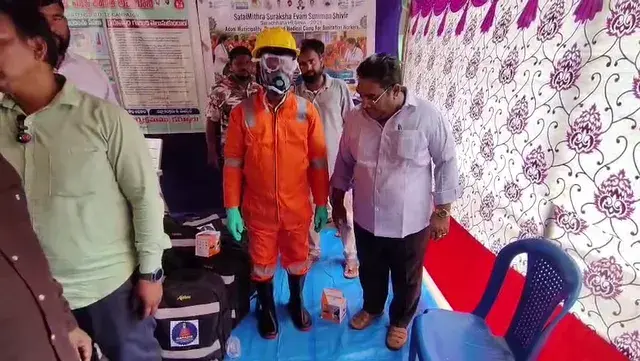
Medical camp screens sanitation staff in Adoni municipality
A medical camp was held at the Adoni municipal office on Wednesday, where sanitation staff underwent health examinations. Kits were distributed to the workers after the check-ups. The municipal commissioner said full-body medical examinations were conducted for staff working in the drainage and septic tank sections. He said the camp was organised keeping the health of the sanitation workers in view.
Source
Adoni — స్థానికం · read the original report ↗
Desk check · compared with the source
What the desk checked (4)
- A medical camp was held at the Adoni municipal office on Wednesday where sanitation staff underwent health check-ups and received kits. — Stated as fact in the source; event details appear in the source text.
- Full-body medical examinations were conducted for staff working in drainage and septic tank sections. — Attributed to the municipal commissioner in the source.
- The camp was organised keeping staff health in view. — Attributed to the municipal commissioner; no further documentation cited.
- Number of sanitation workers screened. — No figure given in the source; do not add one.
Analysts’ view opinion
Adoni municipality's medical camp is, in policy terms, a small but correctly aimed act: it treats the health of sanitation workers as a duty of the local body rather than a private risk. Singling out drainage and septic tank staff suggests the targeting logic was sound, since these are the highest-exposure roles. The real test is whether this moves beyond a one-day camp and kit distribution into a standing system.
- Occupational health risks in sanitation work are chronic and cumulative, so periodic, scheduled screening delivers far more than a single round of check-ups.
- The story describes "full body" examinations but not what follows — treatment, referral or follow-up — and that post-screening link is usually the weakest part of such schemes.
- Handing out kits gestures towards protective equipment, but the contents and how their actual use will be monitored are not specified.
- Initiative at the municipal commissioner's level helps implementation, though programmes resting on one officer's interest risk lapsing when postings change.
- Whether contract and outsourced workers were covered alongside regular staff is not stated, and that coverage gap is often what blunts the impact of such measures.
What to watch — Watch whether this becomes a repeat, documented municipal practice — worker health records, fixed intervals, linked treatment — or remains a one-off event.
The story does not establish how many workers were examined, what conditions were found, whether it sits under any government scheme, or if it will be repeated.
Deep dive
Research brief · 7 facts · 2 dates · exam-readyThe brief
Context
Sanitation workers in urban local bodies handle drainage lines and septic tanks, work that exposes them to toxic gases, sewage pathogens and injury. To address this, the Adoni municipality in Andhra Pradesh organised a medical camp at its municipal office on Wednesday, where sanitation staff were given health examinations and kits. The municipal commissioner said full-body medical tests were conducted specifically for staff deployed in the drainage and septic tank sections, and that the camp was arranged with the workers' health in mind.
Key facts
- A medical camp for sanitation staff was held at the Adoni municipal office on Wednesday (report dated Sep 30, 2026).
- Health examinations were conducted for sanitation (parisudhya) staff at the camp.
- Kits were distributed to the workers after the medical examinations.
- The municipal commissioner said full-body medical examinations were done for staff working in the drainage and septic tank sections.
- The commissioner said the camp was organised keeping the health of the sanitation staff in view.
- The number of workers screened, the tests performed and the contents of the kits are not stated in the source.
- Whether the camp will be repeated periodically is not stated in the source.
Timeline
- Wednesday (as reported)Medical camp held at Adoni municipal office; sanitation staff examined and kits handed over.
- Sep 30, 2026Report of the camp published, quoting the municipal commissioner on full-body examinations for drainage and septic tank staff.
Who has a stake
- Sanitation workers of Adoni municipality — Direct beneficiaries: health screening and kits for those exposed to drainage and septic tank work.
- Adoni municipal commissioner — Organised the camp and publicly accounted for full-body examinations of drainage and septic tank staff.
- Adoni municipality (urban local body) — Responsible for occupational health and safety of its sanitation workforce and for uninterrupted civic services.
- Medical team conducting the camp — Carried out the examinations; specific department or hospital not stated in the source.
- Families of sanitation workers — Early detection of illness in the primary earner reduces health and income risk.
Why it matters
Sanitation workers who enter drainage lines and septic tanks face some of the highest occupational health risks in urban India, yet routine screening for them is uneven. A municipal-level camp with full-body examinations and kits is a small but concrete step towards treating sanitation work as an occupational health issue rather than only a service-delivery one. It also sets a benchmark other urban local bodies can be measured against.
UPSC angle
Prelims pointers
- Adoni is a municipality in Kurnool district, Andhra Pradesh; the camp was held at its municipal office.
- The camp targeted staff of the drainage and septic tank sections with full-body medical examinations.
- Kits were distributed to sanitation workers after the check-ups.
- The initiative was announced by the municipal commissioner, the executive head of a municipality.
- Report date: Sep 30, 2026; camp held on Wednesday.
Mains framing
Sanitation work in Indian cities remains concentrated among a narrow set of workers who clean drains and septic tanks, exposing them to hydrogen sulphide and methane risk, waterborne infection, skin disease and musculoskeletal injury; the Adoni municipality's medical camp, where full-body examinations were conducted for drainage and septic tank staff and kits distributed, illustrates how urban local bodies can act at the point of employment. The causes of poor health outcomes in this workforce are structural: manual handling of waste, irregular protective equipment, contractual engagement that weakens entitlement to occupational health cover, and the absence of periodic mandatory screening. The implications are both individual (chronic illness, loss of earning capacity) and institutional (municipal liability, service disruption). A credible way forward, consistent with what the source reports, is to make such camps periodic rather than one-off, maintain health records for each worker, link findings to treatment and referral, and pair screening with protective equipment and mechanised cleaning so that the exposure itself is reduced. The source does not state whether Adoni plans any of these follow-up measures.
Key terms
- Sanitation staff (parisudhya sibbandi)
- Municipal workers engaged in cleaning streets, drains, sewers and septic tanks.
- Municipal commissioner
- The executive head of a municipality who administers civic services and staff welfare.
- Medical camp
- A short-duration, on-site health screening drive, here held at the Adoni municipal office.
- Full-body medical examination
- A comprehensive health check-up covering multiple systems, conducted here for drainage and septic tank workers.
- Septic tank section
- The municipal unit whose staff handle emptying and cleaning of septic tanks, a high-exposure task.
Practice questions
- Why do sanitation workers handling drains and septic tanks face disproportionate occupational health risks, and how can urban local bodies systematically address them?
- Evaluate the adequacy of one-off medical camps as a public health intervention for municipal sanitation workers. What institutional mechanisms would make such screening durable?
- Discuss the role of municipal commissioners and urban local bodies in ensuring occupational health and safety of their own workforce.
Grounded only in the source report — figures and dates are the source's, not inferred.