
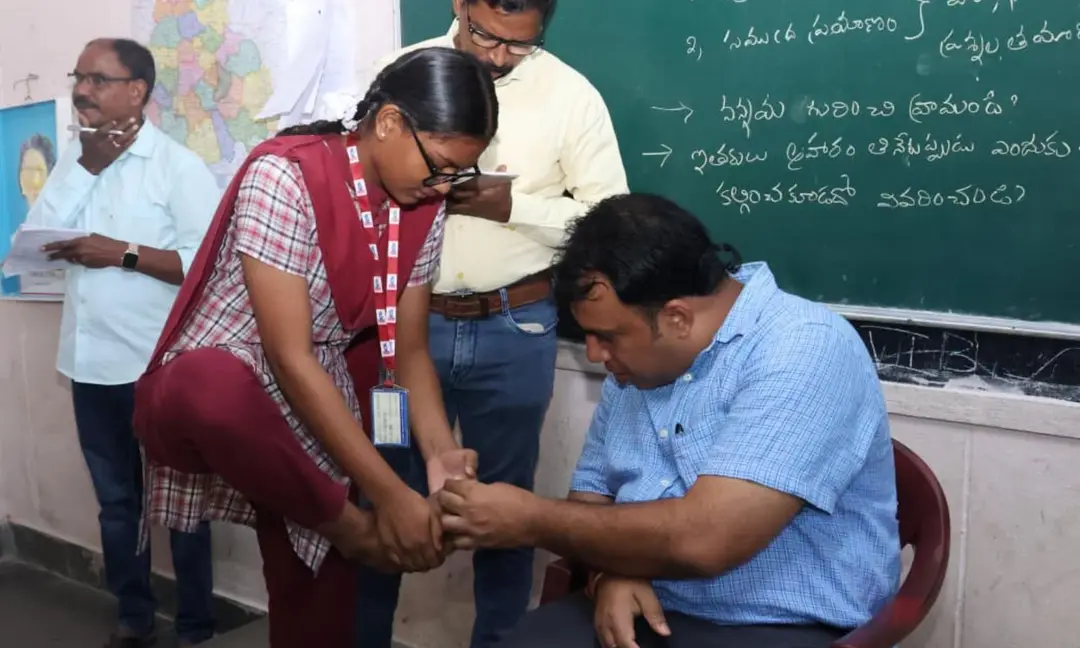
Collector inspects Palakurthi gurukul, finds no rat-bite marks
Jangaon District Collector Sandeep Kumar Jha, along with RDO Kiran Prakash, inspected the Telangana Social Welfare Gurukul School at Palakurthi mandal headquarters on Monday and sought details on reports that students were bitten by rats on the 22nd of this month. Students said they had no fever or bleeding and that food was good. The collector said no bite marks or scratches were found and urged people not to believe rumours. He expressed dissatisfaction with panchayat secretary Srinivas Reddy over sanitation.
Source
Jangaon — వార్తలు · read the original report ↗
Desk check · compared with the source
What the desk checked (5)
- Jangaon Collector Sandeep Kumar Jha inspected the Telangana Social Welfare Gurukul School at Palakurthi on Monday. — Attributed to the collector's visit as reported in the source; no independent confirmation possible.
- Information had emerged that students were bitten by rats on the 22nd of this month. — Reported in the source as 'information received'; no source of the original report named.
- Students told the collector they had no fever or bleeding, food was good and their health was fine. — Attributed to students during the collector's interaction; figure/detail appears in source.
- The collector said no rat-bite marks or scratches were found on students' hands and legs and asked people not to believe rumours. — Directly attributed to the collector; internally consistent with students' statements in the source.
- The collector expressed dissatisfaction with panchayat secretary Srinivas Reddy over sanitation and ordered cleanliness measures. — Attributed to the collector in the source; named official appears in source text.
Analysts’ view opinion
Allegations about conditions in residential welfare schools are politically sensitive terrain in Telangana, which is why a District Collector personally questioning students and publicly declaring there were "no marks of rat bites" and urging people not to believe rumours is more than routine inspection — it is an attempt to take control of the narrative before it grows. At the same time, by expressing displeasure with the panchayat secretary over sanitation, the Collector adopted a balanced line: denying the specific allegation while conceding ground-level lapses.
- Welfare hostels and gurukul schools are politically delicate for any government because their beneficiaries are largely students from socially disadvantaged communities.
- The "don't believe rumours" framing serves a dual purpose: calming parents and pre-empting attempts to turn the episode into a campaign talking point.
- The presence of the Collector, RDO, Tahsildar and MPDO signals that the district machinery treated a local complaint as a reputational risk worth senior attention.
- Locating accountability with the panchayat secretary shifts criticism towards field-level supervision rather than political leadership — a familiar administrative-political pattern.
- Even with an official finding of "no marks", parents or opposition voices in such cases often press for independent medical examination.
What to watch — Watch whether opposition leaders or student organisations visit the school and demand an independent inquiry, or whether the Collector's statement closes the matter locally.
The story records only the Collector's observations and the students' own responses; it does not establish whether any independent medical examination took place, who raised the original complaint, or whether any political party has taken up the issue.
Deep dive
Research brief · 8 facts · 3 dates · exam-readyThe brief
Context
Reports circulated that students at the Telangana Social Welfare Gurukul School in Palakurthi mandal headquarters, Jangaon district, had been bitten by rats on the 22nd of this month. Gurukul schools are state-run residential institutions where socially disadvantaged students study and stay, so hostel hygiene, food quality and student health come under official scrutiny whenever such reports appear. On Monday, Jangaon District Collector Sandeep Kumar Jha visited the school with RDO Kiran Prakash to verify the reports, speak to students directly and inspect the premises. The Collector concluded that no rat-bite marks were found and asked people not to believe rumours.
Key facts
- District Collector Sandeep Kumar Jha inspected the Telangana Social Welfare Gurukul School at Palakurthi mandal headquarters, Jangaon district, on Monday.
- The inspection followed information that students had been bitten by rats on the 22nd of this month.
- RDO Kiran Prakash accompanied the Collector during the inspection.
- Students told the Collector they had no fever, no bleeding, that the food was good and their health was fine.
- The Collector said after examining students that no rat-bite marks and no scratches were found on their hands or legs.
- The Collector inspected the dining hall, provisions store room, kitchen, toilets, urinals and students' beds.
- He expressed dissatisfaction with panchayat secretary Srinivas Reddy over sanitation and ordered removal of useless material and regular cleaning of the surroundings.
- He directed that quality, clean and nutritious food be served with fresh vegetables and no stored stock, and that outsiders not be allowed inside without permission.
Timeline
- 22nd of this monthInformation emerged that students of the Palakurthi social welfare gurukul school were bitten by rats.
- Monday (date not stated in the source)Collector Sandeep Kumar Jha and RDO Kiran Prakash inspected the school, questioned students and examined their hands and legs.
- During the same visitCollector found no bite marks, called for rumours to be disregarded, pulled up the panchayat secretary on sanitation and issued food-quality and security directions.
Who has a stake
- Students of the Palakurthi social welfare gurukul school — Their health, safety, food quality and hostel hygiene; they were questioned and physically examined during the inspection.
- Jangaon District Collector Sandeep Kumar Jha — Accountable for verifying the rat-bite reports, countering rumours and enforcing hostel standards.
- RDO Kiran Prakash, Tahsildar Saraswathi, MPDO Vedavathi — Revenue and mandal-level officials directed to supervise the schools regularly.
- Panchayat secretary Srinivas Reddy — Faced the Collector's dissatisfaction over sanitation in the school surroundings and was ordered to keep the area clean.
- School management (Vice Principal Varalakshmi, teachers) — Responsible for food quality, storage, bedding, toilets and restricting entry of outsiders.
- Parents and the local public — Assurance about children's safety in residential schools; urged not to believe rumours.
Why it matters
Residential welfare schools house children away from their families, so any report of rats, poor food or unhygienic toilets immediately raises questions about state accountability for student safety. The Collector's on-the-spot verification, questioning of students and orders on sanitation, fresh food and restricted entry show how district administration responds when such reports spread. It also highlights the thin line between genuine grievance redressal and official denial, since the only verification cited is a visual examination for bite marks.
UPSC angle
Prelims pointers
- Telangana Social Welfare Gurukul Schools are residential schools for socially disadvantaged students; the one inspected is at Palakurthi mandal headquarters, Jangaon district.
- District Collector is the top district administrative authority; Jangaon's Collector is Sandeep Kumar Jha.
- RDO (Revenue Divisional Officer) is the revenue official between district and mandal level; here, Kiran Prakash.
- MPDO (Mandal Parishad Development Officer) and Tahsildar were told to supervise schools regularly.
- Panchayat secretary is the village-level functionary responsible for local sanitation; here, Srinivas Reddy.
Mains framing
Incidents like the alleged rat bites at the Palakurthi social welfare gurukul school point to structural weaknesses in India's residential welfare schooling: crowded hostels, weak sanitation around premises, storage of provisions, and limited day-to-day supervision by mandal-level officials. The administrative response here combined verification and denial — the Collector personally questioned students about fever, bleeding and pain, examined their hands and legs, found no bite marks or scratches, and appealed against rumours — while simultaneously conceding gaps by expressing dissatisfaction with the panchayat secretary over sanitation and ordering removal of unusable material, fresh vegetables instead of stored stock, and restrictions on outsiders entering the school. The lesson is that credibility rests on institutionalised systems rather than one-off visits: regular monitoring by the MPDO and Tahsildar as directed, documented medical examination of affected students, pest control and sanitation schedules, transparent grievance channels for students and parents, and accountability of both school management and local bodies. Treating such reports as rumours without a documented health check risks eroding parental trust in welfare residential education.
Key terms
- Gurukul (social welfare residential school)
- State-run residential school providing free education, food and lodging to students from socially disadvantaged sections.
- District Collector
- Senior-most administrative officer of a district, responsible for revenue, welfare schemes and supervision of government institutions.
- RDO
- Revenue Divisional Officer, the officer in charge of a revenue division, between district and mandal administration.
- MPDO
- Mandal Parishad Development Officer, the official who oversees development and administration at mandal level.
- Tahsildar
- Mandal-level revenue officer handling land records, revenue collection and local administrative duties.
- Panchayat secretary
- Village-level government functionary responsible for gram panchayat administration, including local sanitation work.
Practice questions
- Residential welfare schools promise access but often struggle with basic living conditions. Examine the administrative safeguards needed to ensure health and hygiene in such institutions, using the Palakurthi gurukul case.
- Discuss the role of the District Collector and mandal-level officials such as the MPDO, Tahsildar and panchayat secretary in monitoring welfare residential schools.
- When allegations of poor conditions in a government school surface, should the administration rely on on-the-spot visual inspection or on documented medical and independent verification? Critically comment.
Grounded only in the source report — figures and dates are the source's, not inferred.