
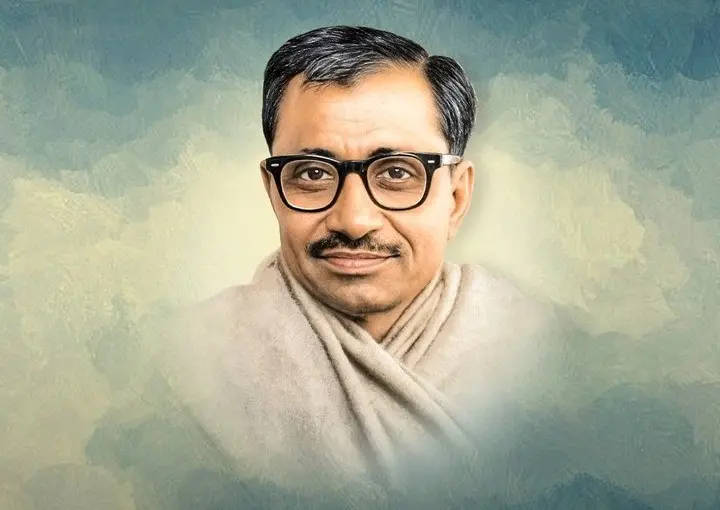
BJP leaders pay tribute to Deendayal Upadhyaya on birth anniversary
BJP leaders on Friday paid tribute to Pandit Deendayal Upadhyaya on his birth anniversary. Union Minister of State and Delhi BJP chief Harsh Malhotra said Upadhyaya was General Secretary of the Bharatiya Jana Sangh from 1951 to 1968 and later its president, and gave the philosophy of Integral Humanism. MP Manoj Tiwari, Delhi Minister Ashish Sood, MP Bansuri Swaraj and Jharkhand Opposition Leader Babulal Marandi recalled the principle of Antyodaya.
Source
BJP (official) · read the original report ↗
Desk check · compared with the source
What the desk checked (5)
- Deendayal Upadhyaya served as General Secretary of the Bharatiya Jana Sangh from 1951 to 1968 and later became its president. — Attributed in the source to Union Minister of State and Delhi BJP President Harsh Malhotra; dates appear as quoted, not independently checked.
- September 25 is Deendayal Upadhyaya's birth anniversary and he was born in the Braj region. — Attributed to BJP MP Manoj Tiwari in a direct quote.
- Antyodaya has become the foundation of PM Narendra Modi's development policies and diplomacy. — Opinion attributed to BJP MP Bansuri Swaraj; evaluative claim, not a verifiable fact.
- Welfare schemes cited include household toilets, PM Awas Yojana, gas connections, Ayushman scheme and free foodgrains under Antyodaya. — Listed in the source as referred to by Babulal Marandi; no figures or data given.
- PM Modi has spoken about collective consciousness since the Covid period. — Attributed to Delhi Minister Ashish Sood; no source or instance cited.
Analysts’ view opinion
Deendayal Upadhyaya's birth anniversary is never just commemoration for the BJP — it is a disciplined political exercise in linking the party's ideological lineage to its current governance record. That leaders from the Delhi unit chief to Jharkhand's Leader of Opposition all spoke within the same frame — Integral Humanism and Antyodaya — points to centralised message discipline. The most telling move is the mapping of Antyodaya onto the Modi government's welfare schemes, which lets the party frame beneficiary politics as ideological continuity rather than mere distribution.
- Anniversary events like this are a low-cost, high-return tool for mobilising cadre and refreshing the party's ideological identity between electoral cycles.
- Tying Antyodaya to toilets, PM Awas Yojana, gas connections, Ayushman and free foodgrains recasts welfare delivery as the fulfilment of a founding philosophy.
- The prominence of the Delhi BJP president, a Delhi minister and Delhi MPs underlines the value the party places on fusing ideology with governance in a capital it now runs.
- Babulal Marandi invoking the same national frame from the opposition benches in Jharkhand shows state setbacks do not loosen adherence to the central leadership's narrative.
- Rivals may read this as scheme publicity dressed as philosophy, though building a narrative around an ideological founder is standard practice across parties.
What to watch — Watch how far the BJP carries the language of Antyodaya into upcoming campaigns as a way of consolidating poor and beneficiary voters.
The story records tribute statements only; it establishes no new policy announcement, no assessment of scheme outcomes and no opposition response to these claims.
Deep dive
Research brief · 8 facts · 4 dates · exam-readyThe brief
Context
Pandit Deendayal Upadhyaya, a key ideologue of the Bharatiya Jana Sangh (the BJP's precursor), is credited with the philosophy of Integral Humanism ("Ekatma Manav Darshan") and the principle of Antyodaya — the uplift of the last person in the queue. On his birth anniversary, observed on September 25, BJP leaders across the Union government, Delhi and Jharkhand paid tribute and linked his ideas to the party's current ideology and to the Modi government's welfare and foreign policy. The occasion is annually used by the BJP to restate its ideological lineage.
Key facts
- Union Minister of State and Delhi BJP President Harsh Malhotra said Upadhyaya was General Secretary of the Bharatiya Jana Sangh from 1951 to 1968 and later became its president.
- Malhotra said Upadhyaya gave the philosophy of Integral Humanism, called 'Ekatma Manav Darshan', which is today the core ideology of the BJP.
- BJP MP Manoj Tiwari said September 25 is the birth anniversary of Deendayal Upadhyaya and an important day for the party.
- Tiwari said Upadhyaya was born in the Braj region, comparing his global reach to that of Lord Krishna of Braj.
- Delhi Minister Ashish Sood cited Upadhyaya's concepts of 'Chiti' (the nation's collective consciousness) and 'Virat' (the awakened form of the nation).
- BJP MP Bansuri Swaraj said Antyodaya means the benefits of development must reach the last person standing in the queue, and called it the foundation of PM Modi's development policies and diplomacy.
- Jharkhand Leader of Opposition Babulal Marandi listed household toilets, PM Awas Yojana, gas connections, the Ayushman scheme and free foodgrains under the Antyodaya scheme as realising Upadhyaya's vision.
- Marandi invoked 'Vasudhaiva Kutumbakam' as the principle given by ancestors, alongside Upadhyaya's Antyodaya-based vision of welfare of the poor.
Timeline
- 1951 to 1968Deendayal Upadhyaya served as General Secretary of the Bharatiya Jana Sangh, as stated by Harsh Malhotra.
- After 1968 (as described)Upadhyaya also became president of the Bharatiya Jana Sangh, per Malhotra.
- Covid period onwardsAshish Sood said PM Narendra Modi has spoken about the importance of collective consciousness since the Covid period and continues to do so.
- September 25 (Friday)BJP leaders paid tribute to Upadhyaya on his birth anniversary, recalling Integral Humanism and Antyodaya.
Who has a stake
- Bharatiya Janata Party — Claims Upadhyaya's Integral Humanism as its core ideology and uses the anniversary to reaffirm ideological continuity from the Bharatiya Jana Sangh.
- Harsh Malhotra, Union Minister of State and Delhi BJP President — Framed Upadhyaya as the leader who gave ideological direction to both the Jana Sangh and the BJP.
- Manoj Tiwari and Bansuri Swaraj, BJP MPs — Projected Upadhyaya's thought as globally studied and as the basis of Modi government's development policy and diplomacy.
- Ashish Sood, Delhi Minister — Linked Upadhyaya's 'Chiti' and 'Virat' to PM Modi's emphasis on collective consciousness since Covid.
- Babulal Marandi, Leader of Opposition, Jharkhand Assembly — Cited welfare schemes as proof that Upadhyaya's vision of a strong India and welfare of the poor is being realised.
- Poor and last-mile beneficiaries — Antyodaya is invoked as the principle that development benefits must reach the last person in the queue, via schemes like PM Awas Yojana and Ayushman.
Why it matters
Ideological anniversaries are how ruling parties translate philosophy into political messaging: here Integral Humanism and Antyodaya are presented as the intellectual source of current welfare schemes and even of India's diplomacy. For readers, it clarifies the lineage from the Bharatiya Jana Sangh to the BJP and the vocabulary — Ekatma Manav Darshan, Chiti, Virat, Antyodaya — that shapes official rhetoric on last-mile delivery.
UPSC angle
Prelims pointers
- Deendayal Upadhyaya's birth anniversary is observed on September 25.
- He was General Secretary of the Bharatiya Jana Sangh from 1951 to 1968 and later its president.
- Integral Humanism is called 'Ekatma Manav Darshan' and is described as the BJP's core ideology.
- Antyodaya: benefits of development should reach the last person standing in the queue.
- 'Chiti' denotes the nation's collective consciousness; its awakening gives the 'Virat' form of the nation.
- Schemes named in the story: PM Awas Yojana, Ayushman scheme, household toilets, gas connections, free foodgrains under the Antyodaya scheme.
Mains framing
The tributes to Deendayal Upadhyaya illustrate how ideological texts are mobilised as governance frameworks. Integral Humanism ('Ekatma Manav Darshan'), with its concepts of Chiti and Virat, offers a non-individualist, community-centred account of the nation, while Antyodaya supplies a distributive test — whether the last person in the queue receives the benefits of development. BJP leaders in the story map this onto concrete delivery programmes named by Babulal Marandi (household toilets, PM Awas Yojana, gas connections, Ayushman, free foodgrains under the Antyodaya scheme) and, per Bansuri Swaraj, onto the Modi government's diplomacy; Ashish Sood extends the collective-consciousness idea to the Covid period. Analytically, the implication is that political ideology increasingly supplies the evaluative language for welfare policy, which invites scrutiny of whether last-mile outcomes match the Antyodaya claim. A grounded way forward, on the story's own terms, is to judge such invocations by measurable saturation of benefits among the poorest rather than by rhetorical continuity alone; the source does not discuss any specific outcome data or criticism.
Key terms
- Integral Humanism (Ekatma Manav Darshan)
- Philosophy given by Deendayal Upadhyaya, described by BJP leaders as the party's core ideology.
- Antyodaya
- Principle that the benefits of development must reach the last person standing in the queue.
- Bharatiya Jana Sangh
- The party in which Upadhyaya was General Secretary (1951-1968) and later president; ideological precursor to the BJP as described in the story.
- Chiti and Virat
- In Integral Humanism, Chiti is the nation's collective consciousness and Virat the powerful form arising from its awakening.
- Vasudhaiva Kutumbakam
- The idea, cited by Babulal Marandi as given by ancestors, that the world is one family.
- PM Awas Yojana / Ayushman scheme
- Government housing and health initiatives cited by Marandi as reflecting Upadhyaya's pro-poor vision.
Practice questions
- Explain the concepts of 'Chiti' and 'Virat' in Deendayal Upadhyaya's Integral Humanism and assess how far they inform contemporary welfare discourse in India.
- "Antyodaya is a test of last-mile delivery rather than a slogan." Discuss with reference to schemes cited in public debate.
- Trace the ideological continuity from the Bharatiya Jana Sangh to the Bharatiya Janata Party, with reference to the role attributed to Deendayal Upadhyaya.
Grounded only in the source report — figures and dates are the source's, not inferred.