
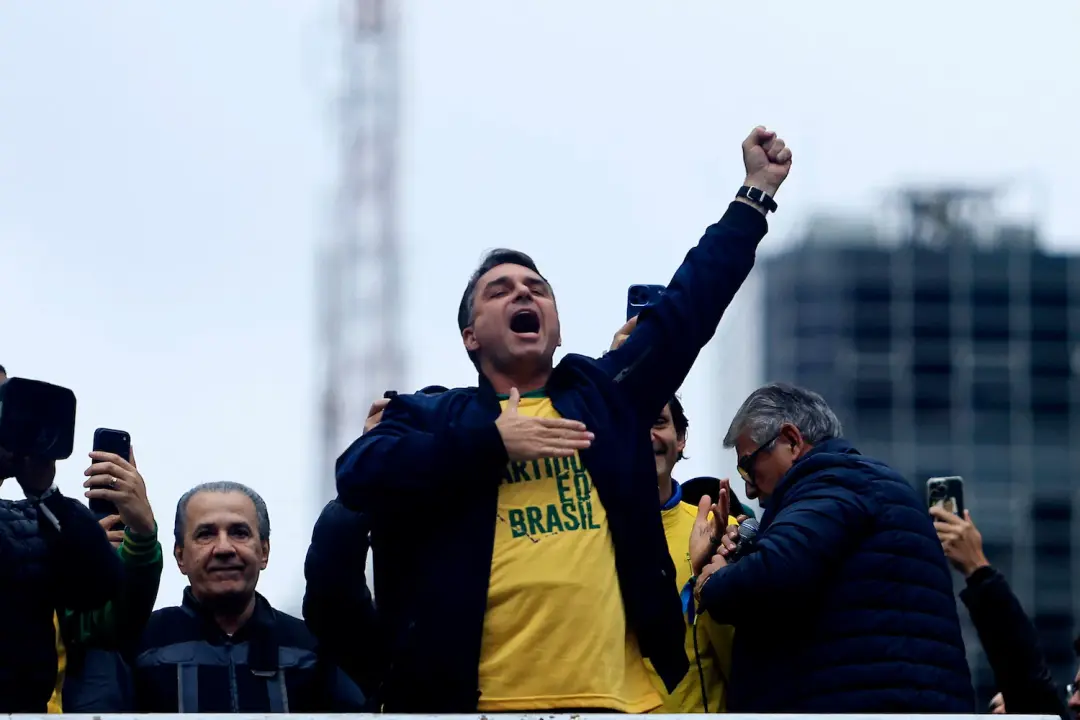
Bolsonaro pledges US tilt in Brazil's foreign policy ahead of vote
Right-wing candidate Flávio Bolsonaro is neck and neck with President Luiz Inácio Lula da Silva in the latest polls before Brazil's presidential election next month. Bolsonaro says he would join Trump's Shield of the Americas anti-gang initiative, immediately seek a free trade deal with Washington and pursue rare earths partnerships. But China remains Brazil's top trade partner, and experts expect him to align with Trump on security while preserving economic ties with Beijing.
Source
Foreign Policy · read the original report ↗
Desk check · compared with the source
What the desk checked (5)
- Flávio Bolsonaro and Lula are neck and neck in the most recent polls ahead of next month's Brazilian election. — Stated in source without naming the pollster; treat as reported polling summary.
- Trump raised tariffs on many Brazilian goods to 50 percent last year, citing Jair Bolsonaro's trial as a 'witch hunt'. — Figure and quote appear in source; attributed to Trump.
- Flávio Bolsonaro has pledged to join Trump's Shield of the Americas, seek a free trade deal with Washington and explore rare earths partnerships. — Attributed in source to Bolsonaro's own statements and campaign documents.
- A Bolsonaro government would likely align with Trump on security while keeping economic links with China. — Attributed to named analysts Creomar de Souza and Fernanda Magnotta; forecast, not verified fact.
- In a July communiqué to the US Trade Representative, Bolsonaro endorsed blocking PIX from non-Western cross-border settlement arrangements. — Source cites a specific document; contents not independently verifiable here.
Analysts’ view opinion
Brazil's election is no longer just a domestic contest — it is a strategic question about which way a major middle power leans in the US-China competition in Latin America. Flávio Bolsonaro's pledges — joining Trump's Shield of the Americas, seeking an immediate free trade deal with Washington, and a rare-earths partnership — signal a clear security tilt towards the West. But as long as China remains Brazil's top trade partner, any full reorientation runs into economic reality; experts quoted in the story expect a dual-track outcome: Washington on security, Beijing on commerce.
- Under Jair Bolsonaro, anti-China rhetoric faded once in office — Huawei was not fully excluded from 5G and Brazil stayed active in BRICS, suggesting structural constraints outweigh campaign rhetoric.
- The most consequential shift could be in intelligence cooperation: Bolsonaro backed Trump's designation of two Brazilian crime groups as terrorist organisations, which Lula opposed, and the story notes this opens the door to sanctions and even military action.
- The real strategic friction lies in currency and tech sovereignty — walling PIX off from non-Western settlement systems and halting de-dollarisation would reduce Brazil's insulation from external economic pressure.
- This is a doctrinal divide: Lula bets on multilateralism to preserve middle-power manoeuvring room, while Bolsonaro assumes middle powers get pulled into one great power's orbit — closer to what analysts call 'peripheral realism'.
- Notably, the electoral mandate for such a shift looks thin — voters rank security and the economy first, and surveys cited indicate Brazilian opinion of the United States has worsened under the second Trump administration.
What to watch — Watch the foreign minister pick — that choice will signal whether this is the moderate path that keeps Brazil inside Mercosur and BRICS, or the more radical line associated with Eduardo Bolsonaro.
The election outcome is undecided and the story does not establish how far campaign pledges would survive contact with governing; the expert views cited are assessments, not settled policy.
Deep dive
Research brief · 8 facts · 9 dates · exam-readyThe brief
Context
Brazil holds a presidential election next month in which right-wing candidate Flávio Bolsonaro is running neck and neck with incumbent President Luiz Inácio Lula da Silva. Flávio is the son of former president Jair Bolsonaro (2019-2022), who was convicted of plotting to overturn Lula's 2022 election win, a trial US President Donald Trump called a "witch hunt" while raising tariffs on many Brazilian goods to 50 percent. Lula's foreign policy has hedged between the United States and China while pushing multilateralism, de-dollarisation and technological diversification. Flávio Bolsonaro promises a sharp tilt towards Washington, though China remains Brazil's top trade partner, limiting how far he could go.
Key facts
- Flávio Bolsonaro and Lula are neck and neck in the most recent polls ahead of next month's Brazilian presidential election.
- Trump hiked US tariffs on many Brazilian goods to 50 percent last year, citing the trial of Jair Bolsonaro as justification.
- Bolsonaro pledges to join Trump's Shield of the Americas militarised anti-gang initiative, immediately seek a US free trade deal, and build rare earths partnerships.
- In May, Trump labelled two Brazilian crime groups as terrorist organisations; Bolsonaro endorsed the move, Lula opposed it.
- In a July communiqué to the Office of the US Trade Representative, Bolsonaro backed blocking Brazil's PIX instant payment system from 'non-Western cross-border settlement arrangements'.
- China's UnionPay International had been planning to link with PIX so Chinese visitors could pay via PIX QR codes.
- Under Lula, Brazil plans to issue yuan-denominated sovereign bonds this year and to buy one Chinese and one American supercomputer.
- Jair Bolsonaro's 2019-2022 government grew trade with China, refused full exclusion of Huawei from 5G, and stayed active in BRICS.
Timeline
- 2018Jair Bolsonaro, emulating Trump's style, wins the Brazilian presidency after visiting Taiwan and accusing China of 'buying Brazil'.
- 2019-2022Jair Bolsonaro's administration expands trade with China, keeps Huawei in 5G despite US pressure, stays active in BRICS.
- 2022Lula wins the presidential election; Jair Bolsonaro is later convicted of plotting to overturn the result.
- Last yearTrump raises US tariffs on many Brazilian goods to 50 percent, citing the 'witch hunt' trial of Jair Bolsonaro.
- MayTrump designates two Brazilian crime groups as terrorist organisations; Bolsonaro endorses it, Lula objects.
- JulyBolsonaro's communiqué to the USTR backs walling PIX off from non-Western settlement systems and criticises de-dollarisation.
- AugustBolsonaro holds kickoff rally in Copacabana; in a TV interview he casts doubt on human responsibility for climate change; Minister Esther Dweck cites tech-diversification gains to Folha de S. Paulo.
- September 13An O Globo columnist reports Eduardo Bolsonaro has said privately he will run the foreign ministry if his brother wins.
- Next monthBrazil's presidential election.
Who has a stake
- Flávio Bolsonaro — Right-wing candidate promising a pro-US tilt: Shield of the Americas, a free trade deal, rare earths ties; has not named a foreign minister.
- President Lula da Silva — Seeking reelection on a platform of hedging between powers, multilateralism, de-dollarisation and tech autonomy.
- Donald Trump / United States — Wants Latin American allies to spurn China and keep 'non-Hemispheric competitors' from strategically vital assets; holds 50 percent tariff leverage.
- China — Brazil's top trade partner; faces possible investment screening, PIX exclusion and slower currency-settlement cooperation under Bolsonaro.
- Eduardo Bolsonaro — Brother who has strategised with Steve Bannon, bashed the UN and climate action; reportedly eyes the foreign ministry.
- Brazilian voters — Rank security and economy above foreign policy; opinion of the US has worsened under the second Trump administration.
- Brazilian tech and business community — Diversification of cloud, AI, satellite and chip partners could shrink; no consensus on non-dollar transactions.
Why it matters
Brazil is Latin America's largest economy and a BRICS co-founder, so its choice between hedging and hemispheric alignment will shape how middle powers navigate US-China rivalry. A Bolsonaro win could mean US intelligence support for security operations, curbs on Chinese access to payment and tech infrastructure, and a retreat from de-dollarisation and climate multilateralism. Yet China's position as Brazil's top trade partner sets hard limits on any full reorientation.
UPSC angle
Prelims pointers
- Shield of the Americas: Trump's militarised anti-gang initiative that Flávio Bolsonaro pledges Brazil will join.
- PIX: Brazil's instant payment system; UnionPay International planned to link with it for Chinese visitors.
- BRICS was co-founded by Brazil with Beijing; Brazil also belongs to the Mercosur trade bloc.
- Trump raised tariffs on many Brazilian goods to 50 percent last year, citing Jair Bolsonaro's trial.
- Brazil plans yuan-denominated sovereign bonds this year as part of de-dollarisation under Lula.
- 'Peripheral realism': 1990s Argentine concept that weak states gain by not building positions independent of great powers.
Mains framing
Brazil's election poses a classic middle-power dilemma: whether to hedge between great powers or accept alignment. Lula's approach bets on multilateral solutions plus deliberate autonomy-building — diversifying cloud, AI, satellite and supercomputer suppliers, working with Spain and India on open-source chips, settling trade with China in national currencies and planning yuan bonds — to widen Brazil's margin for manoeuvre. Flávio Bolsonaro's premise, in analyst Creomar de Souza's words, is that middle powers will be "engulfed by the gravitational pull" of Washington or Beijing and Brazil belongs to the Western Hemisphere, a view resembling 1990s Argentine "peripheral realism". The likely outcome, experts say, is convergence with the US on security (terrorist designations of crime groups, possible US intelligence support for operations as seen in Mexico and Ecuador) and on sensitive tech and payments (PIX exclusion, investment screening), while economic ties with China — Brazil's top trade partner — endure with "less strategic density". Constraints cut both ways: Jair Bolsonaro's own anti-China rhetoric faded in office, business consensus on non-dollar settlement is absent, and voters prioritise security and the economy even as their view of the US has worsened. A balanced path would preserve supplier diversification so that no single partner can interrupt critical state capacities, while using tariff relief negotiations without conceding regulatory sovereignty.
Key terms
- Shield of the Americas
- Trump's militarised anti-gang initiative in the Americas that Bolsonaro says Brazil would join.
- PIX
- Brazil's instant payment system; Bolsonaro backs barring it from non-Western cross-border settlement arrangements.
- De-dollarisation
- Settling trade in national currencies instead of the dollar; Brazil-China deals and planned yuan bonds are examples.
- BRICS
- Geopolitical grouping Brazil co-founded with Beijing; Brazil stayed active in it even under Jair Bolsonaro.
- Peripheral realism
- 1990s Argentine idea that weaker states fare better by not taking positions independent of great powers.
- Mercosur
- South American trade bloc; a moderate Bolsonaro foreign policy would keep Brazil in it.
Practice questions
- How does Brazil's election debate illustrate the strategic choices facing middle powers amid US-China rivalry? Discuss with reference to trade, payments and technology.
- Examine how domestic politics and personal networks shape foreign policy continuity, using the Bolsonaro camp's ties with the Trump administration as a case study.
- 'Diversification of technology partners is a form of strategic autonomy.' Critically evaluate in light of Brazil's cloud, satellite and semiconductor choices.
Grounded only in the source report — figures and dates are the source's, not inferred.