
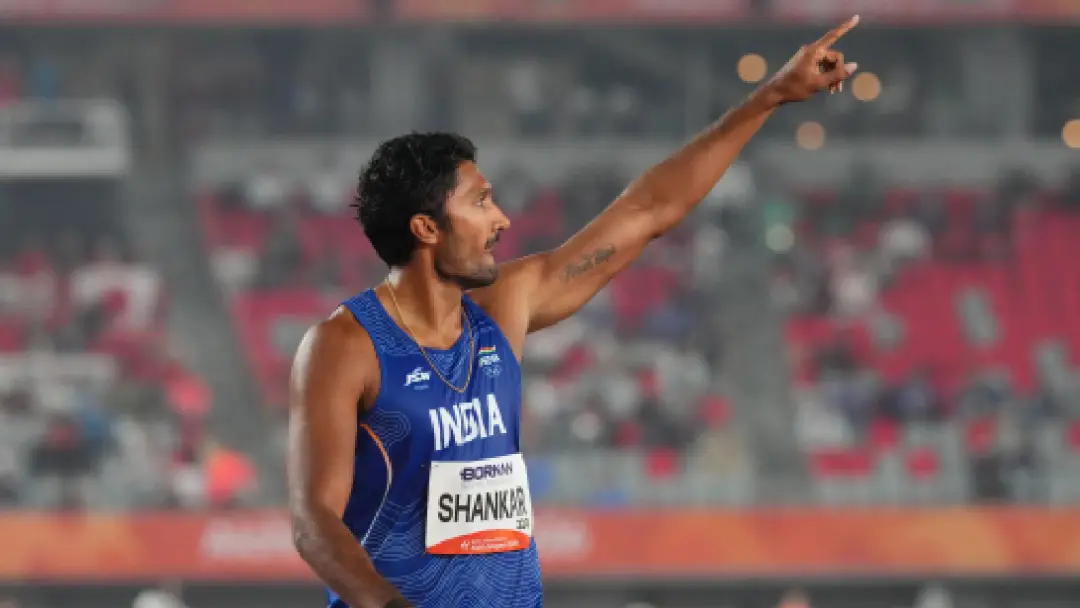
Asian Games: Tejaswin Shankar takes bronze in men's decathlon
India's Tejaswin Shankar won bronze in the men's decathlon at the Asian Games in Nagoya, Japan, finishing with 7934 points. He won the concluding 1500m in 4:33.09 but stayed third overall. Yuma Maruyama of Japan took gold with 8123 points and Chen Xinghua of China silver with 8012. Shankar had won silver with 7666 points at the last edition, and this season also claimed Commonwealth Games silver and a national record of 8057 points.
Source
Indian Express — Sports · read the original report ↗
Desk check · compared with the source
What the desk checked (5)
- Tejaswin Shankar won bronze in the men's decathlon at the Asian Games in Nagoya with 7934 points. — Figure appears in source; no official results body cited.
- Yuma Maruyama of Japan won gold with 8123 points and Chen Xinghua of China took silver with 8012 points. — Points and names appear in source; internally consistent with Shankar's third place.
- He won the decathlon 1500m in 4:33.09. — Timing stated in source, unattributed.
- He won silver at the previous Asian Games with 7666 points, when Sun Qihao of China took gold with 7816 points. — Figures appear in source; no external verification possible.
- He earlier won Commonwealth Games silver and set a national record of 8057 points, the first Indian past 8000. — Claim of first-ever Indian to cross 8000 points is stated in source without attribution.
Analysts’ view opinion
Tejaswin Shankar's medal changed colour, but this is not a step backwards. He won silver at the last Asian Games with 7666 points; here he scored 7934 and finished third — his output went up, but the field rose faster. With both gold and silver clearing the 8000-point mark, this result is really a statement about how hard Asian decathlon has become.
- Last edition 7816 points won gold; this time it took 8123 — a clear jump in the standard of the event.
- Despite a weak opening 100m of 10.98s for 865 points, his 2.18m high jump (973 points) carried him to the top of the leaderboard after day one.
- Leaning on the high jump is natural given it is his core strength, but the 36.77m discus was the kind of weak mark that costs a decathlete on day two.
- A personal best of 53.37m in the javelin is a genuine positive — progress in the throws is where his ceiling lies.
- Commonwealth silver, a national record of 8057 points and now an Asian Games bronze in one season points to real consistency in an event that punishes the body.
What to watch — Watch whether he can reproduce his 8057-point level at major championships and, specifically, whether he can stop leaking points in the discus and the sprints.
The story does not establish why his 100m and discus fell short of expectation — injury, conditions or tactics — nor does it say anything about what he competes in next.
Deep dive
Research brief · 8 facts · 6 dates · exam-readyThe brief
Context
Tejaswin Shankar, India's leading decathlete, competed in the men's decathlon at the Asian Games in Nagoya, Japan. The decathlon is a ten-event athletics contest spread over two days, with performances converted into points. Shankar had won silver at the previous Asian Games edition and had earlier in the 2026 season taken Commonwealth Games silver and set a national record. In Nagoya he finished third despite winning the concluding 1500m race.
Key facts
- Tejaswin Shankar won bronze in the men's decathlon at the Asian Games in Nagoya, Japan, with 7934 points.
- He won the concluding 1500m in 4:33.09 but could not move above third place overall.
- Yuma Maruyama of Japan took gold with 8123 points; Chen Xinghua of China took silver with 8012 points.
- At the previous Asian Games edition Shankar won silver with 7666 points, when gold went to Sun Qihao of China with 7816 points.
- Earlier in the season Shankar won Commonwealth Games silver and became the first Indian to break 8000 points, with a national record of 8057.
- Day one in Nagoya: 10.98s in the 100m (865 points), 7.53m long jump (942 points, topping the event), 13.16m shot put (677 points), 2.18m high jump (973 points), 881 points in the 400m.
- His long jump of 7.53m was behind his personal best of 7.82m set at the Commonwealth Games 2026.
- On day two he set a personal best in the javelin with 53.37m but threw only 36.77m in the discus.
Timeline
- Previous Asian Games edition (year not stated in the source)Tejaswin Shankar wins decathlon silver with 7666 points; Sun Qihao of China takes gold with 7816 points.
- 2026 season, Commonwealth GamesShankar wins silver and records a long jump personal best of 7.82m.
- 2026 seasonShankar becomes the first Indian to cross 8000 decathlon points with a national record of 8057.
- Asian Games, day oneShankar runs 10.98s in the 100m, tops the long jump, and ends the day leading the standings.
- Asian Games, day twoPersonal best javelin throw of 53.37m but a poor discus throw of 36.77m.
- Sunday, September 27, 2026Shankar wins the decathlon 1500m in 4:33.09 in Nagoya and finishes with bronze on 7934 points.
Who has a stake
- Tejaswin Shankar — Second Asian Games medal of his career and a second major medal of the season, though he could not upgrade his earlier silver.
- Yuma Maruyama (Japan) — Won decathlon gold with 8123 points on home soil in Nagoya.
- Chen Xinghua (China) — Took silver with 8012 points as China retained a podium place in the event.
- Indian athletics — Gains a rare combined-events medal and its first 8000-point decathlete, expanding India's presence beyond traditional strength events.
- Sun Qihao (China) — Former Asian Games decathlon champion whose winning mark of 7816 points was well below the scores in this edition.
Why it matters
The decathlon is one of athletics' most demanding all-round tests and India has rarely featured on Asian podiums in combined events, so Shankar's second successive Asian Games medal marks continuity rather than a one-off. His 8057-point national record shows Indian athletes closing in on continental standards, even as this edition's rising winning scores (8123 vs 7816 last time) show competition tightening across Asia.
UPSC angle
Prelims pointers
- Decathlon: ten track and field events over two days, scored on a points table; Shankar's Asian Games bronze came with 7934 points.
- Asian Games decathlon gold in Nagoya: Yuma Maruyama (Japan), 8123 points; silver: Chen Xinghua (China), 8012 points.
- Tejaswin Shankar is the first Indian to cross the 8000-point mark in the decathlon, with a national record of 8057.
- Shankar's previous Asian Games decathlon medal was silver with 7666 points; that gold went to Sun Qihao of China (7816).
- In Nagoya, Shankar won the closing 1500m in 4:33.09 and topped the long jump with 7.53m.
- He also won silver at the Commonwealth Games in the same season, where he set a long jump personal best of 7.82m.
Mains framing
Tejaswin Shankar's decathlon bronze in Nagoya illustrates both progress and the limits of India's combined-events depth. He led after day one on the strength of his high jump (2.18m, 973 points) and long jump (7.53m, 942 points), but a below-par 100m (10.98s) and a weak discus throw (36.77m) cost him the points margin, which even a 1500m win in 4:33.09 could not recover; his final 7934 was below his own national record of 8057. The structural point is that the decathlon rewards consistency across ten disciplines, so an athlete transitioning from a specialist background carries strengths in a few events and deficits in throws. Regionally, the bar has risen sharply: the winning score moved from 7816 points at the last edition to 8123 in Nagoya, meaning Indian athletes must improve absolutely, not relatively. The way forward suggested by the season's own evidence is sustained multi-event coaching support that converts occasional personal bests, such as the 53.37m javelin, into reliable scoring across all ten events, so that Shankar's Commonwealth Games silver and 8000-point breakthrough become a base rather than a peak.
Key terms
- Decathlon
- A ten-event men's athletics competition held over two days, with each performance converted into points and the totals ranked.
- Asian Games
- Continental multi-sport event; this edition was held in Nagoya, Japan, where the decathlon concluded on September 27, 2026.
- Commonwealth Games
- Multi-sport event of Commonwealth nations; Shankar won decathlon silver there in the same season.
- National record
- Best mark by an athlete of that country; Shankar's decathlon national record stands at 8057 points.
- Personal best (PB)
- An athlete's own best performance; Shankar set a javelin PB of 53.37m and has a long jump PB of 7.82m.
Practice questions
- Tejaswin Shankar's Asian Games decathlon bronze came with what point total, and who won gold and silver?
- Discuss how the decathlon's scoring structure explains why winning the 1500m did not change Shankar's final position in Nagoya.
- India's rise in combined events: assess the significance of an Indian athlete first crossing the 8000-point decathlon mark against rising Asian standards.
Grounded only in the source report — figures and dates are the source's, not inferred.