
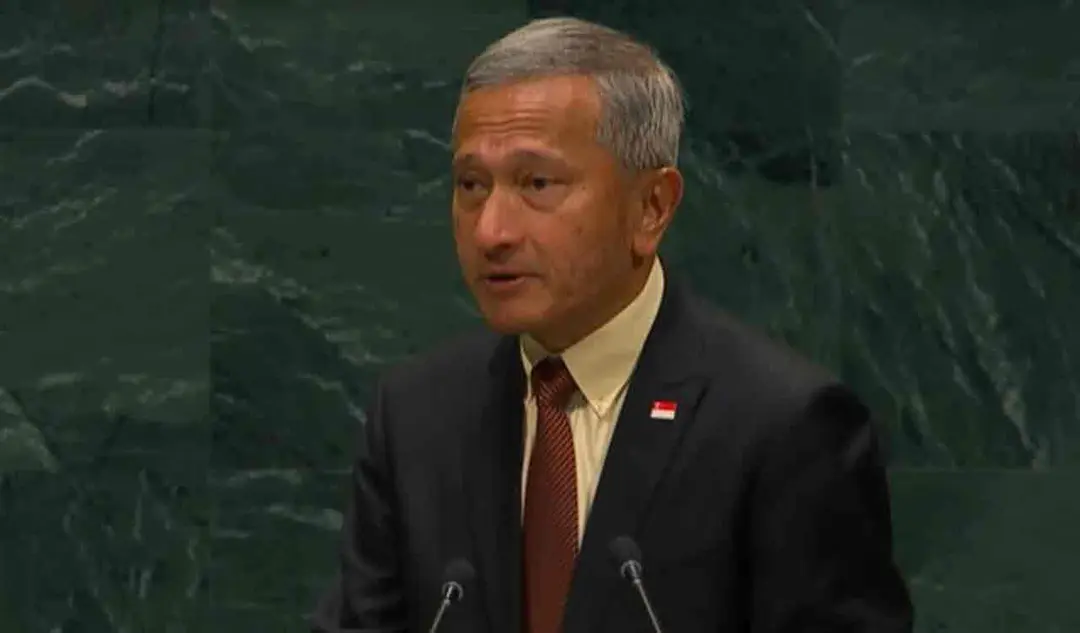
Singapore minister urges talks on UN convention on AI
Singapore Foreign Minister Vivian Balakrishnan has called for discussions on a United Nations convention on artificial intelligence. Speaking at an Asia Society discussion, he said risks fell into three areas: loss of control over AI agents, misuse by rogue actors, and damage to public trust and political debate. He opposed halting AI development, arguing for safeguards alongside progress, and estimated the United States led China by about six months in frontier AI models.
Source
Telangana Today · read the original report ↗
Desk check · compared with the source
What the desk checked (5)
- Singapore Foreign Minister Vivian Balakrishnan called for talks on a UN convention on AI. — Directly attributed to Balakrishnan speaking at an Asia Society discussion; quoted in source.
- AI risks fall into three areas: loss of control, misuse by rogue actors, and damage to public trust. — Attributed to Balakrishnan as his own assessment, with supporting quotes in source.
- The US leads China by about six months in frontier AI models. — Explicitly framed in source as Balakrishnan's personal estimate, not verified data.
- Trump and Xi Jinping held a discussion on AI. — Mentioned in source as welcomed by Balakrishnan; no further detail or independent sourcing given.
- AI could help rogue actors develop biological or chemical weapons. — Attributed warning from the minister; no evidence or source cited.
Analysts’ view opinion
Singapore's call is less about regulating code than about protecting strategic space. If the AI contest is settled bilaterally between Washington and Beijing, everyone else becomes a rule-taker; pushing the UN as the venue is a bid to keep small and middle powers at the table. The warning that no one — not even a system's creator — truly holds the kill switch frames AI squarely as a security problem, tied to bio-chemical weapons risk and information warfare.
- The framing shifts AI from an economic story to a non-proliferation one, borrowing arms-control language by invoking biological and chemical weapons risk.
- Citing the law of the sea and climate accords is a deliberate choice: both are multilateral frameworks that gave legal standing to weaker states.
- Welcoming the Trump-Xi discussion while conceding the resulting guardrails look thin is consistent with Singapore's long-standing refusal to pick sides.
- The "six-month lead" figure is his own estimate; its strategic point is that any advantage is fragile enough that no one can plan around permanent supremacy.
- The emphasis on technology access and open supply chains signals that export controls and tech decoupling, not rogue AI alone, are Southeast Asia's nearer-term worry.
What to watch — Watch whether other middle powers and ASEAN members take up the idea in UN settings, or whether US-China bilateral channels remain the only real forum for AI guardrails.
This is one minister's argument at a public discussion; the story establishes no formal proposal, no backing from other states and no negotiating process under way.
Deep dive
Research brief · 8 facts · 2 dates · exam-readyThe brief
Context
Singapore's Foreign Minister Vivian Balakrishnan, speaking at an Asia Society discussion, has proposed that countries begin negotiating a United Nations convention on artificial intelligence. His argument is that AI's risks — autonomous systems slipping out of human control, misuse by rogue actors, and erosion of public trust through synthetic media — are serious enough to need global rules, but not serious enough to justify stopping development. He pointed to the UN Convention on the Law of the Sea and climate agreements as precedents for hard but necessary multilateral negotiation, and framed US–China AI competition as decisive for Southeast Asia.
Key facts
- Singapore Foreign Minister Vivian Balakrishnan called for talks on a UN convention on artificial intelligence, speaking at an Asia Society discussion (report published 27 September 2026).
- He grouped AI risks into three areas: loss of control over AI agents, use by rogue actors for harmful purposes, and damage to public trust and political debate.
- He said: "Anyone who tells you, even the creator of the AI, that he's got absolute control of the kill switch is fooling you," adding that "loss of control is a very real risk."
- He warned AI could make it easier for rogue actors to develop biological or chemical weapons, and that convincing fake images and videos undermine certainty about what people see and hear.
- He opposed halting or even braking AI development, comparing it to a fast car that needs brakes, seat belts and rules of the road.
- He estimated the United States leads China by perhaps six months in frontier AI models, but said China was determined to seize the opportunities of the new era.
- He cited the law of the sea and climate change agreements as examples of difficult but necessary negotiations, and said the UN offered a forum for countries of different sizes and technological capabilities.
- He welcomed an AI discussion between US President Donald Trump and Chinese President Xi Jinping, while acknowledging concerns that the resulting guardrails were thin: "You need to start somewhere."
Timeline
- Before the report (date not stated in the source)US President Donald Trump and Chinese President Xi Jinping hold a discussion on AI, which Balakrishnan welcomes despite thin guardrails.
- 27 September 2026 (published date)Report of Balakrishnan's Asia Society remarks calling for talks on a UN convention on AI.
Who has a stake
- Singapore government / Vivian Balakrishnan — Seeks access to technology, open supply chains and AI deployment across the economy; is pushing multilateral rule-making via the UN.
- United Nations — Proposed as the forum where countries of different sizes and technological capabilities can negotiate an AI convention.
- United States — Described as holding a roughly six-month lead in frontier AI models; a party to the Trump–Xi AI discussion.
- China — Described as a competitor working from much the same technological foundations and determined to seize the new technological era's opportunities.
- Southeast Asian countries — Unlikely to compete in frontier models but could excel at deploying AI in public services; US–China relations will have profound consequences for the region.
- Workers and education systems — Jobs and tasks will change with AI, requiring changes in education and continued training; governments must prepare people for disruption.
- AI developers — Their claims of absolute control over a "kill switch" are questioned; would be subject to any safeguards agreed.
Why it matters
A UN convention on AI would move governance of the technology from company self-regulation and bilateral superpower talks into a universal forum where small and less technologically advanced states have a voice. For a region like Southeast Asia — and for India, which also depends on technology access and open supply chains — the shape of US–China AI competition and any global rulebook will determine terms of access, safety standards and workforce disruption.
UPSC angle
Prelims pointers
- Vivian Balakrishnan is Singapore's Foreign Minister; he made the UN AI convention call at an Asia Society discussion.
- Three risk categories he named: loss of control over AI agents; misuse by rogue actors; damage to public trust and political debate.
- He cited the law of the sea and climate change agreements as models of difficult but necessary multilateral negotiation.
- He estimated the US lead over China in frontier AI models at about six months.
- He warned AI could ease development of biological or chemical weapons by rogue actors.
- He said Southeast Asia's comparative advantage lies in deploying AI in public services, not building frontier models.
Mains framing
The case for a UN convention on AI rests on a mismatch: capability is concentrated in a handful of firms and two states, while the risks — autonomous systems beyond human control, lowered barriers to biological and chemical weapons, and synthetic media that corrodes public trust and political debate — are global and externalised. Balakrishnan's argument is notable for rejecting both extremes: he is \"not a doomsdayer\" and \"not a believer in putting a halt to AI development\", instead using the metaphor of a fast car that needs brakes, seat belts and rules of the road, so that safeguards develop alongside capability. His institutional choice is deliberate — bilateral US–China talks, though welcome, produce thin guardrails and exclude everyone else, whereas the UN admits countries of differing size and technological capacity, as the law of the sea and climate negotiations did despite their difficulty. The implication for middle and smaller powers, including those in Southeast Asia and South Asia, is a two-track strategy: press for multilateral rules and continued access to technology and open supply chains, while building national strength not in frontier models but in deployment across public services and the economy. Crucially, that requires domestic groundwork — reform of education and continuous retraining for workers whose tasks, if not whole jobs, will be reshaped by AI.
Key terms
- UN convention on AI
- A proposed multilateral treaty on artificial intelligence, negotiated at the UN so states of all sizes and capabilities can participate.
- AI agents
- Autonomous AI systems that act on their own; Balakrishnan cited loss of control over them as a very real risk.
- Frontier AI models
- The most advanced, cutting-edge AI models; the US was estimated to lead China by about six months in these.
- Kill switch
- A mechanism to shut down an AI system; Balakrishnan said claims of absolute control over it are misleading.
- Asia Society
- The forum where Balakrishnan made his remarks on AI risks and global governance.
- Rogue actors
- Malicious users who could exploit AI, including to help develop biological or chemical weapons.
Practice questions
- Is a United Nations convention the right instrument for governing artificial intelligence? Examine with reference to the precedents of the law of the sea and climate change negotiations.
- "Safeguards must develop alongside AI, not by halting it." Critically evaluate this approach in light of risks such as loss of control over autonomous systems and AI-enabled biological or chemical weapons.
- How should middle and smaller powers respond to a technological race dominated by the United States and China? Discuss with reference to technology access, supply chains and workforce retraining.
Grounded only in the source report — figures and dates are the source's, not inferred.