
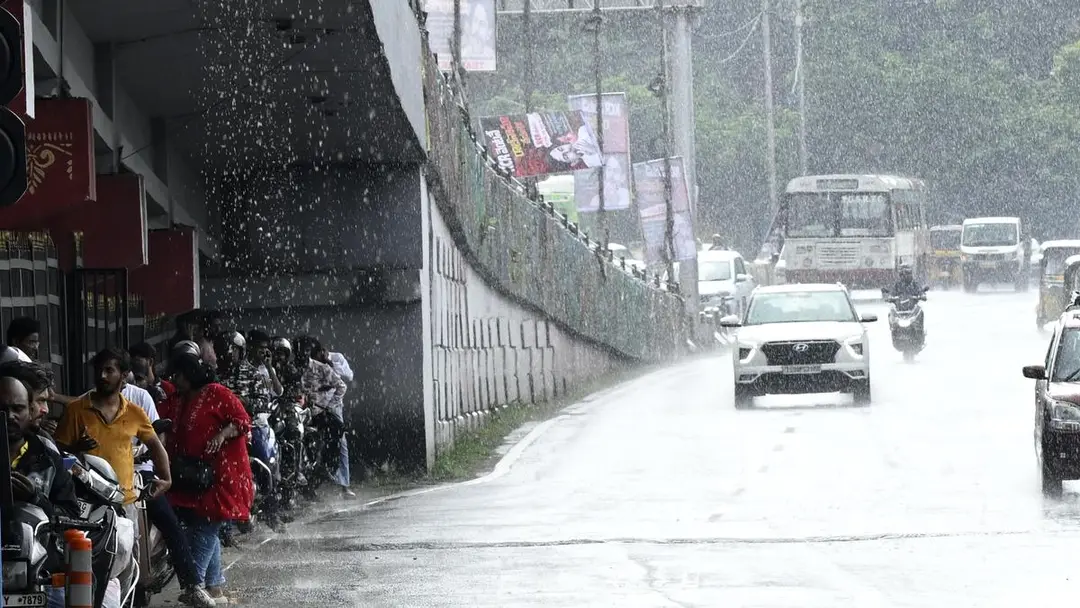
Rain returns to Hyderabad after weeks of dry weather
Hyderabad received a sudden spell of rain on Sunday (September 6) after weeks of dry weather. The day was bright and sunny before dark clouds gathered over parts of the city after 3 p.m., with showers in Uppal, Habsiguda, Tarnaka and Mettuguda. No major traffic disruptions were reported as it was a Sunday. As of 7 p.m., TGDPS data showed Miyapur recorded 25 mm and Malakpet 16 mm. Among districts, Kodakandala in Jangaon topped with 54.5 mm.
Source
Vizianagaram — weather · read the original report ↗
Desk check · compared with the source
What the desk checked (5)
- Hyderabad received a sudden spell of rain on Sunday, September 6, after weeks of dry weather — Stated in source as reporter observation; dateline matches publication date of September 6, 2026.
- Uppal, Habsiguda, Tarnaka and Mettuguda saw showers after 3 p.m. — Appears in source as direct reporting; no official attribution given.
- Miyapur recorded 25 mm rainfall, the highest in the city, as of 7 p.m. — Figure appears in source, attributed to Telangana Development Planning Society (TGDPS) data.
- Kodakandala in Jangaon district recorded 54.5 mm, highest among districts listed — Figure appears in source, attributed to TGDPS.
- No major traffic disruptions were reported — Stated in source without attribution to police or traffic authorities.
Analysts’ view opinion
This is a weather item, but in Telangana rainfall numbers rarely stay purely meteorological. Showers after weeks of dry weather fell unevenly — some areas wet, many still dry — which means this is not the kind of spell that settles agricultural anxieties. That no major traffic disruption was reported owes to it being a Sunday; that is calendar luck, not proof of civic preparedness.
- Weeks of dry weather keep the political space open for opposition questions on rainfall deficit, crops and irrigation, and a moderate spell does not close that argument.
- The uneven spread within the city — 25 mm in Miyapur while several areas stayed dry — is standard raw material for localised 'our area was neglected' grievances.
- Eastern city pockets such as Uppal, Habsiguda and Tarnaka have featured in past monsoon debates over drainage and waterlogging, so any shower there becomes an informal test of infrastructure performance.
- Had the same rain come on a working day, the scrutiny of traffic and drainage would have been sharper — so 'no disruption' should not be read as an administrative win.
- District figures such as 54.5 mm at Kodakandala in Jangaon can feed both narratives — relief for farmers, or damage claims — depending on what follows.
What to watch — Watch whether the dry spell resumes in the coming weeks, and how government and opposition frame irrigation, power and crop arguments if it does.
The story establishes no political statement, administrative action, crop loss or official deficit declaration — it is a single day's weather and rainfall data.
Deep dive
Research brief · 8 facts · 4 dates · exam-readyThe brief
Context
After weeks of dry weather, Hyderabad received a sudden afternoon spell of rain on Sunday, September 6. The morning was bright and sunny, but dark clouds built up over parts of the city after 3 p.m., bringing showers to eastern localities such as Uppal, Habsiguda, Tarnaka and Mettuguda. Rainfall was patchy — several areas received showers while many others stayed dry. Rain gauge readings compiled by the Telangana Development Planning Society (TGDPS) showed moderate rain in several districts as well.
Key facts
- Hyderabad saw a sudden spell of rain on Sunday, September 6, after weeks of dry weather.
- The first half of the day was bright and sunny; dark conditions set in over parts of the city after 3 p.m.
- Showers hit Uppal, Habsiguda, Tarnaka and Mettuguda, catching commuters off guard.
- No major traffic disruptions were reported, as it was a Sunday.
- TGDPS data as of 7 p.m.: Miyapur 25 mm, Malakpet 16 mm, Kavadiguda 15.8 mm, Uppal 15.5 mm, Moosarambagh 15.3 mm.
- Other city readings: Amberpet 14.8 mm, Khairatabad 12.5 mm, Chilkalguda 12.3 mm, Kukatpally 12 mm.
- Among districts, Kodakandala in Jangaon topped with 54.5 mm, followed by Eturunagaram (Mulugu) 51 mm and Narketpally (Nalgonda) 46.8 mm.
- Further district readings: Mothkur (Yadadri Bhuvanagiri) 45.8 mm, Phanigiri (Suryapet) 43.5 mm, Regonda (Jayashankar Bhupalpally) 35 mm.
Timeline
- Weeks before September 6Hyderabad experiences a prolonged dry spell.
- September 6, morningWeather stays bright and sunny through the first half of the day.
- September 6, after 3 p.m.Dark clouds gather over parts of the city; showers lash Uppal, Habsiguda, Tarnaka and Mettuguda.
- September 6, 7 p.m.TGDPS rainfall data shows Miyapur at 25 mm in the city and Kodakandala (Jangaon) at 54.5 mm among districts.
Who has a stake
- Commuters in Hyderabad — Caught off guard by the sudden afternoon showers; some took shelter under a flyover.
- Telangana Development Planning Society (TGDPS) — State agency whose rain-gauge network provided the locality-wise rainfall figures cited.
- Hyderabad residents — Relief from weeks of dry weather, though rainfall was uneven across localities.
- Districts such as Jangaon, Mulugu, Nalgonda, Yadadri Bhuvanagiri, Suryapet and Jayashankar Bhupalpally — Received moderate rain, relevant to agriculture and water availability.
- City traffic and civic authorities — Faced no major disruptions this time because the rain fell on a Sunday.
Why it matters
The spell ends weeks of dry weather in Hyderabad during what is normally the monsoon season, and the patchy distribution — some areas soaked, others dry — shows how localised urban rainfall can be. Because it fell on a Sunday, the city escaped the traffic chaos such sudden showers usually cause, underlining how timing shapes the impact of weather events on urban life.
UPSC angle
Prelims pointers
- Telangana Development Planning Society (TGDPS) maintains the rainfall data network cited for Hyderabad and districts.
- Highest city rainfall on September 6: Miyapur, 25 mm (TGDPS, as of 7 p.m.).
- Highest district rainfall: Kodakandala in Jangaon district, 54.5 mm.
- Eturunagaram, which recorded 51 mm, is in Mulugu district.
- Hyderabad localities that received showers: Uppal, Habsiguda, Tarnaka, Mettuguda.
- Rainfall is measured in millimetres (mm); readings here were compiled up to 7 p.m. on September 6.
Mains framing
Localised, short-duration afternoon rainfall of the kind Hyderabad saw on September 6 highlights three governance challenges for Indian cities. First, intra-city variability: TGDPS readings ranged from 25 mm in Miyapur to 12 mm in Kukatpally, with many areas dry, meaning city-wide averages mask the risk of concentrated waterlogging in specific localities. Second, dry-spell-to-downpour swings within the monsoon season stress both urban water supply and drainage infrastructure, which must cope with idle weeks followed by sudden intense flows. Third, the absence of major traffic disruption was a function of the rain falling on a Sunday rather than of preparedness — a weekday spell of similar intensity would likely have tested the city's roads and drains. The way forward rests on the strengths the story already shows: a dense, locality-level rain-gauge network like TGDPS's enables ward-scale nowcasting, targeted drainage attention and timely commuter advisories, so that data collection translates into anticipatory action rather than post-event reporting. District readings of 35–54.5 mm across Jangaon, Mulugu, Nalgonda, Yadadri Bhuvanagiri, Suryapet and Jayashankar Bhupalpally also matter for agricultural planning after a dry stretch.
Key terms
- TGDPS (Telangana Development Planning Society)
- Telangana state body whose rain-gauge network supplies locality- and mandal-wise rainfall data, quoted in the report.
- Dry spell
- A stretch of days or weeks with little or no rainfall, as Hyderabad experienced before September 6.
- Rainfall in mm
- Depth of rainwater collected in a gauge; 25 mm at Miyapur was the highest city reading that evening.
- Moderate rain
- Term used in the report for the district-level rainfall of roughly 35 mm to 54.5 mm recorded on September 6.
Practice questions
- Sudden, highly localised urban rainfall poses different challenges from prolonged monsoon rain. Discuss with reference to Hyderabad's September 6 spell and the role of dense rain-gauge networks.
- How can locality-level rainfall data, such as that collected by the Telangana Development Planning Society, be used to improve urban flood preparedness and commuter advisories?
- Examine the implications of alternating dry spells and short intense showers during the monsoon for urban water management and agriculture in Telangana.
Grounded only in the source report — figures and dates are the source's, not inferred.