
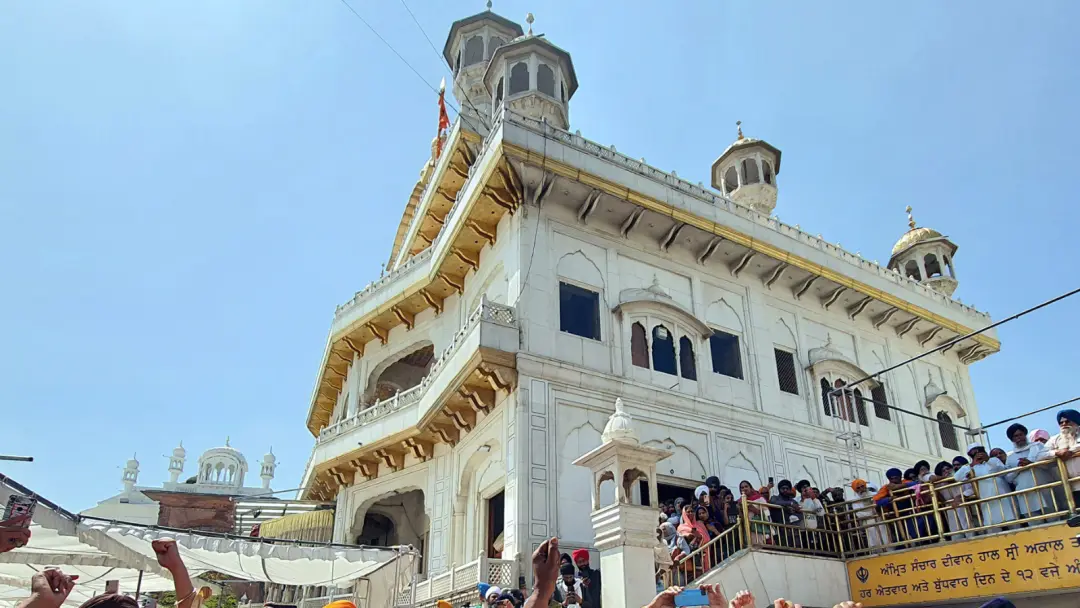
Sikh bodies seek Akal Takht clarity on Vande Mataram singing
Several Sikh organisations have approached the Akal Takht seeking a clear Panthic position on the singing of the national song Vande Mataram. US-based Sikh scholar and former Sant Sipahi editor Gurcharanjit Singh Lamba told The Indian Express that love for the country and worship of it as a deity are different questions. Citing Gurbani's formless God, he said Sikhs may accept the song's historical role while objecting to its devotional imagery. He said the SGPC took a position in 2006.
Source
Indian Express — Cities · read the original report ↗
Desk check · compared with the source
What the desk checked (5)
- Several Sikh organisations have approached the Akal Takht seeking a clear Panthic position on singing Vande Mataram. — Stated in the source without naming the organisations; no document or spokesperson cited.
- Gurcharanjit Singh Lamba says love for the country and worship of the country as a deity are two different questions. — Directly attributed to the named US-based Sikh scholar, writer and former Sant Sipahi editor in an interview with The Indian Express.
- The Shiromani Gurdwara Parbandhak Committee took a position on Vande Mataram in 2006 and the matter was discussed at Sri Akal Takht Sahib. — Asserted by the interviewee; the source gives no resolution text or reference.
- The Bharat Mata Temple in Varanasi contains only a map of Bharat and no deity. — Interviewee's statement as it appears in the source; not independently sourced.
- Vande Mataram has a 150-year history and became associated with India's freedom struggle. — Figure and characterisation appear in the source text as background.
Analysts’ view opinion
The Vande Mataram debate reaching the doors of the Akal Takht signals that this is no longer only a cultural argument but is acquiring a 'Panthic' character in Punjab's politics. Once Sikh organisations demand a clear position, parties end up having to react to what a religious authority says rather than setting the terms themselves. The framing offered by scholar Gurcharanjit Singh Lamba — love of country is distinct from worshipping the country as a deity — gives objectors a political vocabulary that avoids being cast as anti-national. As things stand, this is one scholar's reading; the story records no pronouncement from the Akal Takht itself.
- If the Akal Takht does issue clarity, it could become a political test for every party operating in Punjab.
- Citing the SGPC's 2006 position is an attempt to show this is an old institutional concern, not a fresh agitation.
- The 'not against patriotism, only against worship' framing pre-emptively blunts the nationalist counter-attack.
- Demands routed through religious institutions tend to reshape electoral calculations, and how far each party is willing to go will be the real signal.
- The closing argument that unity need not mean uniformity translates a pluralist case into usable political language.
What to watch — Watch whether the Akal Takht issues a formal position or clarification, and how Punjab's parties and the SGPC respond if it does.
The story does not establish what the Akal Takht's position is, how many or which organisations made the demand, or how any political party has reacted.
Deep dive
Research brief · 8 facts · 3 dates · exam-readyThe brief
Context
The national song Vande Mataram is again in public debate amid discussion of its 150-year history and demands for its full rendition. Several Sikh organisations have now approached the Akal Takht, the highest Sikh temporal seat, seeking a clear "Panthic" (community-wide) position on singing the song. US-based Sikh scholar and former Sant Sipahi editor Gurcharanjit Singh Lamba, speaking to The Indian Express, argues that love for the country and worship of the country as a deity are two different questions, and that Sikh theology's formless God makes the song's devotional imagery a religious, not patriotic, issue.
Key facts
- Several Sikh organisations have approached the Akal Takht seeking a clear Panthic position on singing Vande Mataram.
- The renewed debate follows discussion of the song's 150-year history and demands for its full rendition.
- The Shiromani Gurdwara Parbandhak Committee (SGPC) took a position on Vande Mataram in 2006, and the matter was also discussed at Sri Akal Takht Sahib.
- Gurcharanjit Singh Lamba is a US-based Sikh scholar, writer and former editor of Sant Sipahi; he spoke to The Indian Express.
- Lamba says Gurbani describes the Supreme Being as beyond physical form, colour and appearance — the One, formless God.
- He distinguishes 'vatan' (homeland) from 'Bharat Mata' as a divine or goddess-like representation.
- He says the song's later portions contain imagery associated with Hindu goddesses and divine forms.
- He notes the Bharat Mata Temple in Varanasi has only a map of Bharat and no deity.
Timeline
- 2006The SGPC took a position on Vande Mataram; the matter was also discussed at Sri Akal Takht Sahib.
- Current (undated)Renewed debate over the song's 150-year history and its full rendition revives the question of religious imagery.
- Current (undated)Several Sikh organisations approach the Akal Takht seeking a clear Panthic position on singing Vande Mataram.
Who has a stake
- Akal Takht — Asked to issue a clear Panthic position on whether Sikhs should sing Vande Mataram.
- Shiromani Gurdwara Parbandhak Committee (SGPC) — Already took a position on the song in 2006; its stand frames the current institutional debate.
- Sikh organisations seeking clarity — Want authoritative guidance reconciling patriotic duty with Sikh theological principles.
- Gurcharanjit Singh Lamba, Sikh scholar — Argues the objection is theological, not anti-patriotic, and must not be read as opposing national feeling.
- Ordinary Sikhs and other religious minorities — Risk of patriotism being tested through participation in a song carrying specific devotional imagery.
Why it matters
The controversy tests whether national symbols can command uniform participation in a country of many faiths, or whether religious conscience permits differentiated expression of patriotism. Lamba's framing \u2014 that historical significance and theological acceptance are separate matters \u2014 offers a way to honour the song's role in the freedom struggle without requiring every community to accept its devotional content. His conclusion that unity need not mean uniformity speaks directly to how India manages contested symbols.
UPSC angle
Prelims pointers
- Vande Mataram is India's national song; the current debate marks its 150-year history.
- Akal Takht is the seat approached for a 'Panthic' (community-wide) Sikh position.
- SGPC took a position on Vande Mataram in 2006; matter also discussed at Sri Akal Takht Sahib.
- Gurbani/Sikh theology: the Supreme Being is One and formless, beyond form, colour and appearance.
- Bhagat Namdev's verses (bani) are included in the Guru Granth Sahib.
- Bharat Mata Temple, Varanasi, contains only a map of Bharat and no deity.
Mains framing
The Vande Mataram controversy reaching the Akal Takht illustrates the recurring tension between shared national symbols and religious pluralism. The immediate trigger is renewed emphasis on the song's 150-year history and its full rendition, which revives an older objection: the later portions carry imagery associated with Hindu goddesses, while Sikh theology, as expressed in Gurbani, holds the Supreme Being to be One and formless and therefore not representable in physical form. The scholarly position articulated by Gurcharanjit Singh Lamba separates 'vatan' or homeland from 'Bharat Mata' as deity, and historical significance from theological acceptance \u2014 pointing to Sikh traditions of sacrifice, including Master Tara Singh's account from imprisonment in Almora, and to Bhagat Namdev's bani in the Guru Granth Sahib. The implication is that treating recitation as a loyalty test risks converting a question of conscience into an allegation of disloyalty. A constructive way forward, on the source's own logic, lies in institutional clarity from bodies such as the Akal Takht and SGPC, recognition that patriotism may be expressed through service, sacrifice and responsibility, and acceptance that national unity does not require religious uniformity.
Key terms
- Akal Takht
- The highest Sikh temporal seat, approached here to declare a binding community-wide position on Vande Mataram.
- Panthic position
- A stand taken on behalf of the whole Sikh Panth (community), as distinct from individual opinion.
- SGPC
- Shiromani Gurdwara Parbandhak Committee, the body that took a position on Vande Mataram in 2006.
- Gurbani
- Sikh scriptural utterance; describes the Supreme Being as One and beyond physical form, colour and appearance.
- Vatan vs Bharat Mata
- Distinction between the homeland as an object of love and the nation personified as a divine or goddess-like figure.
- Sant Sipahi
- A Sikh publication that Gurcharanjit Singh Lamba formerly edited.
Practice questions
- Can reverence for the motherland be separated from the religious imagery in which it is expressed? Discuss with reference to the Vande Mataram debate.
- "National unity does not require religious uniformity." Examine this proposition in the context of contested national symbols in India.
- Discuss the role of institutions like the Akal Takht and the SGPC in articulating religious community positions on questions of national symbolism.
Grounded only in the source report — figures and dates are the source's, not inferred.