
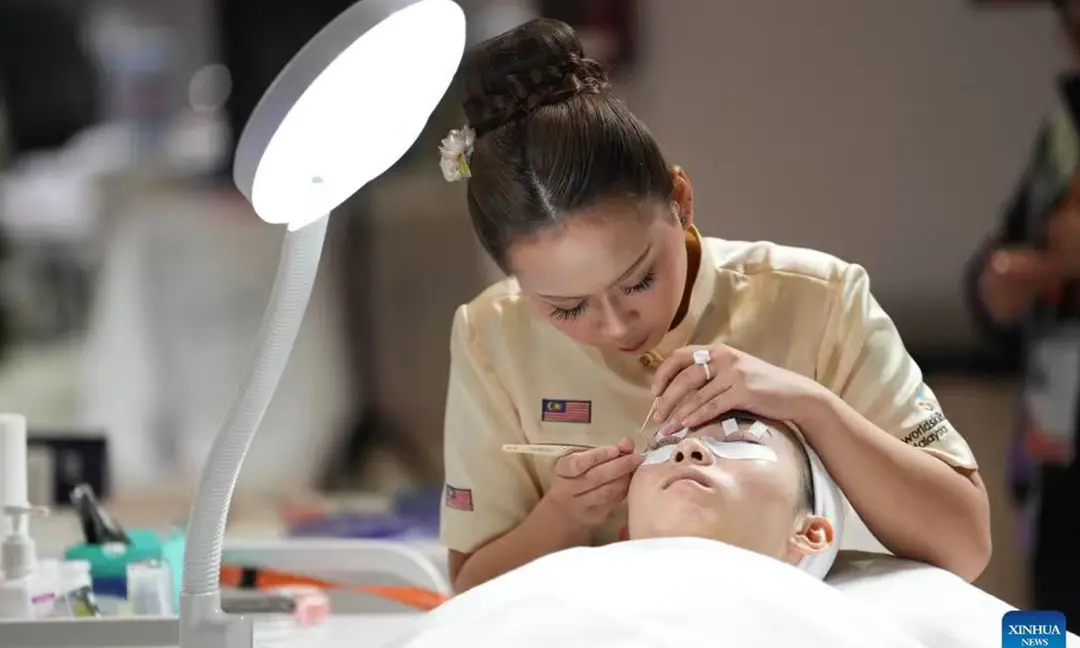
China tops WorldSkills gold table with 41 medals in Shanghai
China topped the gold medal table at the 48th WorldSkills Competition, which concluded in Shanghai on Sunday, winning 41 golds and ranking first for the fifth consecutive edition, Xinhua News Agency reported. A total of 1,385 competitors from 68 countries and regions contested 64 skill events, with China fielding 71 competitors across all events in six sectors. China National Radio said competition standards are increasingly being built into vocational curricula and industrial training.
Source
Global Times (China) · read the original report ↗
Desk check · compared with the source
What the desk checked (5)
- China won 41 gold medals and topped the gold table at the 48th WorldSkills Competition, its fifth consecutive first place. — Attributed to Xinhua News Agency report of Sunday; figure appears in source.
- 1,385 competitors from 68 countries and regions competed in 64 skill events. — Attributed to organizers; figures appear in source.
- China sent 71 competitors covering all 64 events across six sectors. — Attributed to organizers; internally consistent with event count.
- Hotel reception competitors are assessed against more than 400 criteria. — Attributed to Hu Xiao, leader of the Chinese technical expert team, via CNR.
- Shanghai has launched training programs in AI data annotation and model application benchmarked to WorldSkills standards. — Attributed to Chen Jie, Shanghai vice mayor and deputy director of the organizing committee.
Analysts’ view opinion
A skills competition is not a security event, but industrial capability is the raw material of national power, and this result should be read in that light. China fielded competitors across all 64 events and topped the gold table for the fifth straight edition — a signal less about medals than about a state-backed pipeline that converts competition standards into curricula, industry training and assessment benchmarks. Hosting in Shanghai adds a soft-power layer: China is positioning itself as the reference point for what a skilled industrial workforce looks like.
- Full-spectrum entry across all 64 events in six sectors suggests a deliberate strategy of breadth, not selective medal-hunting.
- The stated move from competition floor to classroom and industrial training — including AI data annotation and model application in Shanghai — links skills policy directly to advanced-manufacturing and technology ambitions.
- Skilled-labour depth underwrites defence-industrial and dual-use capacity in areas like manufacturing, engineering and ICT, even though the story makes no defence claim.
- Bilingual Chinese-English training resources shared across institutions hint at exportable standards, a quieter form of influence than infrastructure or arms sales.
- For competing economies, including India and European states, the strategic question is less how many medals China won than whether their own vocational systems can institutionalise comparable standards at scale.
What to watch — Watch whether WorldSkills-benchmarked curricula are scaled nationally in China and offered abroad, and whether other major economies respond with their own vocational-capability pushes.
The story establishes competition results and training-integration plans only; it does not establish any defence or dual-use application, nor how effective or widely adopted these standards have actually become.
Deep dive
Research brief · 8 facts · 2 dates · exam-readyThe brief
Context
The WorldSkills Competition is an international vocational skills contest in which young competitors from participating countries and regions compete across trade and technical disciplines. The 48th edition was hosted in Shanghai and concluded on Sunday, with Xinhua News Agency reporting that China topped the gold medal table. Alongside the medal tally, Chinese state media highlighted how competition standards are being converted into vocational curricula, industry training standards and assessment benchmarks.
Key facts
- China's delegation won 41 gold medals at the 48th WorldSkills Competition, which concluded in Shanghai on Sunday, as reported by Xinhua News Agency.
- It was the fifth consecutive edition in which China ranked first in gold medals.
- A total of 1,385 competitors from 68 countries and regions competed in 64 skill events.
- China sent 71 competitors and participated in all 64 events.
- The events covered six sectors: transportation and logistics; construction and building technology; manufacturing and engineering technology; information and communication technology; creative arts and fashion; and social and personal services.
- In the hotel reception skill, competitors are assessed against more than 400 criteria covering communication, work organization, financial skills and other areas, said Hu Xiao, leader of the Chinese technical expert team for the skill.
- A team led by Jiang Hong, dean of the school of hotel management at Shanghai Business School, has converted training procedures, simulated scenarios and competition standards into teaching materials, including a bilingual Chinese-English version of an originally English-language resource shared with
- Chen Jie, a vice mayor of Shanghai and deputy director of the event's organizing committee, said Shanghai has launched training programs in areas such as AI data annotation and model application, benchmarked against WorldSkills standards.
Timeline
- September 24, 2026A contestant competes in the beauty therapy event at the 48th WorldSkills Competition in Shanghai (as per the Xinhua photo caption).
- Sunday (date otherwise not stated in the source)The 48th WorldSkills Competition concludes in Shanghai; Xinhua and China National Radio report China's 41 golds and the mainstreaming of competition standards.
Who has a stake
- Chinese delegation / 71 competitors — Competed in all 64 events and delivered 41 golds, a fifth straight first place in the gold tally.
- WorldSkills Competition organizers — Ran 64 skill events for 1,385 competitors from 68 countries and regions across six sectors.
- Shanghai municipal government (vice mayor Chen Jie, deputy director of the organizing committee) — Hosting city that is launching AI data annotation and model application training benchmarked to WorldSkills standards.
- Chinese vocational institutions and Shanghai Business School team (dean Jiang Hong) — Converting competition standards and simulated scenarios into bilingual teaching materials shared nationwide.
- Chinese technical expert teams (e.g., Hu Xiao, hotel reception) — Translating international competition criteria into curricula, industry training standards and vocational assessment benchmarks.
- Employers in emerging industries — Company demand for skilled workers is shaping new training programs such as AI data annotation.
Why it matters
Skills competitions have become a visible marker of national industrial capability, and China's fifth successive gold-table lead is being presented as evidence of a maturing vocational training system rather than a one-off sporting result. The more consequential shift described in the source is institutional: competition criteria are being converted into classroom curricula, industry training standards and assessment benchmarks, including for emerging fields such as AI data annotation. For countries pursuing skilling missions, this illustrates how international benchmarks can be internalised into education systems.
UPSC angle
Prelims pointers
- 48th WorldSkills Competition was held in Shanghai, China; concluded on a Sunday (Xinhua report).
- China won 41 gold medals and topped the gold table for the fifth consecutive edition.
- Participation: 1,385 competitors from 68 countries and regions in 64 skill events.
- China fielded 71 competitors across all 64 events in six sectors.
- Hotel reception skill uses more than 400 assessment criteria (communication, work organization, financial skills, etc.).
- Shanghai's new WorldSkills-benchmarked training programs include AI data annotation and model application.
Mains framing
China's performance at the 48th WorldSkills Competition in Shanghai — 41 golds and a fifth consecutive first place in the gold tally among 1,385 competitors from 68 countries and regions in 64 events — is significant less for the medals than for the reported institutional spillover. Chinese officials and experts describe a deliberate pipeline in which international competition criteria, such as the 400-plus assessment points in hotel reception, are translated into vocational curricula, industry training standards and assessment benchmarks; Shanghai Business School has turned competition procedures and simulated scenarios into bilingual teaching material circulated to vocational institutions nationwide, and Shanghai has launched employer-driven courses in AI data annotation and model application benchmarked to WorldSkills. The implication is that competition acts as a standard-setting instrument for skilled-talent development rather than an isolated showcase. The way forward suggested by the source is scaling this conversion of competition standards into curriculum and certification, and extending it to emerging industries where employer demand is changing fastest; the source does not detail outcomes, costs or comparative data for other countries.
Key terms
- WorldSkills Competition
- International vocational skills competition; its 48th edition in Shanghai featured 64 skill events across six sectors.
- Skill sectors
- The six WorldSkills groupings: transportation and logistics; construction; manufacturing and engineering; ICT; creative arts and fashion; social and personal services.
- Vocational assessment benchmarks
- Standards derived from competition criteria used to judge and certify skills in vocational education and industry training.
- AI data annotation
- Labelling of data for training artificial intelligence models; a Shanghai training area benchmarked against WorldSkills standards.
- Xinhua News Agency / China National Radio (CNR)
- Chinese state media outlets that reported the medal tally and the mainstreaming of competition standards respectively.
Practice questions
- How can international skills competition standards be institutionalised into vocational curricula and assessment systems? Discuss with reference to China's approach at the 48th WorldSkills Competition.
- Skills competitions are increasingly treated as indicators of industrial capability rather than individual achievement. Critically examine.
- Examine the role of employer demand in designing vocational training for emerging fields such as artificial intelligence, drawing on the Shanghai example.
Grounded only in the source report — figures and dates are the source's, not inferred.