
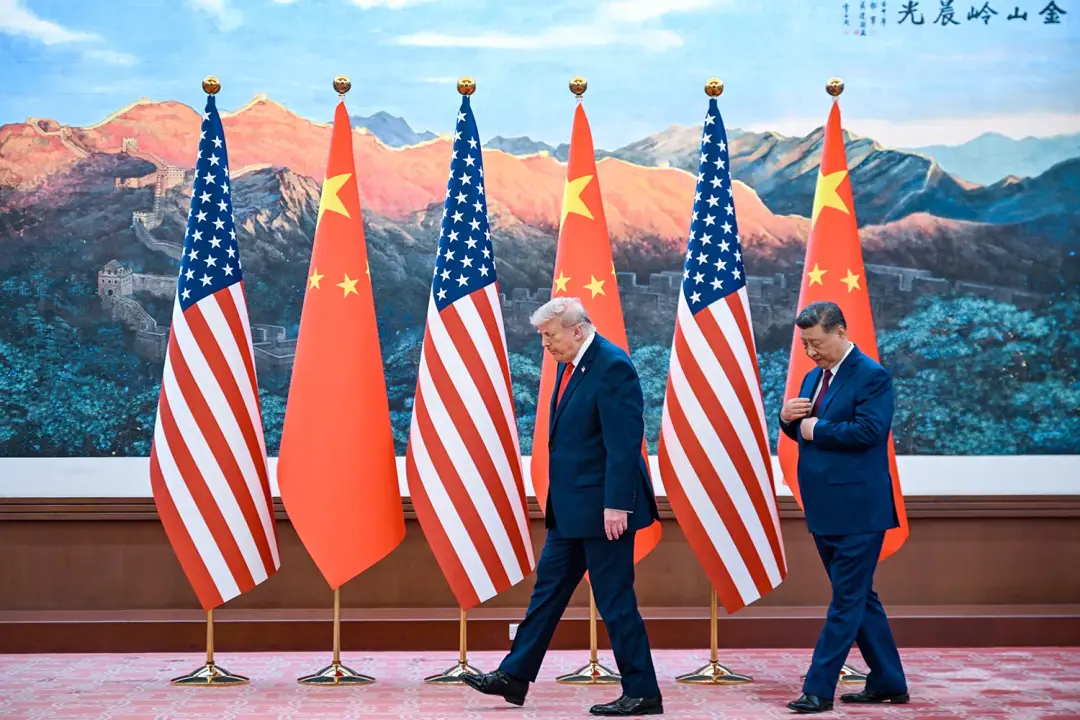
Analysis: China policy, not Iran, Trump's bigger setback
A Foreign Policy analysis argues that the failure of US President Donald Trump's China policy may prove more consequential than the Iran war during his second term. It says the trade deficit has not fallen, supply-chain dependence on rare earths persists, and America's lead in artificial intelligence is narrowing. The piece also cites weakened deterrence over Taiwan and reduced allied confidence, published ahead of Xi Jinping's Sept. 24 visit to Washington.
Source
Foreign Policy · read the original report ↗
Desk check · some claims need care
What the desk checked (5)
- Xi Jinping is to visit Washington on Sept. 24 for a summit — Stated in source without attribution; date appears in source text only.
- At the October 2025 Busan meeting Trump dropped a threatened additional 100 percent tariff in exchange for a truce on rare earths, soybeans, fentanyl and export controls — Asserted by the author; no document or official statement cited.
- A Peterson Institute study found the trade war rerouted Chinese exports mainly via Vietnam, Taiwan and Mexico — Attributed to a named institute but no specific study title or date given.
- A Pew 2026 survey of 36 countries found 39% say the US respects personal freedoms and 56% say it does not; China viewed more favourably than the US in 25 places — Figures attributed to Pew Research Center in the source; not independently verified here.
- US aid fell 57 percent in 2025 and is now below Germany's level — Figure appears in source with no source given for the calculation.
Analysts’ view opinion
The core argument of the Foreign Policy analysis is that while the Iran conflict was a single, highly visible crisis, the damage from China policy accumulates slowly and largely out of sight. The piece points to an unreduced trade deficit, continuing dependence on rare earths, and a narrowing artificial-intelligence gap as evidence that the limits of American economic leverage have now been exposed to the wider world. Strategically, the deeper risk is less a shortfall of hardware than an erosion of allied confidence in US security assurances across the Indo-Pacific.
- The analysis argues that diverting forces, long-range precision missiles and interceptors to the Middle East for the Iran war thinned out deterrence in the Western Pacific.
- Treating a Taiwan arms package as a "negotiating chip" signals to Beijing that the island's security may be tradeable against concessions elsewhere, the article warns.
- Rare earths, magnets and farm exports show chokepoints run both ways; the Busan truce made clear that tariff threats have real ceilings, and other capitals took note.
- South Korea seeking "full restoration" of ties with China, and India converging pragmatically with Beijing through BRICS on alternative trade and financial channels, are read as symptoms of allied hedging.
- The piece concedes the counter-case: the US economy and markets are strong while China faces property debt, demographic decline and tight political control — but it judges the long-term trend to run the other way.
What to watch — Watch whether the Sept. 24 Xi visit to Washington produces arrangements on rare earths and export controls in which Taiwan-related or allied-security questions become part of the bargaining.
This is an argued analytical commentary, not a verified official assessment, and the story does not establish that the balance of power has shifted irreversibly or that US policy cannot be corrected.
Deep dive
Research brief · 8 facts · 6 dates · exam-readyThe brief
Context
A Foreign Policy analysis argues that while the Iran war may look like the decisive turning point of Donald Trump's second term, the failure of his China policy will prove more consequential. It contends that over the administration's first year and a half, China gained ground economically, militarily, technologically and diplomatically, and is better placed relative to the United States than when Trump returned to office. The piece is framed around Xi Jinping's Sept. 24 visit to Washington and argues the summit's pageantry masks a shift in the balance of power toward Beijing. It also notes the administration never set a clear hierarchy of China objectives, making the failure harder to measure.
Key facts
- The 2025 US National Security Strategy did not identify China as America's paramount geopolitical competitor, framing the challenge mainly in economic terms.
- A Peterson Institute study cited in the piece says the trade war mainly rerouted Chinese exports through third countries, chiefly Vietnam, Taiwan and Mexico, without cutting the deficit.
- At the October 2025 Busan meeting on the APEC sidelines, Trump dropped a threatened additional 100 percent tariff on Chinese imports for a fragile truce on rare earths, soybeans, fentanyl and export controls.
- Deploying the USS George Washington from Japan to the Middle East left the Western Pacific without a US aircraft carrier.
- Trump treated a $14 billion arms package for Taiwan as a 'negotiating chip', signalling Taiwan's security was tradeable.
- In a Pew Research Center 2026 survey of 36 countries, only 39 percent said the US government respects its people's personal freedoms, while 56 percent said it does not.
- Brand Finance's 2026 Global Soft Power Index recorded the largest decline for the US among all 193 countries assessed.
- US foreign aid fell 57 percent in 2025 after USAID was dismantled; America now provides less international aid than Germany.
Timeline
- Sept. 23, 2024Trump speaks at a Smithton, Pennsylvania farm on the China threat to US agriculture.
- 2025The administration's National Security Strategy omits China as America's paramount geopolitical competitor; US foreign aid falls 57 percent after USAID is dismantled.
- Late 2025 onwardBeijing conducts its largest and closest exercises around Taiwan, fires rockets into surrounding waters, rehearses blockades and surveys Taiwan's EEZ.
- October 2025Busan agreement: Trump and Xi meet on APEC sidelines; the 100 percent additional tariff threat is dropped for a truce.
- January (year as stated)US forces capture Venezuelan President Nicolas Maduro and fly him to New York; protests against Trump's immigration policies in Washington's Chinatown on Jan. 30.
- Sept. 24Xi Jinping due in Washington for a summit with Trump.
Who has a stake
- United States / Trump administration — Credibility of tariffs, export controls, alliance commitments and soft power; whether it can sustain its lead over China.
- China / Xi Jinping — Seeks to constrain American power, push the US from its dominant position in Asia and advance the 'rise of the East, decline of the West'.
- Taiwan — Faces the largest, closest Chinese exercises and blockade rehearsals while its $14bn US arms package is used as a bargaining chip.
- South Korea (President Lee Jae-myung) — US-ROK annual exercise ordered 'substantially reduced'; Seoul seeks 'full restoration' of ties with China.
- India — Cultivated across administrations as a counterweight to China, but ties strained; converging with Beijing pragmatically through BRICS.
- US farmers and manufacturers — Revenues hostage to Chinese soy and animal-product purchases; hit by tariff volatility and rare-earth chokepoints.
Why it matters
The analysis suggests the US-China balance, not a single Middle East war, will define the era: supply-chain chokepoints, AI diffusion and alliance credibility decide long-run national power. For India, the argument matters twice over, as a courted counterweight to China now described as needlessly alienated, and as a BRICS partner exploring trade and financial systems insulated from US interference.
UPSC angle
Prelims pointers
- Busan agreement (October 2025): Trump-Xi truce on APEC sidelines covering rare earths, soybeans, fentanyl and export controls.
- Rare earths and magnets are described as 'chokepoints' Beijing used as leverage against US tariffs.
- Pew Research Center 2026 survey of 36 countries: 39 percent say the US respects personal freedoms, 56 percent say it does not.
- Brand Finance 2026 Global Soft Power Index assesses 193 countries; the US posted the largest decline.
- APEC = Asia-Pacific Economic Cooperation; the Trump-Xi Busan meeting was held on its sidelines.
- USAID's dismantling coincided with a 57 percent fall in US aid in 2025, taking it below Germany.
Mains framing
The analysis locates the failure of US China policy in a lack of strategic clarity rather than a shortage of instruments: the 2025 National Security Strategy did not name China as the paramount competitor and framed it economically, leaving different arms of government pulling in different directions. The consequences appear across four domains. Economically, tariffs rerouted Chinese exports through Vietnam, Taiwan and Mexico instead of cutting the deficit, while rare-earth and magnet chokepoints and farm dependence on Chinese soy purchases forced the Busan truce and the abandonment of a 100 percent tariff threat. Technologically, the piece argues national power flows from dominating the full cycle of a general-purpose technology - discovery, commercialisation and diffusion at scale - and here China's cheap open-weight models, robot deployment, patent filings and near-double STEM PhD output offset a narrowing US lead, aggravated by unenforced semiconductor controls and hostility to universities and immigrant talent. Militarily, force diversion to the Iran war, the USS George Washington's departure from Japan, munitions depletion and treating Taiwan's $14bn package as a bargaining chip weakened deterrence, pushing South Korea and others to hedge. Diplomatically, the USAID shutdown, a 57 percent aid cut and record soft-power decline narrow the values gap. The way forward implied is a stated hierarchy of objectives, anticipatory rather than reactive export controls, domestic investment in talent and clean-technology capacity, and repair of alliances.
Key terms
- Chokepoint
- A supply-chain node like rare earths and magnets whose control gives one country coercive leverage over another.
- Open-weight models
- AI models whose parameters are publicly released, aiding rapid, low-cost adoption at home and abroad - a Chinese strength cited in the piece.
- Busan agreement
- October 2025 Trump-Xi understanding on APEC sidelines: no extra 100 percent tariff, in return for a fragile truce on rare earths, soybeans, fentanyl and export controls.
- Export controls
- Curbs on selling advanced semiconductors and technology to a rival; effective only if workarounds via third countries are anticipated.
- Soft power
- Influence from political values, reliability as a partner and rule-bound conduct; measured here by Pew and Brand Finance's index.
- BRICS
- Grouping through which Beijing and New Delhi are described as converging on alternative trade and financial systems insulated from US interference.
Practice questions
- 'National power depends less on invention than on dominating the discovery-commercialisation-diffusion cycle of a general-purpose technology.' Examine this claim with reference to US-China competition in artificial intelligence.
- Supply-chain chokepoints such as rare earths have become instruments of statecraft. Discuss their implications for the effectiveness of tariff-based coercion.
- How does the erosion of US alliance credibility in the Asia-Pacific affect India's strategic choices, including its engagement with BRICS?
Grounded only in the source report — figures and dates are the source's, not inferred.