
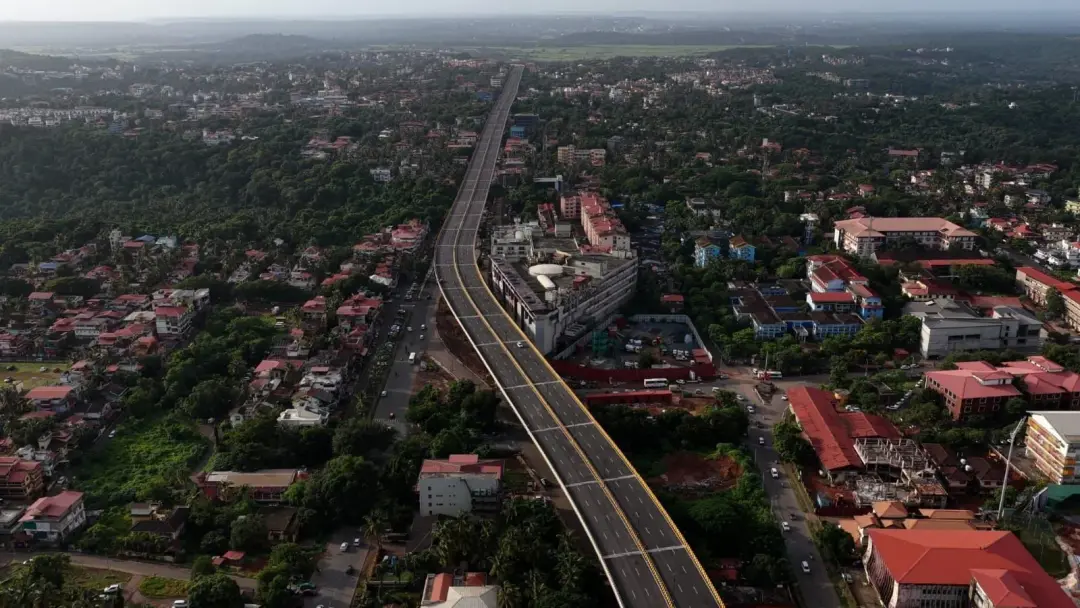
Goa commuters protest curbs on newly opened Porvorim flyover
Union Minister Nitin Gadkari inaugurated the 5.15-km, six-lane elevated corridor at Porvorim on National Highway-66 in Goa on September 9, and it opened to traffic on September 11. Within about 24 hours, a collision killed Sarvesh Vengurlekar (40) and Amita Salgaonkar (39). The PWD then barred two-wheelers and closed entry and exit points towards Atal Setu, except for emergency services. Commuters and residents criticised the curbs, built at Rs 641 crore. Minister Rohan Khaunte called them knee-jerk.
Source
Indian Express — India · read the original report ↗
Desk check · compared with the source
What the desk checked (5)
- Nitin Gadkari inaugurated the six-lane elevated corridor at Porvorim on NH-66 on September 9; it opened to the public on September 11. — Dates appear in source; attributed to reporting on the inauguration.
- Two people died after a speeding car hit a scooter and a truck on the flyover, identified as Sarvesh Vengurlekar (40) and Amita Salgaonkar (39). — Names and ages given in source; no police official cited by name.
- A PWD notification banned two-wheelers on the corridor and closed entry/exit points towards Atal Setu except for emergency services. — Attributed to the PWD notification quoted in the source.
- The 5.15-km corridor cost Rs 641 crore and is expected to carry 75,000-80,000 vehicles a day. — Figures appear in source, attributed to government estimates; not independently verifiable here.
- Minister Rohan Khaunte said he was 'not taken into confidence' and called the curbs 'knee jerk'. — Direct quote attributed to Khaunte speaking to the media.
Analysts’ view opinion
The political dividend of inaugurating a Rs 641-crore corridor evaporated within days, replaced by a row over restrictions — an awkward turn for the ruling establishment. The most telling element is not opposition attack but the fact that Porvorim's own BJP MLA and minister Rohan Khaunte publicly called the decisions "knee jerk" and said he was not taken into confidence. That points to a coordination gap inside government and a classic tension between the local elected representative and the technical/administrative machinery.
- The ribbon-cutting gain proved short-lived; the narrative has shifted from infrastructure delivery to safety and planning lapses.
- Constituency pressure is visible — Porvorim voters who endured years of construction disruption are unlikely to accept being locked out of the benefit, which is why the local MLA has sided with them.
- Khaunte's open displeasure with PWD decisions, and his call to fix responsibility on engineers, reads as an intra-government accountability fight rather than routine criticism.
- The government's strongest defence also exists: after two deaths, imposing temporary curbs while traffic patterns are assessed can be framed as prudent risk management.
- Because the highway falls in the Centre's domain while traffic curbs are a state call, there is political room for blame to be passed between the two.
What to watch — Watch the PWD review meeting called for later this week — whether the Atal Setu entry/exit points reopen and the two-wheeler ban is eased will decide if the government can defuse local anger.
The story does not establish whether the crash stemmed from a design flaw or speeding, nor how long the restrictions will last or how the Chief Minister and PWD Minister have responded.
Deep dive
Research brief · 8 facts · 6 dates · exam-readyThe brief
Context
Goa's Porvorim stretch of National Highway-66 is one of the state's most congested urban corridors, carrying traffic between Panaji, Porvorim, Mapusa and North Goa. To ease it, a 5.15-km, six-lane elevated corridor was built at a cost of Rs 641 crore and inaugurated by Union Road Transport and Highways Minister Nitin Gadkari on September 9, opening to traffic on September 11. Little over 24 hours after opening, a fatal collision on the flyover prompted the Public Works Department to impose "temporary traffic restrictions" — banning two-wheelers and closing entry/exit points towards Atal Setu — triggering protests from commuters, residents and even a BJP minister.
Key facts
- The Porvorim elevated corridor is 5.15 km long, six-lane, on National Highway-66, built at a cost of Rs 641 crore.
- Union Minister Nitin Gadkari inaugurated it on September 9; it opened to vehicular traffic on September 11.
- A little over 24 hours after opening, a speeding Baleno car hit a scooter and a truck from behind at the corridor's southern end.
- Scooter driver Sarvesh Vengurlekar (40), from Maharashtra, and Amita Salgaonkar (39), a Goa native seated in the car, died of injuries.
- A PWD notification prohibited all two-wheelers on the corridor, diverting them to service roads below.
- All entry and exit points and accesses towards the Atal Setu side were closed, except for emergency or essential services.
- Government estimates the corridor will carry 75,000 to 80,000 vehicles a day.
- The corridor was projected to improve links between Panaji, Porvorim, Mapusa, North Goa, Mopa International Airport and parts of Maharashtra.
Timeline
- September 9Union Minister Nitin Gadkari inaugurates the six-lane elevated corridor at Porvorim on NH-66.
- September 11The corridor is opened to the public and to vehicular traffic.
- A little over 24 hours after openingA speeding Baleno car collides with a scooter and a truck at the corridor's southern end; two people die.
- After the mishapPWD notification imposes temporary restrictions: two-wheelers banned; entry/exit points towards Atal Setu closed.
- Thursday (as reported)Tourism Minister Rohan Khaunte calls the curbs 'knee jerk' and asks PWD Minister Digambar Kamat to convene a meeting.
- Later this week (per PWD official)A meeting has been called to review the situation.
Who has a stake
- Goa Public Works Department (PWD) — Issued the notification imposing restrictions to assess traffic movement, patterns, congestion and operational performance of the corridor.
- Commuters and Porvorim residents — Face longer journeys and congestion on service roads after the main exit towards Panaji was barricaded; say they cannot use a flyover they suffered years of construction for.
- Two-wheeler riders — Barred from the corridor and diverted to service roads below after the fatal collision.
- Rohan Khaunte, Tourism Minister and BJP MLA from Porvorim — Says he was 'not taken into confidence'; demands review of restrictions, long-term measures and accountability for waterlogging on the new corridor.
- Digambar Kamat, PWD Minister — Asked by Khaunte to convene a meeting on the Porvorim flyover issue.
- Union Ministry of Road Transport and Highways / Nitin Gadkari — Inaugurated the NH-66 corridor; its safety and design performance is now under public scrutiny.
Why it matters
A Rs 641-crore highway asset meant to carry 75,000-80,000 vehicles a day became partly unusable for local commuters within days of opening, raising questions about design, safety audits and post-commissioning planning on national highways. The episode also shows how emergency traffic curbs, imposed without consulting local representatives, can shift congestion to service roads and erode public trust in big infrastructure.
UPSC angle
Prelims pointers
- Porvorim elevated corridor: 5.15 km, six-lane, on National Highway-66 in Goa; cost Rs 641 crore.
- Inaugurated by Union Road Transport and Highways Minister Nitin Gadkari on September 9; opened September 11.
- Atal Setu runs over the Mandovi river at Panaji and serves as a bypass for north-south travellers avoiding Panaji.
- Both Atal Setu and the Porvorim corridor lie along NH-66, Goa's heaviest traffic stretches near Panaji and Porvorim.
- Restrictions were notified by Goa's Public Works Department (PWD); two-wheelers diverted to service roads.
- Corridor projected to improve access to Mopa International Airport and North Goa's coastal belt.
Mains framing
The Porvorim flyover episode illustrates a recurring gap in Indian infrastructure delivery: physical completion is treated as the end point, while safety engineering, traffic management and last-mile integration are addressed only after a tragedy. Within roughly 24 hours of opening, a high-speed collision on the 5.15-km, Rs 641-crore NH-66 corridor killed two people, after which the PWD banned two-wheelers and shut all entry and exit points towards Atal Setu, closing the interchange that made the corridor useful to Porvorim residents. The result was displaced congestion onto service roads and the paradox of a bypass that forces a Mapusa-Porvorim commuter to travel to the Merces circle roundabout and back. The local MLA and Tourism Minister's complaint that he was "not taken into confidence" and his description of the curbs as "knee jerk", along with waterlogging reported on the new surface, point to weak stakeholder consultation and possible design or supervision lapses. A credible way forward, on the source's own terms, lies in the review meeting convened by the PWD: examining whether a specific stretch of the flyover is at fault, restoring interchange access with engineered safeguards, providing for two-wheelers rather than blanket exclusion, and fixing responsibility for construction quality — that is, replacing immediate prohibitions with long-term measures based on public feedback.
Key terms
- Elevated corridor
- A raised road built above existing ground-level roads; here a 5.15-km six-lane structure over the congested Porvorim stretch of NH-66.
- National Highway-66 (NH-66)
- The national highway along which both Atal Setu and the Porvorim elevated corridor run, covering Goa's heaviest traffic stretches.
- Atal Setu
- Bridge over the Mandovi river at Panaji that lets north-south travellers bypass the capital city; its interchange with the new corridor is now shut.
- Public Works Department (PWD)
- State department that issued the notification imposing temporary traffic restrictions on the corridor and has called a review meeting.
- Service road
- Parallel road at ground level beside a highway or flyover; two-wheelers were diverted to service roads below the corridor.
- Mopa International Airport
- North Goa airport to which the new corridor was expected to improve access, along with links to neighbouring Maharashtra.
Practice questions
- Newly built urban highway corridors in India often shift congestion rather than eliminate it. Examine, with reference to the Porvorim elevated corridor, the role of road safety audits and stakeholder consultation in project commissioning.
- "Blanket prohibitions are no substitute for engineering solutions." Critically analyse this statement in the context of banning two-wheelers on elevated corridors after fatal accidents.
- Discuss how the closure of interchange points between two bypasses can defeat the purpose of both, using the Atal Setu-Porvorim corridor case.
Grounded only in the source report — figures and dates are the source's, not inferred.