
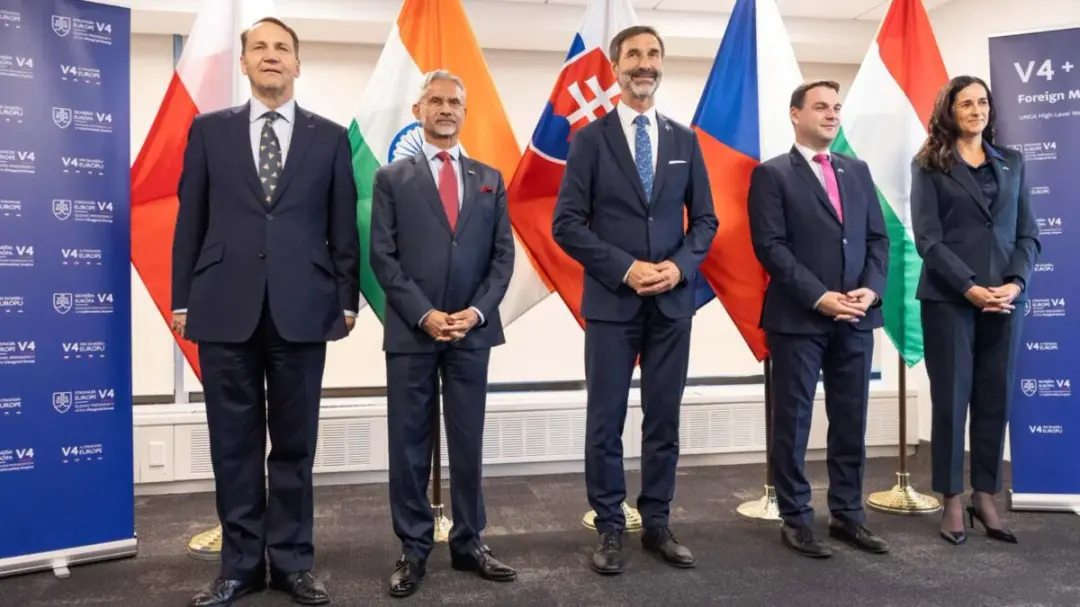
V4 nations back India's bid for permanent UNSC seat
The four Visegrad Group (V4) members — Poland, Hungary, Slovakia and the Czech Republic — backed India's bid for a permanent UN Security Council seat at their first foreign ministers' meeting with India on the sidelines of the UN General Assembly. Slovak Foreign Minister Juraj Blanar said India, part of the Global South and an upcoming superpower in the Indo-Pacific, must be at the table. The sides agreed to deepen political, economic, technology, defence and people-to-people ties, hold annual ministerial meetings and create a business forum.
Source
News18 — India · read the original report ↗
Desk check · compared with the source
What the desk checked (5)
- Poland, Hungary, Slovakia and the Czech Republic are united in supporting India's bid for a permanent UN Security Council seat — Attributed to Slovak Foreign Minister Juraj Blanar, with a direct quote in the source
- The meeting was the first V4-India foreign ministers' meeting, held on the sidelines of the UN General Assembly — Stated in source and attributed to Jaishankar, who called it a 'new historic occasion'
- The sides agreed to annual foreign ministers' meetings and an annual business forum — Appears in source as an outcome of the meeting; attributed to Jaishankar's remarks and X post
- Talks covered space, connectivity, research, education, defence, the Ukraine conflict and the Gulf situation — Listed in source without independent documentation beyond ministers' statements
- Source dateline is New York, first published September 22, 2026 — Figure appears in source; date is in the future relative to normal publishing and should be verified by the desk
Analysts’ view opinion
The V4 endorsement is a real diplomatic gain for India, but it is not the key that unlocks Security Council reform — a permanent seat requires a UN Charter amendment, a two-thirds General Assembly majority and the assent of all five veto powers. The genuine strategic value lies elsewhere: India has just built an institutional dialogue platform with four NATO and EU member states in Central Europe, and agreed to revive defence cooperation. The story notes Ukraine and the Gulf were on the agenda, which suggests this was more than a symbolic photo opportunity.
- V4 backing is valuable political signalling, but it does not shift the calculus of the veto-wielding powers on Council reform.
- "Reinvigorating" defence ties taps a long-standing Central European arms and defence-industrial relationship with India, and points toward supply diversification inside the EU space.
- Annual ministerial meetings and a business forum matter more than the declaration itself — institutional continuity is the real test of such groupings.
- The framing of India as both "Global South" and an "upcoming superpower in the Indo-Pacific" mirrors precisely the dual identity New Delhi seeks.
- Given that V4 members have publicly diverged on Ukraine policy, how much practical, unified weight the group can put behind India remains unclear.
What to watch — Watch whether the promised annual ministerial and business forum actually convene, and whether defence cooperation translates into concrete agreements or industrial tie-ups.
Beyond the statement of support, the story establishes no specific defence deals, economic commitments or agreed steps on Council reform — and says nothing about where the veto powers stand.
Deep dive
Research brief · 8 facts · 2 dates · exam-readyThe brief
Context
India has long sought a permanent seat on the UN Security Council, arguing that the Council's post-1945 composition does not reflect contemporary realities or the voice of the Global South. On the sidelines of the 81st UN General Assembly session in New York, India held its first-ever foreign ministers' meeting with the Visegrád Group (V4) — Poland, Hungary, Slovakia and the Czech Republic — a Central European grouping. At that meeting the four countries jointly backed India's permanent membership bid, and both sides agreed to institutionalise the format with annual ministerial meetings and a business forum.
Key facts
- The four V4 members — Poland, Hungary, Slovakia and the Czech Republic — backed India's bid for a permanent UN Security Council seat.
- The endorsement came at the first V4-India foreign ministers' meeting, held on the sidelines of the UN General Assembly (UNGA81) in New York.
- Slovak Foreign Minister Juraj Blanár said India, as part of the Global South and an 'upcoming superpower in the Indo-Pacific region', must be at the table as a permanent UNSC member.
- External Affairs Minister S Jaishankar called the first V4-India foreign ministers' meeting a 'new historic occasion'.
- The sides agreed to strengthen political, economic, technology, defence and people-to-people ties.
- They agreed to hold annual meetings of their foreign ministers and to create an annual business forum.
- Talks covered space, connectivity, research, education and cultural exchanges, plus the presence of Indian students in the four countries.
- The ministers also discussed the Ukraine conflict and the situation in the Gulf, and agreed to work together to support multilateralism.
Timeline
- September 21, 2026First V4 + India foreign ministers' meeting held on the sidelines of UNGA81; Jaishankar posts Blanár's remarks on X.
- September 22, 2026 (04:34 IST)Report on the V4 backing for India's permanent UNSC seat first published, datelined New York.
Who has a stake
- India / Ministry of External Affairs — Seeks a permanent UNSC seat and a larger role in the UN's top decision-making body; gains four more supporting voices in Europe.
- Visegrád Group (Poland, Hungary, Slovakia, Czech Republic) — Deeper political, economic, technology and defence engagement with India through a new institutionalised dialogue format.
- Juraj Blanár, Slovak Foreign Minister — Articulated the V4's united position backing India's permanent membership.
- S Jaishankar, External Affairs Minister — Led India's side; pushed to 'refresh' long-standing defence cooperation and expand tech and innovation ties.
- United Nations Security Council — Its composition and reform agenda are at issue as more states endorse expanding permanent membership.
- Indian students in V4 countries — People-to-people and education ties flagged as a focus area of the new partnership.
Why it matters
Support from a bloc of four Central European EU members adds diplomatic weight to India's decades-long campaign for permanent UNSC membership and to the wider case for Security Council reform. The meeting also converts an ad hoc contact into a standing format — annual ministerials plus a business forum — extending India's European outreach beyond the big West European capitals into Central Europe, including in defence and technology.
UPSC angle
Prelims pointers
- Visegrád Group (V4) members: Poland, Hungary, Slovakia, Czech Republic.
- First-ever V4-India foreign ministers' meeting held on the sidelines of the UN General Assembly (UNGA81), September 2026.
- Slovak Foreign Minister Juraj Blanár announced the V4's united support for India's permanent UNSC seat.
- India's EAM at the meeting: S Jaishankar, who termed it a 'new historic occasion'.
- Outcomes: annual foreign ministers' meetings and an annual India-V4 business forum.
- Agreed cooperation areas: political, economic, technology and innovation, defence, space, connectivity, research, education, culture, people-to-people.
Mains framing
India's claim to a permanent UN Security Council seat rests on the argument that the Council's structure does not reflect current global power distribution or the voice of the Global South — a case Slovakia's foreign minister echoed by describing India as an 'upcoming superpower in the Indo-Pacific' that 'must be at the table'. The V4's collective endorsement, delivered at the first India-Visegrád ministerial on the UNGA sidelines, illustrates how India is broadening its reform coalition by cultivating sub-regional European groupings rather than relying only on major capitals; it also dovetails with New Delhi's interest in Central European defence industry links, technology and innovation partnerships, and the large Indian student presence in these countries. Implications include a marginally stronger diplomatic base for Council reform and a new institutionalised channel — annual ministerials and a business forum — for trade, space, connectivity and research cooperation, even as the two sides must manage divergent perspectives on the Ukraine conflict and the Gulf. The way forward, as signalled in the source, lies in converting declaratory support into sustained engagement: regular ministerial reviews, the promised business forum, refreshed defence cooperation and joint advocacy for multilateralism.
Key terms
- Visegrád Group (V4)
- A grouping of four Central European countries — Poland, Hungary, Slovakia and the Czech Republic — which met India's EAM jointly for the first time.
- UN Security Council permanent membership
- Permanent seats in the UN's top decision-making body, which India seeks as part of its long-standing reform demand.
- UN General Assembly (UNGA81)
- The annual UN gathering in New York, on whose sidelines the first V4-India foreign ministers' meeting was held.
- Global South
- Term used by Blanár to describe India's constituency, invoked as a reason India must sit at the UNSC table.
- India-V4 business forum
- An annual forum the two sides agreed to create to deepen economic engagement.
Practice questions
- Evaluate India's case for permanent membership of the UN Security Council. How does support from groupings such as the Visegrád Group advance this claim?
- Discuss the significance of India's engagement with Central European sub-regional groupings for its wider Europe policy, with reference to the first India-V4 foreign ministers' meeting.
- The India-V4 meeting identified technology, defence, space and people-to-people ties as priority areas. Examine the opportunities and constraints in translating such declarations into outcomes.
Grounded only in the source report — figures and dates are the source's, not inferred.