
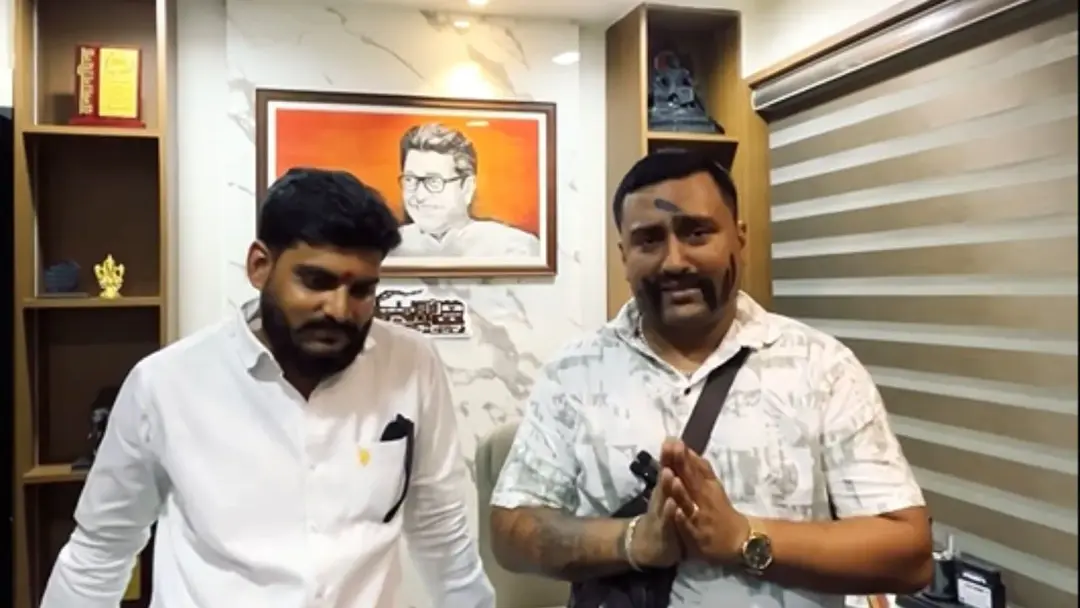
Influencer made to apologise in Pune over Raj Thackeray remarks
Maharashtra Navnirman Sena (MNS) activists in Pune on Sunday smeared black paint on social media influencer Mahesh Mote's face, made him do sit-ups with a slipper on his head and forced him to apologise over his remarks about party chief Raj Thackeray. Activists confronted him at a park in Katraj and took him to the party office. MNS leader Shubham Jagdale called it the party's "signature mahaprasad" treatment. Mote later apologised in a Facebook video.
Source
Indian Express — Cities · read the original report ↗
Desk check · some claims need care
What the desk checked (5)
- MNS activists smeared black paint on Mahesh Mote's face and made him do sit-ups with a slipper on his head in Pune on Sunday. — Stated in source as fact but no police statement or named eyewitness given; no source attribution.
- Mote had posted a video about a month ago questioning why he was mocked for shaving his moustache while leaders like Raj Thackeray were not. — Source quotes Mote's remark directly from the video.
- MNS leader Shubham Jagdale said Mote was given the party's 'signature mahaprasad' treatment and warned of 'tit-for-tat' replies. — Attributed by name and designation to Jagdale, Deputy Division President, Hadapsar Assembly constituency.
- Mote left Pune for Kerala after the online backlash. — Hedged in source with the word 'reportedly'; no source named.
- Mote posted a Facebook video apologising and said MNS workers had not bullied him. — Source quotes the video directly; statement made after the alleged coercion.
Analysts’ view opinion
At its core this is a case of a private group substituting itself for the courts on a question of speech, which sits uneasily with the Article 19(1)(a) framework — in Indian law only police and courts decide whether a remark crosses a legal line. The conduct described in the story — blackening a man's face, intercepting him and taking him to a party office, forcing sit-ups and an apology — could, if established, attract penal provisions on wrongful restraint or confinement, assault or use of criminal force, and intentional humiliation. Calling it a "signature mahaprasad" treatment carries no legal weight as a defence, and the open warning of similar treatment to others is itself a distinct concern.
- Even if Mote's remarks were genuinely offensive, the lawful remedy is a complaint or a defamation action, not self-administered punishment.
- Interception, being taken to a party office and coerced acts — as described — are the kind of allegations that typically map onto cognisable offences involving restraint, force and humiliation.
- A victim saying he was not bullied does not close the matter: for cognisable offences police can act on their own, and an apology extracted under pressure carries little legal value.
- Supreme Court jurisprudence on mob action and vigilantism has repeatedly placed a positive duty on state authorities to prevent and prosecute such self-appointed policing.
- The stated promise of a "tit-for-tat reply" to anyone making similar remarks could be read as intimidation with a chilling effect well beyond this one individual.
What to watch — Watch whether police register an FIR on their own motion despite the apology, which sections are invoked against which individuals, and whether the available video material is treated as evidence.
The story does not establish whether any FIR has been filed, how police have responded, what the party's official position is, or whether Mote's original remarks face any legal proceeding — and none of the allegations has been tested in court.
Deep dive
Research brief · 8 facts · 4 dates · exam-readyThe brief
Context
Maharashtra Navnirman Sena (MNS) activists in Pune publicly humiliated social media influencer Mahesh Mote on Sunday evening over a video he had posted about a month earlier, in which he referred to party chief Raj Thackeray while complaining about taunts he received for shaving off his moustache. Activists smeared black paint on his face, made him do sit-ups with a slipper on his head, and forced him to apologise by prostrating before a photograph of Thackeray. An MNS office-bearer publicly defended the act, calling it the party's "signature mahaprasad" treatment and warning of similar "tit-for-tat" responses. Mote later posted a Facebook video repeating his apology and saying he had not been bullied.
Key facts
- MNS activists in Pune "punished" influencer Mahesh Mote on Sunday over alleged remarks against party chief Raj Thackeray.
- The punishment involved smearing black paint on Mote's face, making him do sit-ups with a slipper on his head, and forcing him to apologise.
- The video that triggered the backlash was posted about a month before the incident.
- In the video, Mote asked why he was taunted as a transgender for shaving his moustache while leaders like Raj Thackeray, who had removed his moustache for years, were spared.
- Mote had reportedly left Pune for Keralam after the online backlash, and the confrontation happened after he returned.
- Activists confronted Mote at a park in Katraj and took him to the MNS local office, where he was made to prostrate before a photo of Thackeray.
- Shubham Jagdale, Deputy Division President of MNS's Hadapsar Assembly constituency, called it the party's "signature mahaprasad" treatment.
- Jagdale warned that anyone making similar remarks would get an equally "fitting, tit-for-tat reply" from the party.
Timeline
- About a month before the incidentMote posts a video questioning why he was mocked for shaving his moustache while leaders like Raj Thackeray were not.
- After the videoSharp online backlash; Mote reportedly leaves Pune for Keralam.
- Sunday evening (after his return to Pune)MNS activists confront Mote at a Katraj park, take him to the party's local office and make him apologise before Thackeray's photo.
- Sunday, laterMote posts a Facebook video repeating his apology and saying MNS workers had not bullied him.
Who has a stake
- Mahesh Mote, social media influencer — Physically humiliated and made to apologise publicly; had reportedly left Pune for Keralam after online backlash.
- Maharashtra Navnirman Sena (MNS) — Its activists' actions and the public defence of them shape the party's image and its claim to enforce respect for its chief.
- Raj Thackeray, MNS chief — The remarks were allegedly against him; the punishment was framed as a defence of his honour.
- Shubham Jagdale, Deputy Division President, MNS Hadapsar Assembly constituency — Publicly defended the action as the party's "signature mahaprasad" and warned of similar responses.
- Social media users and content creators — Face the risk of extra-legal retribution for commenting on political leaders.
- Police and law enforcement (Pune) — Action taken, if any, on the incident is not stated in the source.
Why it matters
The incident shows political party workers acting as enforcers of public humiliation outside any legal process, with a party office-bearer openly defending it and threatening repeat action. It raises questions about free speech online, the safety of content creators who criticise or merely mention political leaders, and the state's response when such coercion is publicised rather than hidden.
UPSC angle
Prelims pointers
- Maharashtra Navnirman Sena (MNS) is headed by Raj Thackeray; the incident occurred in Pune.
- Location of the confrontation: a park in Katraj, Pune; Mote was then taken to the MNS local office.
- Shubham Jagdale is Deputy Division President of MNS's Hadapsar Assembly constituency.
- The phrase used by the MNS leader for the punishment: "signature mahaprasad" treatment.
- Mote's original video, posted about a month earlier, referenced Raj Thackeray while discussing taunts over his shaved moustache.
- Mote reportedly left Pune for Keralam after the online backlash and was confronted on his return.
Mains framing
The Pune incident, in which MNS activists blackened an influencer's face, made him do sit-ups with a slipper on his head and forced him to prostrate before the party chief's photograph, illustrates how political outfits can substitute street retribution for legal remedies when they perceive an insult to their leader. The trigger was minor and rhetorical: Mote's video merely compared online taunts he faced to the absence of similar taunts against leaders, including Raj Thackeray. Two features deepen the concern: the punishment was defended openly by a party office-bearer, who branded it the party's "signature mahaprasad" and promised "tit-for-tat" responses to future critics; and the victim, after the episode, publicly denied being bullied and blamed himself, a pattern that suggests coercion can also silence complaints. The implications run from chilling effects on ordinary content creators, who lack institutional protection, to the normalisation of vigilante discipline in public life. The way forward lies in prompt, visible legal action against acts of public humiliation irrespective of the perpetrators' political affiliation, protection and confidence-building for complainants so that apologies extracted under duress are not treated as closure, and party-level accountability for office-bearers who publicly endorse such methods. The source does not state what action, if any, the police have taken.
Key terms
- Maharashtra Navnirman Sena (MNS)
- Political party led by Raj Thackeray, whose Pune activists carried out the punishment of the influencer.
- Raj Thackeray
- MNS chief; the influencer's remarks about him triggered the online backlash and the punishment.
- "Signature mahaprasad"
- Term used by MNS leader Shubham Jagdale to describe the party's punishment meted out to Mote.
- Katraj
- Pune locality where the park is situated at which activists confronted Mote before taking him to the party office.
- Hadapsar Assembly constituency
- Pune constituency where Shubham Jagdale is MNS's Deputy Division President.
- Social media influencer
- A content creator with an online following; here, Mahesh Mote, who posted the video about moustache-related taunts.
Practice questions
- Extra-legal punishment by party workers, publicly defended by office-bearers, poses a distinct challenge to the rule of law. Discuss with reference to the Pune influencer incident.
- How do intimidation and forced apologies affect freedom of expression for ordinary social media users? Suggest safeguards.
- Examine the responsibility of political parties for the conduct of their local activists, and the mechanisms available to hold them accountable.
Grounded only in the source report — figures and dates are the source's, not inferred.