
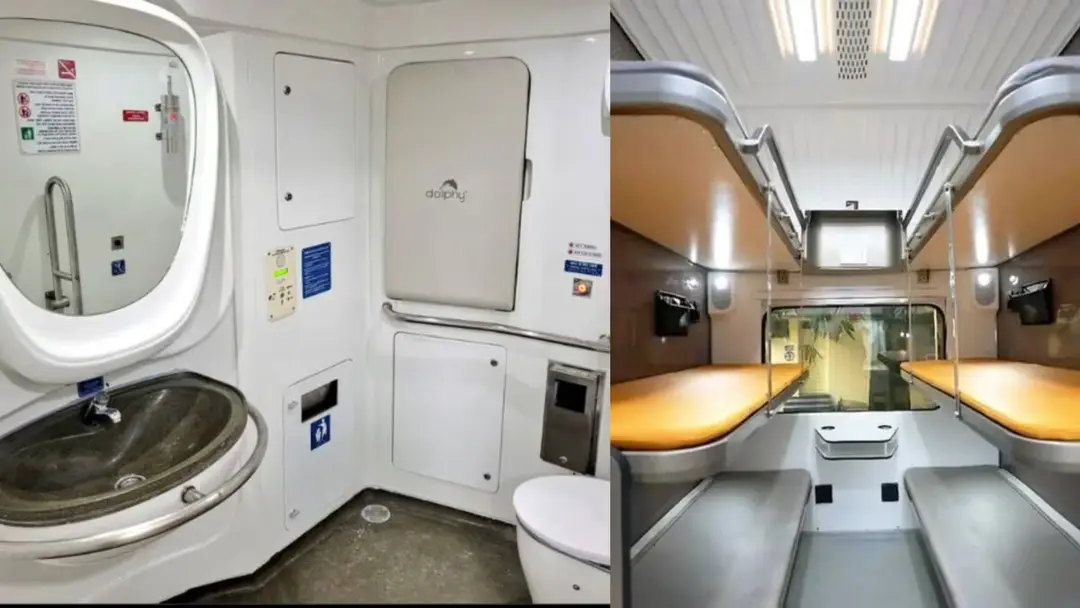
Sleeper Vande Bharat proposed on Delhi-Varanasi overnight route
Indian Railways is planning a second Sleeper Vande Bharat service on the New Delhi-Varanasi route. Under the proposed schedule, the train would leave at around 9:20 PM and arrive at about 5 AM, running via Prayagraj and Kanpur Central. The Times of India reported a 16-coach formation seating 823 passengers, with 11 AC 3-tier, four AC 2-tier and one First AC coach. Officials are targeting a Diwali launch. The Railway Board has not confirmed the train number, fares or final timetable.
Source
News18 — India · read the original report ↗
Desk check · some claims need care
What the desk checked (5)
- Proposed Sleeper Vande Bharat would leave New Delhi and Varanasi Cantt around 9:20 PM and arrive around 5 AM, via Prayagraj and Kanpur Central. — Attributed in source to a schedule reported by railway officials; described as provisional, no named official.
- Train would have 16 coaches with capacity for 823 passengers — 11 AC 3-tier, four AC 2-tier and one First AC. — Source attributes the figures to a report in The Times of India; internally consistent.
- Launch is targeted around Diwali, subject to trials and operational approvals. — Attributed to railway officials 'reportedly'; source states Railway Board has not confirmed date, fares, train number or timetable.
- Railway Ministry said in April 2026 that the New Delhi-Varanasi route carried over 73 lakh passengers, the busiest Vande Bharat route. — Attributed to the Railway Ministry; figure appears in source and cannot be independently verified here.
- Service could run at 130-160 kmph subject to track conditions and Mission Raftaar progress. — Stated conditionally in source without named attribution.
Analysts’ view opinion
The Delhi–Varanasi corridor is not just Indian Railways' busiest Vande Bharat route; it is also one of the country's most symbolically loaded, linking the national capital with the Prime Minister's constituency. That makes the plan for a second Sleeper Vande Bharat here, timed for Diwali, more than a routine operational decision — it doubles as a festive-season delivery message. Yet the story itself notes the train number, fares and final timetable are unconfirmed, so this remains a proposal, and the political dividend depends on the announcement actually converting into a running service.
- The Delhi–Prayagraj–Kanpur–Varanasi alignment touches politically significant urban centres in Uttar Pradesh, giving any new service outsized visibility.
- Aiming for a Diwali launch serves both a practical need — peak festive travel demand — and the familiar logic of well-timed announcements.
- An overnight option with 823 berths hands the governing side a concrete, tangible 'delivery' narrative aimed at middle-class, business and pilgrimage travellers.
- The predictable counter-argument is whether premium trains crowd out capacity for ordinary and regional services — a debate that will sharpen once fares are published.
- Because this sits with the Union Railway Ministry, credit is likely to accrue centrally, with limited scope for state-level contestation.
What to watch — Watch whether the Railway Board issues its formal notification — train number, fares and start date — before Diwali, and who fronts the launch.
The story establishes no political motive whatsoever; it reports a proposed schedule only, with trials, approvals and fares still pending.
Deep dive
Research brief · 8 facts · 4 dates · exam-readyThe brief
Context
Indian Railways is planning a second Sleeper Vande Bharat service, this time as an overnight train between New Delhi and Varanasi via Prayagraj and Kanpur Central. Sleeper Vande Bharat rakes are the berth-based version of the Vande Bharat family, designed for long-distance night travel with modern safety and comfort features. The New Delhi-Varanasi corridor is already the busiest Vande Bharat route, and officials are reportedly targeting a launch around Diwali, subject to trial runs and operational clearances. The Railway Board has not yet confirmed the train number, fares, final timetable or regular operation date.
Key facts
- Proposed schedule: departure from New Delhi at around 9:20 PM and arrival in Varanasi at approximately 5 AM the next morning.
- In the reverse direction, the train would leave Varanasi Cantt around 9:20 PM, reach Prayagraj about 10:45 PM, pass Kanpur Central about 12:35 AM and reach New Delhi about 5 AM.
- The Times of India reported a 16-coach formation with capacity for 823 passengers.
- Coach composition: 11 AC 3-tier coaches, four AC 2-tier coaches and one First AC coach.
- The Railway Ministry said in April 2026 that the New Delhi-Varanasi route had carried more than 73 lakh passengers, making it the busiest Vande Bharat route.
- The service could run at speeds of around 130 kmph to 160 kmph, subject to track conditions and progress of the Mission Raftaar initiative.
- Safety and comfort features include KAVACH-related provisions, fire barrier doors, automatic plug doors, CCTV cameras, emergency talk-back units and semi-permanent couplers with anti-climbers.
- Northern Railway is likely to be responsible for the primary maintenance of the proposed train, as per reports.
Timeline
- April 2026Railway Ministry says the New Delhi-Varanasi route has carried more than 73 lakh passengers, making it the busiest Vande Bharat route.
- September 23, 2026Report published on the proposed second Sleeper Vande Bharat between Delhi and Varanasi, with provisional timings and coach composition.
- Around Diwali (targeted)Railway officials reportedly aim to launch the service, subject to trials and operational approvals.
- PendingRailway Board yet to confirm train number, fares, final timetable and regular operation date.
Who has a stake
- Indian Railways / Railway Board — Must clear trials, timetable, train number and fares before the service can begin regular operation.
- Northern Railway — Likely to handle primary maintenance of the proposed rake.
- Overnight passengers on the Delhi-Varanasi corridor — Gain a berth-based option instead of conventional seating on India's busiest Vande Bharat route.
- Intermediate cities Prayagraj and Kanpur — Served by the proposed route with late-night stops, improving connectivity to Delhi and Varanasi.
- Divyangjan passengers — Specially designed lavatories in driving coaches and ergonomic berth ladders aimed at accessibility.
Why it matters
The Delhi-Varanasi corridor is the busiest Vande Bharat route, having carried more than 73 lakh passengers as per the Railway Ministry in April 2026, so adding an overnight sleeper service targets proven demand. It also signals Indian Railways' shift from chair-car day trains to sleeper Vande Bharat rakes for long-distance night travel, with speeds tied to Mission Raftaar and track upgrades.
UPSC angle
Prelims pointers
- New Delhi-Varanasi is the busiest Vande Bharat route: over 73 lakh passengers, per Railway Ministry, April 2026.
- Proposed Sleeper Vande Bharat: 16 coaches, 823 passengers - 11 AC 3-tier, 4 AC 2-tier, 1 First AC.
- Proposed route stops: Prayagraj and Kanpur Central between New Delhi and Varanasi Cantt.
- Mission Raftaar is the initiative linked to raising speeds to around 130-160 kmph on the route.
- KAVACH is the train safety provision cited among the Sleeper Vande Bharat features.
- Northern Railway is likely to carry out primary maintenance of the proposed rake.
Mains framing
The proposed New Delhi-Varanasi Sleeper Vande Bharat illustrates how Indian Railways is matching rolling stock to demand patterns: the corridor is already the busiest Vande Bharat route with over 73 lakh passengers (Railway Ministry, April 2026), and a 9:20 PM to 5 AM timing converts a full day journey into a night trip, freeing daytime hours for travellers. The 16-coach, 823-berth configuration skewed towards AC 3-tier suggests an attempt to balance premium service with affordability, while features such as KAVACH-related provisions, automatic plug doors, fire barrier doors, CCTV, emergency talk-back units and Divyangjan-friendly lavatories reflect a safety-and-accessibility orientation in newer designs. The binding constraints are operational rather than technological: the 130-160 kmph potential depends on track conditions and the progress of Mission Raftaar, and the schedule itself is provisional pending trial runs and clearances. The way forward lies in completing trials, firming up fares and the timetable through formal Railway Board notification, ensuring maintenance capacity at Northern Railway, and sequencing track and signalling upgrades so that sleeper Vande Bharat rakes actually realise their design speeds rather than running as premium-branded conventional services.
Key terms
- Sleeper Vande Bharat
- Berth-based version of the Vande Bharat train designed for overnight and long-distance journeys instead of chair-car seating.
- KAVACH
- Train safety provision referenced among the features built into Sleeper Vande Bharat coaches.
- Mission Raftaar
- Indian Railways initiative on which higher operating speeds of about 130-160 kmph for the proposed service depend.
- Railway Board
- Apex body that must officially confirm the train number, fares, final schedule and regular operation date.
- Northern Railway
- Zonal railway likely to be responsible for primary maintenance of the proposed rake.
- Divyangjan
- Persons with disabilities, for whom specially designed lavatories are provided in the driving coaches.
Practice questions
- Discuss how the introduction of Sleeper Vande Bharat services on high-density corridors such as New Delhi-Varanasi can reshape long-distance passenger travel in India.
- Higher train speeds in India are constrained more by infrastructure than by rolling stock. Examine this statement with reference to Mission Raftaar.
- Evaluate the safety and accessibility features being built into new Indian Railways rolling stock, using the proposed Delhi-Varanasi Sleeper Vande Bharat as an example.
Grounded only in the source report — figures and dates are the source's, not inferred.