
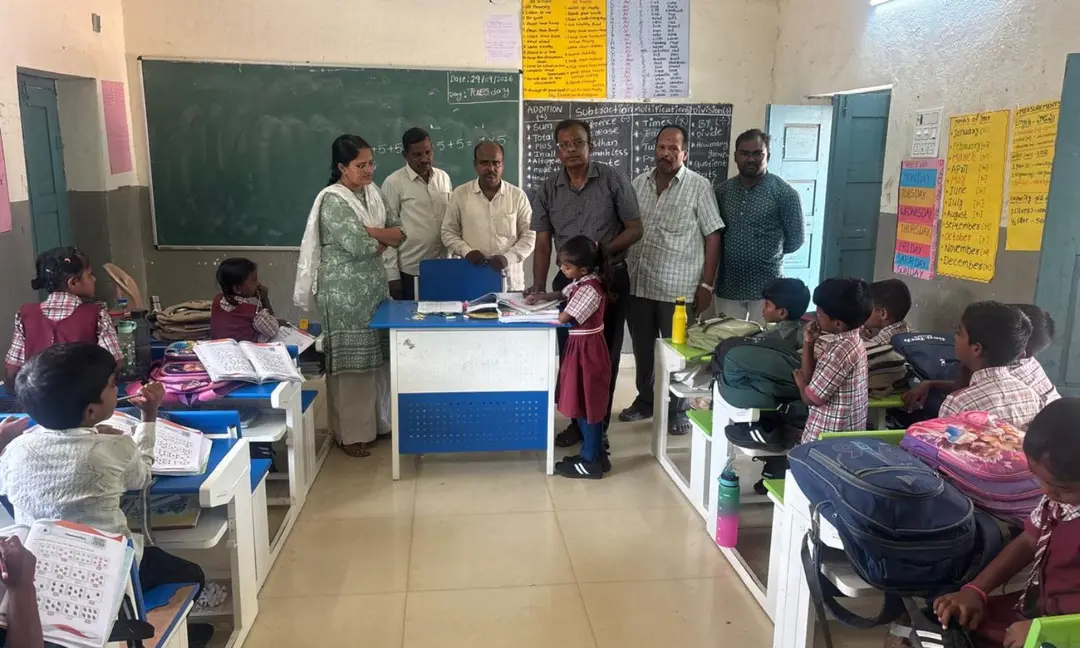
Officials inspect primary schools in Nirmal district
Officials made a surprise visit to the Boothkoor and Dasturabad primary schools at Dasturabad mandal headquarters in Nirmal district and personally tested students' learning levels. They said teachers are responsible for ensuring that students from Classes 1 to 5 speak English fluently by the time they complete primary schooling, and directed planned efforts from now. After examining school records, they questioned students in classrooms, expressed satisfaction with their performance and advised further improvement in English skills. Headmaster Kota Venu, additional nodal officers Narasayya and Maheshwar and IRP Edla Jagan participated.
Source
Nirmal — స్థానికం · read the original report ↗
Desk check · some claims need care
What the desk checked (4)
- Officials made a surprise visit to Boothkoor and Dasturabad primary schools in Dasturabad mandal, Nirmal district. — Place names appear in source; the visiting officials are not named or designated.
- Teachers were told students of Classes 1-5 must speak English fluently by the end of primary schooling. — Attributed in source to the unnamed visiting officials.
- Officials checked records, questioned students and expressed satisfaction with their performance. — Described in source; no data or documentation cited.
- Headmaster Kota Venu, additional nodal officers Narasayya and Maheshwar, and IRP Edla Jagan attended. — Names listed in source as participants.
Analysts’ view opinion
Surprise inspections are the cheapest, fastest oversight tool a school system has — but they diagnose problems rather than fix them. What stands out here is that officials moved beyond checking registers to questioning children directly in the classroom, which fits a broader shift in education governance from inputs to learning outcomes. Yet framing fluent English by Class 5 as a duty resting on teachers leaves the harder policy question — training, teaching material, staffing — unaddressed in this account.
- Unannounced visits deliver high oversight value at low cost, but their impact depends entirely on documented follow-up and repeat visits.
- Testing students directly rather than stopping at records is a meaningful step toward outcome-based monitoring.
- How an English-fluency target sits alongside the widely accepted priority of foundational literacy and numeracy in the mother tongue is not spelled out.
- Assigning an ambitious target to frontline teachers alone risks recasting systemic gaps — vacancies, multi-grade teaching, thin training — as individual failure.
- The presence of nodal officers and a resource person suggests a middle tier of supervision exists; whether it functions routinely will decide if such checks become a system or stay one-off events.
What to watch — Watch for whether this visit produces a written report, concrete teacher training or teaching-learning material, and a follow-up inspection at the same schools.
The story does not establish which department the officials belong to, how many schools were covered, what benchmark was used to judge learning levels, or whether this was part of a sustained drive or a single visit.
Deep dive
Research brief · 8 facts · 3 dates · exam-readyThe brief
Context
Education officials in Telangana's Nirmal district carried out an unannounced inspection of two government primary schools — Boothkoor and Dasturabad — at Dasturabad mandal headquarters. Rather than only checking registers, they entered classrooms and personally tested pupils' learning levels by questioning them. The visit's central instruction was that children of Classes 1 to 5 should be able to speak English fluently by the time they finish primary schooling, and that teachers must work towards this in a planned way from now on. Such surprise visits are a routine monitoring tool used to verify learning outcomes and school record-keeping on the ground.
Key facts
- Officials made a surprise (unannounced) visit to Boothkoor and Dasturabad primary schools at Dasturabad mandal headquarters in Nirmal district.
- Officials personally tested students' learning abilities during the visit instead of relying only on reports.
- The directive covered students of Classes 1 to 5, the full primary schooling stage.
- Officials said the responsibility of making students speak English fluently by the time they leave primary school rests on teachers.
- Teachers were directed to work in a planned manner from now on to achieve this English fluency goal.
- Officials thoroughly examined school records before entering classrooms.
- Officials questioned students in classrooms and drew answers from them, expressing satisfaction with their performance.
- Participants included Headmaster Kota Venu, additional nodal officers Narasayya and Maheshwar, IRP Edla Jagan and school staff.
Timeline
- Date not stated in the sourceOfficials make a surprise visit to Boothkoor and Dasturabad primary schools in Dasturabad mandal, Nirmal district.
- During the visitStudents' learning levels tested personally; teachers directed to ensure English fluency by the end of primary schooling.
- After the directiveSchool records scrutinised, students questioned in classrooms; officials express satisfaction and advise further improvement in English skills.
Who has a stake
- Students of Classes 1 to 5 in the two primary schools — Their learning levels were directly tested; expected to attain fluent spoken English before leaving primary school.
- Teachers of the schools — Held responsible for building students' English fluency and asked to follow a planned approach from now.
- Headmaster Kota Venu — Accountable for school records, classroom teaching quality and implementing the officials' directions.
- Additional nodal officers Narasayya and Maheshwar, and IRP Edla Jagan — Monitoring officials responsible for inspecting learning outcomes and guiding school-level improvement.
- Nirmal district education administration — Credibility of its monitoring system and of learning-outcome improvement in government primary schools.
- Parents and the local community of Dasturabad mandal — Quality of government schooling, especially English-language competence, affects their children's future options.
Why it matters
Surprise inspections that test children directly, rather than only checking registers, shift school monitoring from paperwork compliance to actual learning outcomes. The emphasis on spoken English at the primary stage reflects the demand from parents in government schools for English competence as a route to wider opportunity, and places clear accountability on teachers.
UPSC angle
Prelims pointers
- Nirmal is a district in Telangana; Dasturabad is a mandal within it — the schools inspected were Boothkoor and Dasturabad primary schools.
- Primary schooling in the source covers Classes 1 to 5.
- Officials named: Headmaster Kota Venu; additional nodal officers Narasayya and Maheshwar; IRP Edla Jagan.
- The inspection involved two steps: scrutiny of school records and direct oral questioning of students in classrooms.
- The stated goal: fluent spoken English for students by the time they complete primary education.
- Officials expressed satisfaction with students' performance but advised further improvement in English skills.
Mains framing
Surprise school inspections of the kind carried out at Boothkoor and Dasturabad primary schools in Nirmal district illustrate a shift in education monitoring from verifying inputs and records to testing learning outcomes directly in the classroom. The officials' directive — that teachers are responsible for ensuring students of Classes 1 to 5 can speak English fluently by the time they complete primary schooling, and must plan for it from now — reflects both rising parental aspiration for English in government schools and the accountability burden placed on teachers, who must deliver a second-language competence alongside foundational literacy and numeracy in the mother tongue. The implications are twofold: such spot checks can surface real learning gaps that paper reporting hides, but a fluency target without stated support — teacher training, teaching-learning material or time allocation, none of which is mentioned in the source — risks becoming exhortation rather than reform. A grounded way forward, as far as the source supports, lies in combining routine record scrutiny with direct student assessment, converting the officials' satisfaction-plus-improvement feedback into school-level plans, and sustaining follow-up visits so that the English-fluency goal is tracked over the full primary cycle rather than measured in a single inspection.
Key terms
- Mandal
- An administrative sub-district unit in Telangana; Dasturabad mandal headquarters hosted the inspected schools.
- Primary school (Classes 1 to 5)
- The first stage of school education referred to in the source, after which students leave for upper primary levels.
- Learning levels / abilities
- Students' actual competence in reading, answering and speaking, which officials tested in person rather than inferring from records.
- Additional nodal officer
- An officer given supervisory charge of monitoring schools in a designated area; Narasayya and Maheshwar held this role here.
- IRP
- A resource-person designation in the school monitoring team; Edla Jagan participated as IRP. Full form not stated in the source.
- Surprise inspection
- An unannounced official visit to a school to check records and verify teaching and learning as they actually happen.
Practice questions
- Surprise inspections that test students directly can reveal learning gaps that record-based monitoring cannot. Examine, with reference to the Nirmal district inspection, how school monitoring can be made outcome-oriented.
- Should spoken English fluency be a stated target for students completing Class 5 in government primary schools? Discuss the opportunities and the challenges for teachers.
- Discuss the role of nodal officers and resource persons in strengthening accountability for learning outcomes at the primary school level.
Grounded only in the source report — figures and dates are the source's, not inferred.