
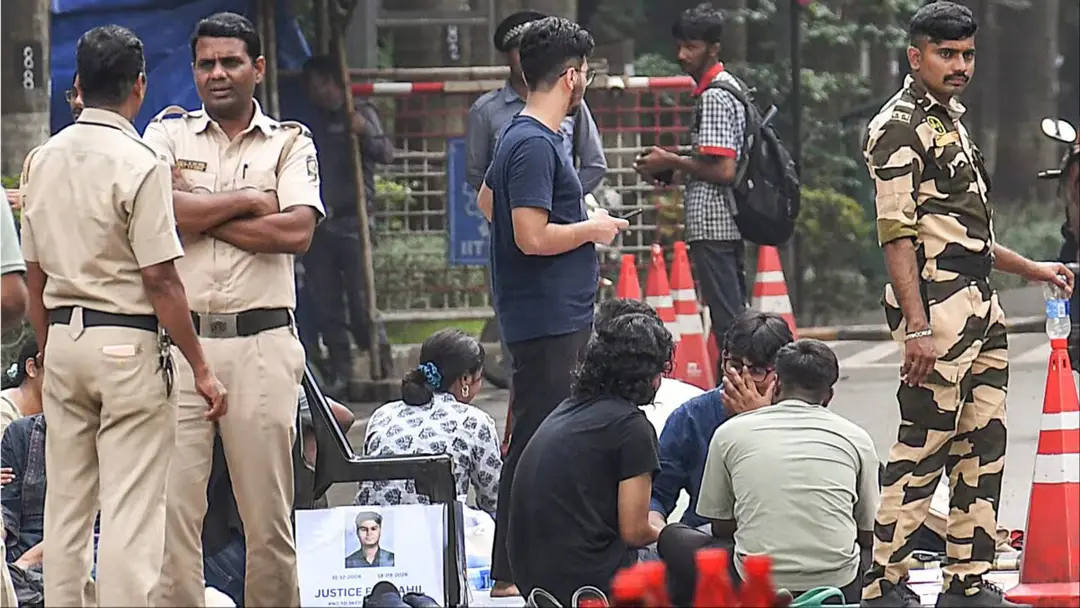
IIT Bombay signs 18-point charter on discipline, mental health reforms
IIT Bombay Director Professor Shireesh Kedare has signed an 18-point charter with protesting students after a student's death on the Powai campus. The demands include changes to the Disciplinary Action Committee process, a code of conduct for faculty, improved mental-health services with a 24-hour psychiatrist-on-call facility, student representation with voting rights on committees, grievance redressal and an independent investigation. The institute has denied allegations of harassment and caste discrimination; the matter is under investigation.
Source
News18 — India · read the original report ↗
Desk check · some claims need care
What the desk checked (5)
- IIT Bombay Director Professor Shireesh Kedare signed an 18-point charter with protesting students. — Stated in source as an agreement reached; attributed to the institute's administration, no document cited.
- The charter seeks changes in disciplinary procedures, faculty code of conduct, mental-health support, student representation with voting rights, grievance redressal and accountability. — Detailed in source; consistent across the article and its summary box.
- The student's family alleges harassment and caste-based discrimination, which IIT Bombay has denied. — Attributed to the family and the institute respectively; matter described as under investigation.
- The Faculty Forum defended Professor Suryanarayana Doolla, saying he followed prescribed procedure. — Attributed to the Faculty Forum; a linked item separately refers to his suspension, so status should be verified before publishing.
- IIT Bombay apologised for earlier statements on the circumstances of the student's death. — Reported in source without a quoted statement; no date or text of apology given.
Analysts’ view opinion
This is more than a campus settlement — it is an attempt to fold four distinct governance areas, disciplinary process, faculty conduct, mental health and student representation, into a single charter. What makes it notable is not the list of demands but the compliance machinery attached to it: time-bound reports, written implementation updates and accountability if reforms are not delivered within the stipulated period. Even so, it remains an IIT Bombay arrangement; the story does not establish a system-wide policy change across the IITs.
- The key design shift sought is a clearer separation between detecting academic misconduct and assessing a student's welfare needs — not diluting integrity rules, but attaching a welfare protocol alongside them.
- The demand for student representation with voting rights is the most contested element, because it redistributes authority in processes traditionally driven by faculty and administration.
- A 24-hour psychiatrist-on-call facility and a distress task force signal a move from a complaint-driven model to early identification — which is precisely where staffing, funding and continuity make implementation hard.
- The institute has denied the harassment and caste-discrimination allegations and the Faculty Forum says the professor followed prescribed procedure, so with the facts contested, written protocols and documentation protect both students and faculty.
- The institute's apology for commenting on the circumstances before an official investigation pushes crisis communication into the governance frame — separating verified facts, allegations and matters still under inquiry.
What to watch — Watch whether the written implementation updates and the independent investigation report arrive within the stipulated timelines, and whether other IITs review their own disciplinary, grievance and mental-health systems on their own initiative.
The story establishes only that the charter was signed — it does not establish how any demand will actually be implemented, the truth of the allegations, or whether any change will extend beyond IIT Bombay.
Deep dive
Research brief · 8 facts · 6 dates · exam-readyThe brief
Context
After the death of a student on IIT Bombay's Powai campus, protesting students negotiated with the administration and Director Professor Shireesh Kedare signed an 18-point charter. The charter goes beyond the individual case, seeking changes in disciplinary procedures, faculty conduct, mental-health support, student representation, grievance redressal and institutional accountability. The student's family has alleged harassment and caste-based discrimination; IIT Bombay has denied this and the matter is under investigation. The institute has also apologised for commenting on the circumstances of the death before an official investigation.
Key facts
- IIT Bombay Director Professor Shireesh Kedare signed an 18-point charter with protesting students on the Powai campus.
- The charter covers disciplinary procedures, faculty conduct and code of conduct, mental-health support, student representation with voting rights, grievance redressal and institutional accountability.
- Mental-health demands include a task force of students, faculty, mental-health professionals and external experts, plus a 24-hour psychiatrist-on-call facility.
- IIT Bombay rules allow penalties for unauthorised possession or use of electronic devices in examinations, including a one-semester academic suspension in specified circumstances.
- The institute's disciplinary framework allows appeals on grounds of procedural error, new evidence, bias or discrimination.
- The charter seeks an independent investigation, time-bound reports, written implementation updates and accountability if reforms are not implemented within the stipulated period.
- The Faculty Forum defended Professor Suryanarayana Doolla, saying he followed the institute's prescribed procedure after detecting alleged academic malpractice.
- IIT Bombay said the student was counselled and assured the examination incident would not adversely affect his academic career.
Timeline
- Before the protestAn examination incident involving alleged academic malpractice; the institute says the student was counselled and assured his career would not be affected.
- SubsequentlyA student dies on the Powai campus; the family alleges harassment and caste-based discrimination, which IIT Bombay denies.
- After the deathStudents protest; IIT Bombay apologises for its earlier communication commenting on the circumstances of the death before an official investigation.
- After the protestDirector Professor Shireesh Kedare signs the 18-point charter with protesting students; the matter remains under investigation.
- Around the same periodIIT Kharagpur Director Suman Chakraborty addresses students on exam pressure, urging those facing overwhelming circumstances to seek help.
- September 21, 2026News18 report published analysing five possible institutional after-effects of the 18-point charter.
Who has a stake
- IIT Bombay administration and Director Shireesh Kedare — Must implement the 18-point charter, defend institutional processes and manage crisis communication amid an ongoing investigation.
- Protesting students at IIT Bombay — Seek voting rights on committees, reformed disciplinary and grievance processes, mental-health reforms and an apology over the deceased student's public portrayal.
- The deceased student's family — Has alleged harassment and caste-based discrimination and seeks accountability through an independent investigation.
- Professor Suryanarayana Doolla and the Faculty Forum — The Forum says Doolla followed prescribed procedure after detecting alleged academic malpractice; faculty face demands for a code of conduct and complaint mechanisms.
- Other IITs, including IIT Kharagpur — May face pressure to review their own disciplinary, grievance-redressal and mental-health systems before a similar crisis arises.
- Counselling and medical services on campus — Expected to shift from reactive counselling to preventive early identification of distress, including 24-hour psychiatrist availability.
Why it matters
The charter is one of the rare instances where a premier engineering institute has formally committed, in writing, to student-drafted reforms in discipline, mental health and governance. If implemented, it could redefine how academic-integrity cases are handled alongside student welfare, and how much voice students get in faculty- and administration-driven committees. Its wider significance for the IIT system will depend entirely on whether the commitments produce measurable change on the ground.
UPSC angle
Prelims pointers
- 18-point charter signed by IIT Bombay Director Professor Shireesh Kedare with protesting students at the Powai campus.
- Charter demands include a 24-hour psychiatrist-on-call facility and a student-faculty-expert task force on student distress.
- IIT Bombay rules provide for up to one-semester academic suspension for unauthorised electronic devices in exams, in specified circumstances.
- Appeals against disciplinary action are allowed on grounds of procedural error, new evidence, bias or discrimination.
- IIT Bombay's Faculty Forum defended Professor Suryanarayana Doolla over the alleged academic malpractice case.
- IIT Kharagpur Director Suman Chakraborty publicly told students that an exam or grade should not define their identity or future.
Mains framing
The IIT Bombay episode illustrates how disciplinary enforcement, academic pressure and inadequate welfare escalation can converge into a crisis in elite technical institutions. The immediate trigger was an examination-related misconduct case followed by a student's death, with the family alleging harassment and caste-based discrimination and the institute denying it, leaving the facts under investigation. The 18-point charter identifies systemic gaps: disciplinary processes without an accompanying welfare protocol, absence of a faculty code of conduct and clear timelines for complaints against professors, counselling models that depend on students approaching help rather than early identification of distress, minimal student voice in committees that govern them, and institutional communication that comments on unverified details. The way forward suggested by the charter is procedural rather than rhetorical: separating detection of misconduct from assessment of student welfare, written protocols for faculty communication, documentation and escalation, a preventive mental-health task force with 24-hour psychiatrist access, student representation with voting rights, time-bound independent investigation, written implementation updates and accountability if deadlines are missed. The test is whether these translate into measurable change at IIT Bombay and whether other IITs audit their own systems pre-emptively rather than after a similar tragedy.
Key terms
- 18-point charter
- The written agreement signed by IIT Bombay's Director with protesting students listing reform demands across discipline, mental health, faculty conduct and student representation.
- Disciplinary Action Committee (DAC)
- The IIT Bombay body that handles academic misconduct cases; the charter seeks changes to its process and greater scrutiny of how cases are handled.
- Faculty Forum
- The association of IIT Bombay faculty that publicly defended Professor Suryanarayana Doolla, saying he followed prescribed procedure.
- Psychiatrist-on-call facility
- A demanded round-the-clock (24-hour) psychiatric availability on campus, beyond routine counselling services.
- Student representation with voting rights
- The demand that students sit with votes, and in some cases equal representation, on academic and non-academic committees dealing with student matters.
- Crisis communication
- How an institution publicly presents facts, allegations and matters under investigation; IIT Bombay apologised for commenting prematurely on the death.
Practice questions
- The IIT Bombay 18-point charter argues that disciplinary processes must be accompanied by a welfare protocol. Examine how higher education institutions can balance academic integrity enforcement with student mental-health safeguards.
- Should students have voting rights on committees that decide disciplinary and welfare matters in autonomous technical institutions? Critically discuss with reference to the IIT Bombay agreement.
- Institutional crisis communication after a student death involves distinguishing verified facts, allegations and matters under investigation. Discuss the accountability implications for public educational institutions.
Grounded only in the source report — figures and dates are the source's, not inferred.