
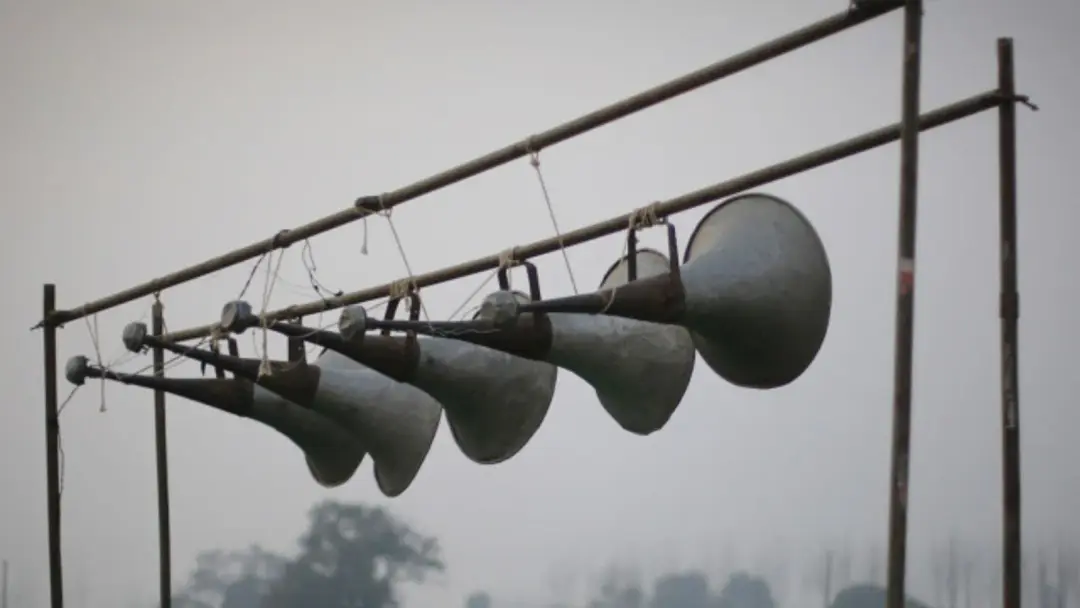
Pune forum welcomes Bombay HC order on noise pollution
Punekars Against Loudspeakers has welcomed the Bombay High Court order issued on Tuesday on noise pollution. A division bench of Justice Girish Kulkarni and Justice Dr. Neela Gokhale had taken suo motu cognisance of noise from religious processions. Forum head Mukund Kirdat said the order imposes a complete ban on bursting firecrackers on public roads, makes display of procession permissions mandatory for mandals and bans use of cylinders as musical instruments. Police must monitor decibel levels, and Silent Zones are to be notified.
Source
Indian Express — Cities · read the original report ↗
Desk check · some claims need care
What the desk checked (5)
- A division bench of Justice Girish Kulkarni and Justice Dr. Neela Gokhale took suo motu cognisance of noise pollution from religious processions. — Appears in source; named judges, but detail relayed via the forum's statement rather than the court record.
- The order bans bursting firecrackers on public roads, bans use of cylinders as musical instruments, and makes display of procession permissions mandatory for mandals. — Attributed to Mukund Kirdat of Punekars Against Loudspeakers; order text not quoted directly in source.
- Police and competent authorities must monitor decibel levels and act if permissible limits are exceeded; Silent Zones to be officially notified. — Attributed to Kirdat; source says a detailed order is yet to be issued.
- The order is a rebuke to the Chief Minister, politicians, mandal workers and the Mayor. — Opinion expressed by Kirdat, not a finding stated in the source as coming from the court.
- Maharashtra Pollution Control Board measures sound levels through contractors with little practical result. — Unverified assertion by Kirdat; no data or official response given in source.
Analysts’ view opinion
This looks like an environmental story, but its roots are unmistakably political. With the Bombay High Court taking suo motu cognisance of noise from religious processions, an administration that has so far avoided confrontation with Ganesh mandals and procession organisers now has to operate inside a court-defined framework. Forum head Mukund Kirdat's framing of the order as a "slap" to the Chief Minister, the Mayor and mandal workers is an attempt to convert a regulatory question into one of political accountability — though it is worth remembering this is his characterisation, not the court's language.
- Festival mandals function as powerful local mobilising networks, so tightening rules on them is politically costly for any party — which is why judicial intervention can double as political cover for those in office.
- Kirdat's charge that citizens were "forced onto the streets" hands the opposition a ready-made line about local governance failure.
- The question of why what works in Nagpur and Solapur cannot work in Pune sharpens comparisons between cities and raises pressure on local police and municipal leadership.
- By naming coordination between the Police Commissioner, the Pollution Control Board and the Municipal Commissioner, the order makes responsibility for any failure far easier to pin down.
- Kirdat's line that mandals have "always adopted a progressive approach" is strategically conciliatory — seeking cooperation rather than open conflict serves the forum better than confrontation.
What to watch — Watch the tone of the state government, the city police and mandal associations once the detailed order is out — whether they signal compliance or push for relaxations.
All the order's specifics and the criticism of the Chief Minister and Mayor come from the forum's spokesperson; the full text of the court's order and any response from the government or the mandals are not established here.
Deep dive
Research brief · 8 facts · 3 dates · exam-readyThe brief
Context
Pune has seen sustained citizen protests against extremely loud sound systems, dhol-tasha troupes and firecrackers during religious processions, especially Ganesh festival processions. A citizens' forum, Punekars Against Loudspeakers, led by Mukund Kirdat, has been demanding enforcement of noise norms. A division bench of the Bombay High Court, comprising Justice Girish Kulkarni and Justice Dr. Neela Gokhale, took suo motu cognisance of noise pollution caused by religious processions and passed an order on Tuesday for immediate implementation. The forum has welcomed the order as a "first stage of success".
Key facts
- The Bombay High Court order on noise pollution was issued on Tuesday and is meant for immediate implementation.
- The division bench of Justice Girish Kulkarni and Justice Dr. Neela Gokhale took suo motu cognisance of noise pollution caused by religious processions.
- The court directed a complete ban on bursting firecrackers on public roads.
- Mandals have been made to compulsorily display the permission granted for processions.
- Police and other competent authorities must monitor and regulate decibel levels during processions and act as per law if permissible limits are exceeded.
- The court banned the use of cylinders as musical instruments by dhol tasha troupes.
- The court instructed that Silent Zones be officially notified, a demand raised by Punekars Against Loudspeakers.
- The court raised the forum's question of why practices followed in Nagpur and Solapur cannot be implemented in Pune; a detailed order is to follow.
Timeline
- Before the orderLarge numbers of Punekars took to the streets demanding a check on 'forced, deafening noise'; the Chief Minister advised ignoring the controversy, per Kirdat.
- TuesdayBombay High Court division bench issues order on noise pollution from religious processions, for immediate implementation.
- After the orderPunekars Against Loudspeakers welcomes the order; a detailed order on all these matters is awaited.
Who has a stake
- Punekars Against Loudspeakers (forum head Mukund Kirdat) — Has campaigned against deafening procession noise; calls the order the first stage of success for protesting citizens.
- Bombay High Court division bench (Justices Girish Kulkarni and Neela Gokhale) — Took suo motu cognisance and issued directions; a detailed order is to follow.
- Ganesh mandals and dhol-tasha troupes — Must display procession permissions and stop using cylinders as musical instruments; celebrations face regulation.
- Pune Police / Police Commissioner — Must monitor decibel levels on the spot, act against violations, and, per Kirdat, curb vulgar and obscene displays.
- Maharashtra Pollution Control Board — Its contractor-based sound measurement is criticised as yielding little practical result; must coordinate on enforcement.
- Pune Municipal Commissioner — Named as a coordinating authority, along with Police Commissioner and MPCB, to relieve Punekars of noise.
- Residents in and near Silent Zones — Stand to benefit if Silent Zones are officially notified and enforced.
Why it matters
Noise from festival processions is a recurring public health and civic-rights flashpoint in Pune, where citizens say existing rules were not enforced on the ground. By ordering on-spot police monitoring, notification of Silent Zones and bans on road firecrackers and cylinder "instruments", the High Court shifts the burden from paper measurement by contractors to actual enforcement by local authorities. It also tests whether judicial directions can override political reluctance to regulate popular festivals.
UPSC angle
Prelims pointers
- Bombay High Court bench in the noise pollution matter: Justice Girish Kulkarni and Justice Dr. Neela Gokhale.
- Suo motu cognisance means a court taking up an issue on its own, without a petition being filed.
- Order directs: complete ban on firecrackers on public roads; mandatory display of procession permissions by mandals.
- Use of cylinders as musical instruments by dhol tasha troupes banned.
- Silent Zones to be officially notified; police and competent authorities to monitor decibel levels.
- Maharashtra Pollution Control Board (MPCB) currently measures sound levels through contractors at several locations.
Mains framing
Festival noise pollution in Pune illustrates the gap between regulatory norms and enforcement: the Maharashtra Pollution Control Board measures sound through contractors at several locations, but as the forum argues, this yields little practical result, while police and civic authorities have been reluctant to act against politically influential mandals. Citizen mobilisation — street protests by Punekars and the demands of Punekars Against Loudspeakers — pushed the issue into the judicial arena, and the Bombay High Court's suo motu intervention converted civic grievance into enforceable directions: a complete ban on firecrackers on public roads, mandatory display of procession permissions, a ban on cylinders used as musical instruments, on-spot decibel monitoring with action as per law, and official notification of Silent Zones. The implications are twofold: it establishes that religious and cultural celebration cannot override the right to a quiet, healthy environment, and it relocates accountability to named local officials. The way forward, as the forum suggests, lies in coordinated action by the Police Commissioner, the Pollution Control Board and the Pune Municipal Commissioner, replication of practices already followed in cities like Nagpur and Solapur, and voluntary cooperation by mandals — which, Kirdat notes, have historically adopted a progressive approach to positive change — pending the detailed order.
Key terms
- Suo motu cognisance
- A court taking up a matter on its own initiative rather than on a petition; used here by the Bombay HC on procession noise.
- Silent Zone
- An area where stricter noise limits apply; the court has instructed that such zones be officially notified.
- Maharashtra Pollution Control Board (MPCB)
- State body that measures sound levels, currently through contractors at several locations, per the forum.
- Dhol tasha troupes
- Traditional percussion groups in Maharashtra processions; barred by the order from using cylinders as musical instruments.
- Mandal
- Community festival organising committee (e.g. Ganesh mandals), now required to display procession permissions.
- Punekars Against Loudspeakers
- Pune citizens' forum headed by Mukund Kirdat campaigning against forced, deafening festival noise.
Practice questions
- Examine how judicial suo motu intervention has shaped the enforcement of noise pollution norms during religious festivals, using the Bombay High Court's order on Pune processions as a case study.
- "Noise pollution control fails not for want of rules but for want of enforcement." Discuss with reference to contractor-based monitoring by pollution control boards versus on-spot inspection by police.
- How should authorities balance the right to celebrate religious festivals with citizens' right to a quiet and healthy environment? Illustrate with the directions on Silent Zones, firecrackers and decibel limits.
Grounded only in the source report — figures and dates are the source's, not inferred.