
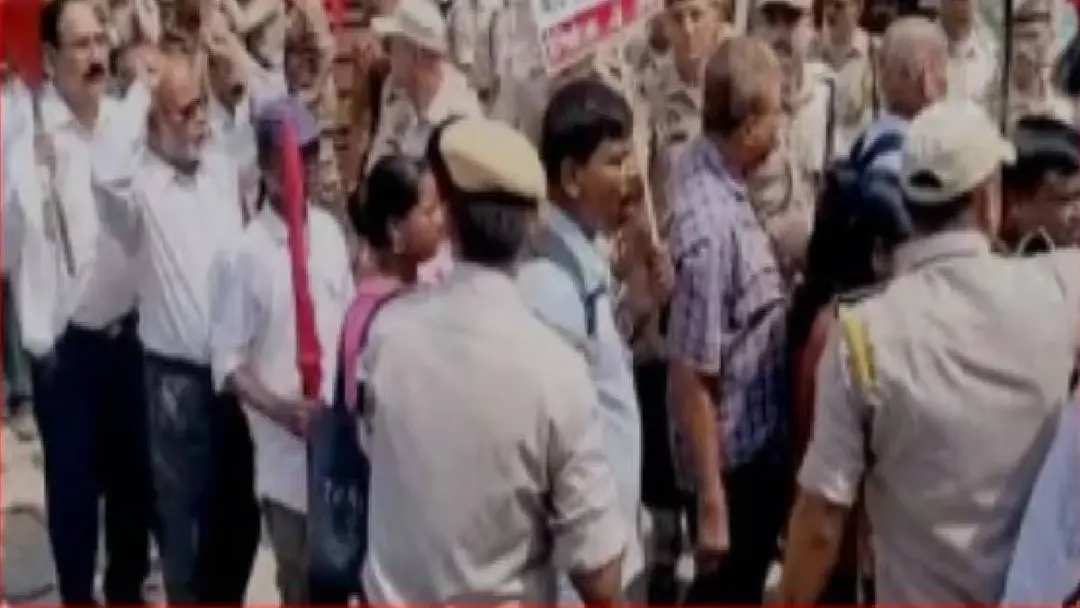
Left parties in Guwahati seek Rs 25 lakh for Assam flood victims' families
The CPI(M), along with several other Left parties, staged a protest at Volvo Point in Ulubari, Guwahati, on Wednesday, October 7, demanding enhanced compensation for Upper Assam flood victims. Hundreds of workers sought Rs 25 lakh for families of those who died and immediate financial assistance for affected families. They also demanded that Assam's recurring flood problem be declared a national issue and that Chief Election Commissioner Gyanesh Kumar resign. The protest escalated into a scuffle with police, who detained several demonstrators and took them to the dharna venue at Chachal.
Source
Left (CPI-M) · read the original report ↗
Desk check · compared with the source
What the desk checked (5)
- CPI(M) and other Left parties protested at Volvo Point, Ulubari, Guwahati on Wednesday, October 7. — Stated in source with date and venue; no official attribution given.
- Protesters demanded Rs 25 lakh compensation for families of those who died in Upper Assam floods. — Figure appears in source as a protest demand, attributed to the demonstrators.
- Left parties demanded Assam's recurring flood problem be declared a national issue. — Attributed to Left parties in source.
- Protesters sought the resignation of Chief Election Commissioner Gyanesh Kumar. — Reported in source as a demand raised at the demonstration; no quote provided.
- Several protesters were detained and later taken to the dharna venue at Chachal. — Source gives no exact number or police statement; based on reporter description and visuals.
Analysts’ view opinion
With the Left electorally marginal in Assam, this is street politics as relevance-building: own the flood-compensation grievance even if you cannot win the seat count. The Rs 25 lakh figure looks deliberately high — if the government moves closer to it, the Left claims credit; if it does not, the gap becomes the charge of neglect. Folding in a demand for the Chief Election Commissioner's resignation signals an attempt to tie a local disaster agitation to a wider national opposition narrative.
- Demanding that Assam's floods be declared a national issue is a framing move that shifts responsibility from the state to the Centre.
- Naming a specific compensation figure gives the opposition a yardstick against which any government relief announcement can be measured.
- Attaching the CEC resignation demand broadens the protest into opposition-unity territory, but also risks diluting its disaster-relief focus.
- Detentions and a scuffle hand the Left visibility it rarely gets, while allowing the government side to recast the episode as a law-and-order matter.
- Upper Assam is politically significant terrain, so relief dissatisfaction there is the kind of grievance larger parties may also pick up.
What to watch — Watch whether the state government responds with any formal relief or compensation announcement, and whether larger opposition parties including the Congress adopt the same demand.
The story does not establish how many were detained, what triggered the clash, what compensation is currently on offer, or how the government has responded.
Deep dive
Research brief · 8 facts · 4 dates · exam-readyThe brief
Context
The CPI(M) and allied Left parties held a street protest in Guwahati over the handling of floods in Upper Assam, demanding higher compensation for the families of those killed and immediate relief for affected households. Assam faces recurring annual flooding that damages homes, property and livelihoods, and the Left parties want this treated as a national issue rather than a state-level disaster. The demonstration at Volvo Point in Ulubari also carried a separate political demand — the resignation of Chief Election Commissioner Gyanesh Kumar — and ended in a scuffle with police and several detentions.
Key facts
- CPI(M) along with several other Left parties staged a protest at Volvo Point in Ulubari, Guwahati, on Wednesday, October 7.
- Protesters demanded Rs 25 lakh compensation for the families of each person who lost their life in the Upper Assam floods.
- Hundreds of party workers and supporters participated in the demonstration.
- The Left parties demanded immediate financial assistance for families affected by the floods.
- They demanded that Assam's recurring flood problem be declared a national issue.
- Protesters also raised a political demand for the resignation of Chief Election Commissioner Gyanesh Kumar.
- The protest escalated into a confrontation with police; several protesters were detained.
- Detained protesters were taken from the Ulubari site to the dharna venue at Chachal to continue their demonstration.
Timeline
- Wednesday, October 7CPI(M) and other Left parties stage a protest at Volvo Point, Ulubari, Guwahati, demanding enhanced flood compensation.
- Same day, during the protestProtesters demand Rs 25 lakh per deceased victim's family, immediate aid, national-issue status for Assam floods, and the CEC's resignation.
- Later that dayProtest escalates into a scuffle with police; several demonstrators are detained.
- After detentionProtesters are shifted from Ulubari to the dharna venue at Chachal, where they were expected to continue agitating.
Who has a stake
- CPI(M) and allied Left parties — Leading the agitation for enhanced flood compensation and seeking to convert flood relief into a political and national-level issue.
- Families of Upper Assam flood victims — Seeking Rs 25 lakh compensation for deaths and immediate financial assistance for losses to homes, property and livelihoods.
- Flood-affected residents of Upper Assam — Need adequate relief for damage to houses, property and livelihoods caused by the floods.
- Assam Police — Managing the protest; personnel attempted to control demonstrators amid a scuffle and detained several protesters.
- Chief Election Commissioner Gyanesh Kumar — Target of the protesters' political demand for his resignation.
- Assam state government and Centre — Under pressure on relief adequacy and on the demand to declare Assam's recurring floods a national issue (response not stated in the source).
Why it matters
Assam's floods recur every year, and the adequacy of compensation and relief directly determines whether affected families recover their homes and livelihoods. The demand to declare the floods a national issue raises the larger question of how disaster responsibility and funding are shared between the state and the Centre. The protest also shows how disaster relief becomes a political flashpoint, with the opposition linking it to wider demands such as the CEC's resignation.
UPSC angle
Prelims pointers
- CPI(M) stands for Communist Party of India (Marxist); it led the Guwahati protest with other Left parties.
- Protest venue: Volvo Point, Ulubari, Guwahati; dharna venue: Chachal.
- Compensation demanded: Rs 25 lakh for each family of a person who died in Upper Assam floods.
- Left parties demanded that Assam's recurring flood problem be declared a national issue.
- Protesters sought the resignation of Chief Election Commissioner Gyanesh Kumar.
- Date of protest: Wednesday, October 7; report published Oct 07, 2026.
Mains framing
Assam's annual floods are a structural disaster-governance problem, and the CPI(M)-led protest in Guwahati reframes it as a question of compensation adequacy and jurisdiction: the Left parties want Rs 25 lakh for each family that lost a member, immediate financial assistance for affected households, and the recurring floods declared a national issue because of their extensive impact on lives, property and livelihoods across the state. The demand reflects a familiar tension in Indian disaster management — state governments bear the immediate relief burden while the scale of damage is often national in character, raising questions about the quantum and speed of ex gratia payments and about whether episodic relief can substitute for durable flood mitigation. The protest's escalation into a scuffle, with police detaining demonstrators and shifting them from Ulubari to the designated dharna site at Chachal, also illustrates the civil-liberties dimension of protest regulation in urban spaces. A way forward, on the evidence of the story, would involve transparent and time-bound disbursal of relief to verified affected families and a clear official response to the demand for national-issue status; the governments' position is not stated in the source.
Key terms
- CPI(M)
- Communist Party of India (Marxist), the Left party that led the Guwahati protest along with several other Left parties.
- Ex gratia compensation
- Relief payment to victims' families; here the protesters demanded Rs 25 lakh per family of a flood fatality.
- Dharna
- A sit-in protest; detained demonstrators were taken to the designated dharna venue at Chachal to continue agitating.
- Chief Election Commissioner (CEC)
- Head of the Election Commission of India; protesters demanded the resignation of CEC Gyanesh Kumar.
- National issue (for floods)
- Demand that Assam's recurring floods be officially recognised as a national-level problem given their statewide impact.
- Upper Assam
- The region of Assam whose flood victims and affected families were the focus of the compensation demands.
Practice questions
- Assam's floods recur annually. Examine the arguments for and against declaring them a 'national issue', and discuss how relief responsibility is shared between the Centre and the states.
- Discuss the role of ex gratia compensation in disaster response. Is monetary relief an adequate substitute for long-term flood mitigation? Illustrate with the demands raised in the Guwahati protest.
- Protest and public order: critically analyse the balance between the right to peaceful assembly and police powers of detention, using the Ulubari-Chachal episode as a reference.
Grounded only in the source report — figures and dates are the source's, not inferred.