
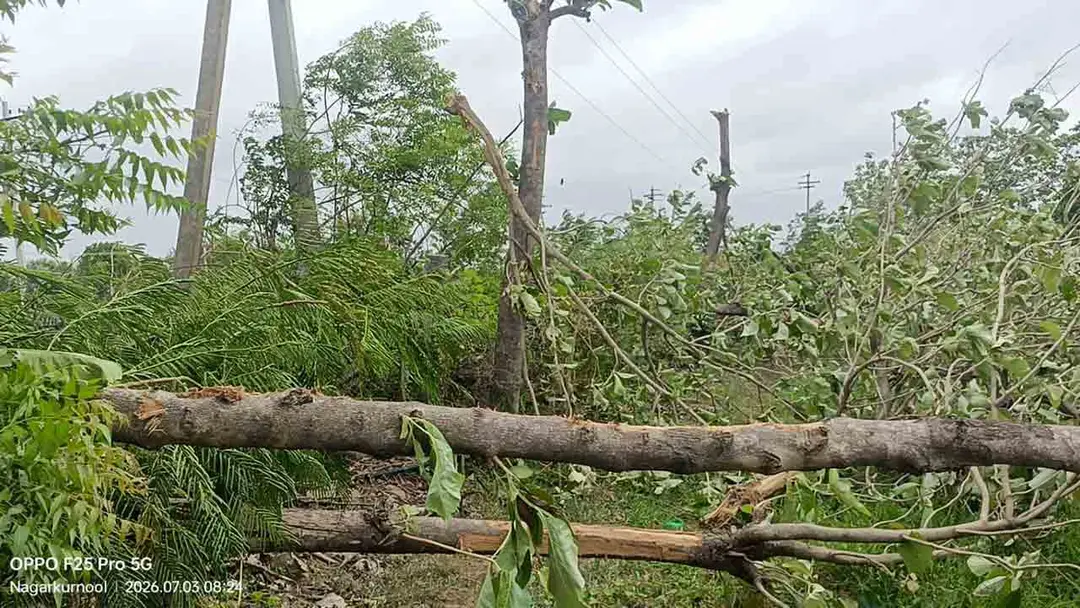
Farmers allege 18 teak trees felled in Nagarkurnool village
Farmers have alleged that 18 large teak trees, planted about 20 years ago on land belonging to Gadi Buchchanna (survey number 46) on the outskirts of Endabetla village in Nagarkurnool mandal, Nagarkurnool district, were brought down using a JCB. They said the trees were removed on Wednesday night without prior notice, on the grounds that they obstructed a power line. Officials are denying responsibility, farmers said, adding that they have complained to forest officials. Villagers are seeking an inquiry and compensation.
Source
Nagarkurnool — వార్తలు · read the original report ↗
Desk check · some claims need care
What the desk checked (5)
- 18 teak trees planted about 20 years ago in survey number 46, belonging to Gadi Buchchanna, were felled with a JCB. — Attributed to farmers' allegations in the source; no official confirmation or independent verification cited.
- The trees were removed on Wednesday night without prior notice, in the name of tree cutting for a power line. — Farmers' account as stated in the source; no departmental statement given.
- Rules require prior intimation to the farmer and removal of only branches in the farmer's presence. — Presented as a procedural norm in the source without citing the specific rule or authority.
- Electricity officials denied any connection with the incident when contacted. — Reported by farmers, not as a direct quote from officials; unverified.
- A complaint has been lodged with forest department officials. — Attributed to the farmers; no confirmation from the forest department in the source.
Analysts’ view opinion
This is not a story about 18 trees; it is about a smallholder family's two-decade savings asset being wiped out in a single night. Timber species like teak function as a farmer's long-horizon deposit — money goes in for twenty years before any return comes out — which makes the loss hard to price but certainly not small. Line safety is a genuine public good, but if its cost lands without notice on one farmer, the distribution of that cost is the real problem.
- In long-rotation timber, almost all value arrives at harvest, so felling before maturity converts twenty years of labour, water and land use into near-total loss.
- Trimming only the branches under the line is the cheaper social option; felling whole trees may be simpler for the utility but shifts the entire cost onto the landowner.
- Prior notice and the farmer's presence are not mere formalities — they create the record needed to verify and value damage, and their absence has now turned valuation itself into a dispute.
- If responsibility stays blurred between the power department, the forest department and the JCB contractor, compensation gets delayed, which is an extra cost in time and stress for the farmer.
- Repeated incidents of this kind erode the incentive for farmers to grow timber on field margins, weakening a useful source of income diversification and tree cover.
What to watch — Watch how the forest department's inquiry values the felled teak and whether liability is fixed on the utility or on the contractor — those two questions will decide the economic outcome of this case.
The story does not establish the market value of the felled teak, whether the trees genuinely obstructed the line, whether any permission existed, or where the timber went; these remain farmers' allegations, not verified official findings.
Deep dive
Research brief · 8 facts · 5 dates · exam-readyThe brief
Context
Farmers in Endabetla village, on the outskirts of Nagarkurnool mandal in Nagarkurnool district of Telangana, allege that 18 large teak trees planted about 20 years ago on agricultural land (survey number 46) belonging to Gadi Buchchanna were felled with a JCB. The trees were reportedly brought down on Wednesday night on the grounds that they obstructed a power line, with no prior notice to the landowner. Farmers say the practice should have been to inform the farmer in advance and trim only the branches in his presence. Electricity officials have denied any involvement, and villagers have complained to forest department officials and are demanding an inquiry and compensation.
Key facts
- Farmers allege 18 large teak trees were felled on agricultural land bearing survey number 46 in Endabetla village, Nagarkurnool mandal, Nagarkurnool district.
- The teak trees had been planted about 20 years ago on land belonging to Gadi Buchchanna of the village.
- The trees were brought down using a JCB machine, according to the farmers' account.
- The felling is alleged to have taken place on Wednesday night without any prior notice to the farmer, in the name of 'tree cutting'.
- Farmers say the rule is that advance information must be given to the farmer and only branches removed in his presence; no electricity official was present at the site during the cutting.
- Farmers went to the field on Friday morning and found all the teak trees on the ground.
- Farmers allege that when contacted, electricity officials said they had no connection with the incident and were evading responsibility.
- Villagers demand action against those who violated rules and against the JCB owner, plus compensation for the affected farmer; a complaint has been given to forest officials.
Timeline
- About 20 years agoGadi Buchchanna planted the teak trees on his farmland (survey number 46), reportedly watering them with pots when there was no water supply.
- Wednesday nightTrees allegedly felled with a JCB, citing obstruction to a power line, without prior notice to the farmer and without officials present at the site.
- Friday morningFarmers visited the field and found all the teak trees felled; Buchchanna's wife Prabhavathamma broke down at the site.
- After the incidentFarmers complained to forest department officials; villagers sought a comprehensive inquiry, action against those responsible and compensation.
- July 3, 2026The report carrying the farmers' allegations was published.
Who has a stake
- Gadi Buchchanna and family (including wife Prabhavathamma) — Loss of 18 teak trees nurtured for about 20 years on their land; seeking justice and compensation.
- Farmers and villagers of Endabetla — Demanding a comprehensive inquiry, action against rule violators and assurance that trees will not be felled without notice.
- Electricity (power) department officials — Accused of felling the trees citing a power line obstruction and of denying responsibility; face demands for accountability.
- Forest department officials — Recipients of the farmers' complaint; expected to examine the felling of teak trees.
- JCB owner/operator — Villagers demand action for allegedly felling the trees arbitrarily despite knowing they were teak.
- State government — Asked by villagers to order an inquiry and provide compensation to the affected farmer.
Why it matters
Trees on farmland are long-term assets for small farmers, and teak in particular represents decades of investment and care; removing them without notice raises questions of due process and property rights. The episode also highlights the friction between utility maintenance work along power lines and farmers' rights, and the confusion over which department is accountable when such felling occurs.
UPSC angle
Prelims pointers
- Endabetla village lies in Nagarkurnool mandal of Nagarkurnool district (Telangana); the affected land is survey number 46.
- 18 teak trees, planted about 20 years ago, were allegedly felled using a JCB on the night in question.
- Farmers say procedure requires advance notice to the landowner and trimming only of branches, in the farmer's presence.
- The complaint over the felling was lodged with forest department officials.
- Electricity officials denied any connection with the felling, according to the farmers.
- Demands raised: comprehensive inquiry, action against rule violators and the JCB owner, and compensation to the farmer.
Mains framing
The Endabetla incident illustrates how routine utility maintenance can collide with farmers' property rights when procedural safeguards are ignored. Farmers allege that instead of giving advance notice and trimming only the branches obstructing the power line in the landowner's presence, 18 mature teak trees planted two decades ago were felled with a JCB at night, with no official supervision at the site; electricity officials then disclaimed responsibility, leaving the farmer without an accountable authority to approach. The immediate causes cited are negligence, absence of prior notice and unsupervised contracting of the cutting work to a JCB operator. The implications extend beyond one family: loss of a long-gestation asset, erosion of trust in departments that must enter private fields for maintenance, and a disincentive to farm forestry and tree planting on agricultural land. A grounded way forward, based on what the villagers themselves demand, would be a comprehensive inquiry, fixing responsibility on those who violated the notice-and-supervision norms as well as on the JCB owner, and payment of appropriate compensation to the affected farmer, with coordination between the electricity and forest departments before any tree on private land is touched.
Key terms
- Teak
- A high-value timber tree often grown by farmers on field boundaries as a long-term asset; 18 such trees were allegedly felled here.
- Survey number
- The revenue record number identifying a specific land parcel; the affected field is survey number 46 in Endabetla.
- JCB
- Commonly used term for heavy earth-moving/excavator machinery; alleged to have been used to bring down the trees.
- Tree cutting (for power lines)
- Clearing of branches obstructing electricity lines; farmers say only branches should be removed, after notice and in the farmer's presence.
- Forest department
- State authority with which the farmers lodged their complaint over the felling of the teak trees.
Practice questions
- Farmers' tree assets on private land are often removed for utility maintenance. Examine the procedural safeguards farmers in the Endabetla case say were violated, and suggest an accountability mechanism.
- Discuss how disputes between the electricity and forest departments over responsibility for felled trees affect farmers' access to remedy and compensation.
- Tree planting on farmland requires decades of investment. Analyse how incidents like the Nagarkurnool felling can discourage farm forestry, and what institutional responses are needed.
Grounded only in the source report — figures and dates are the source's, not inferred.