
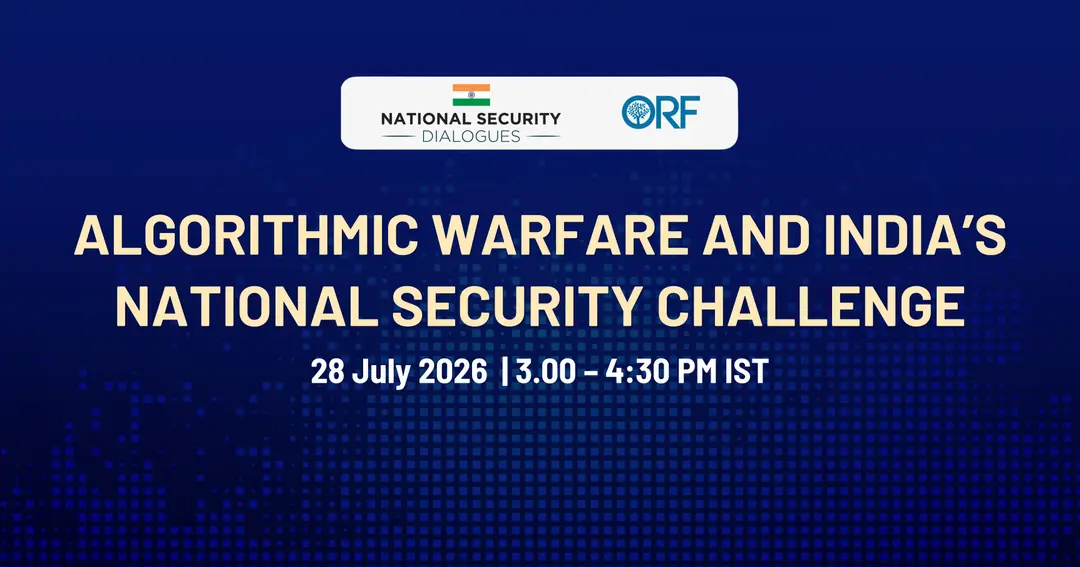
Panel on algorithmic warfare, India's security set for July 28
A National Security Dialogue panel discussion on "Algorithmic Warfare and India's National Security Challenge" is scheduled for July 28, 2026 at 3:00 PM at the Conference Hall, ORF Delhi. Organisers say artificial intelligence, machine learning, autonomous systems and data-driven decision architectures are transforming the character of warfare. Policymakers, military practitioners, technologists, legal scholars and civil society representatives will examine meaningful control, accountability and security in this era.
Source
Observer Research Foundation (ORF) · read the original report ↗
Desk check · compared with the source
What the desk checked (4)
- A National Security Dialogue panel discussion on algorithmic warfare is scheduled for July 28, 2026 at 3:00 PM. — Date and time appear in the source event listing; no external verification possible.
- The venue is the Conference Hall, ORF Delhi. — Venue stated in the source listing.
- The panel will bring together policymakers, military practitioners, technologists, legal scholars and civil society. — Stated in the organiser's event description; participant names are not listed in the source.
- AI, machine learning, autonomous systems and data-driven decision architectures are becoming central to how states plan, fight and deter conflict. — Framing claim in the event description, not attributed to any named expert or study.
Analysts’ view opinion
On paper this is just a think-tank event notice, but politically it signals that India's national security conversation is shifting from hardware procurement towards algorithms and data-driven decision systems. Putting policymakers, military practitioners, legal scholars and civil society on one panel means the question of who controls AI-enabled warfare is no longer purely technical — it becomes a question of political accountability. This is not a government policy statement; but forums like this often lay the groundwork for the policy debate that follows.
- The framing around "meaningful control" and accountability pushes forward the politically sensitive question of who answers for decisions taken by autonomous systems.
- Including civil society and legal scholars opens the security debate beyond the military-government circle to wider public scrutiny.
- Convenings held in Delhi, close to the policy establishment, typically help shape the vocabulary and framework of future policy discussion.
- The likely central policy tension is between those urging speed in building technological capability and those urging restraint, transparency and oversight.
- With no speakers or moderator named in the story, it is not possible to judge how much official or governmental representation the panel will carry.
What to watch — Watch who actually appears on the panel — particularly whether government or military voices participate — and whether the discussion produces any concrete policy recommendation on controlling AI in warfare.
This story establishes only that a discussion has been announced; it says nothing definitive about India's official AI-defence policy, any decision taken, or the identity of the participants.
Deep dive
Research brief · 8 facts · 1 dates · exam-readyThe brief
Context
The Observer Research Foundation (ORF) has scheduled a National Security Dialogue panel discussion titled "Algorithmic Warfare and India's National Security Challenge" for July 28, 2026 at 3:00 PM at the Conference Hall, ORF Delhi. The framing note argues that artificial intelligence, machine learning, autonomous systems and data-driven decision architectures are no longer peripheral tools of modern militaries but are becoming central to how states plan, fight and deter conflict. The panel intends to bring together policymakers, military practitioners, technologists, legal scholars and civil society to examine both the promise and the peril of algorithmic warfare. Speakers and moderator are not stated in the source.
Key facts
- The panel discussion is titled "National Security Dialogue | Algorithmic Warfare and India's National Security Challenge".
- Date of the event: July 28, 2026; time: 03:00 PM.
- Venue: Conference Hall, ORF Delhi.
- The organisers list AI, machine learning, autonomous systems and data-driven decision architectures as becoming central to how states plan, fight and deter conflict.
- Participants sought include policymakers, military practitioners, technologists, legal scholars and civil society.
- The discussion aims to interrogate what "meaningful control", accountability and security mean in the era of algorithmic warfare.
- The note states that India's experience makes the exploration of these questions "especially urgent".
- Speakers and moderator for the panel are listed but not named in the source.
Timeline
- July 28, 2026, 3:00 PMNational Security Dialogue panel on "Algorithmic Warfare and India's National Security Challenge" to be held at the Conference Hall, ORF Delhi.
Who has a stake
- Policymakers — Must frame rules on adoption of AI and autonomous systems in defence, including accountability and control standards.
- Military practitioners — Operate and depend on data-driven decision architectures in planning, fighting and deterring conflict.
- Technologists — Build the AI, machine learning and autonomous systems whose promise and peril the panel will examine.
- Legal scholars — Have to define what "meaningful control" and accountability mean legally when algorithms shape use of force.
- Civil society — Represents public concerns about security, oversight and the perils of algorithmic warfare.
- Observer Research Foundation (ORF), Delhi — Hosts the National Security Dialogue and frames the agenda for debate on algorithmic warfare in India.
Why it matters
The source argues the character of warfare itself is being transformed, with algorithms moving from peripheral tools to the core of how states plan, fight and deter conflict. That shift raises unresolved questions of meaningful human control, accountability and security which the panel says are especially urgent given India's experience.
UPSC angle
Prelims pointers
- Event: National Security Dialogue on "Algorithmic Warfare and India's National Security Challenge", July 28, 2026, 3:00 PM.
- Venue: Conference Hall, ORF Delhi.
- Four technology drivers named: artificial intelligence, machine learning, autonomous systems, data-driven decision architectures.
- Three normative concepts under scrutiny: meaningful control, accountability, security.
- Five stakeholder groups invited: policymakers, military practitioners, technologists, legal scholars, civil society.
Mains framing
The scheduled ORF National Security Dialogue frames algorithmic warfare as a structural shift rather than an incremental one: AI, machine learning, autonomous systems and data-driven decision architectures are described as becoming central to how states plan, fight and deter conflict, not peripheral tools of modern militaries. The consequence is a governance gap — speed and machine-assisted decision-making outpace existing notions of human oversight, which is why the organisers place "meaningful control", accountability and security at the centre of the agenda, and why the panel deliberately mixes policymakers, military practitioners, technologists, legal scholars and civil society rather than treating this as a purely defence-technical question. The source holds that India's experience makes these questions especially urgent, though it does not elaborate on specific Indian doctrines, incidents or policies. The way forward suggested by the event's design is deliberative and cross-disciplinary: interrogating both the promise and the peril of algorithmic warfare before capabilities harden into practice. Any further claims about India's AI-defence policy architecture are not stated in the source.
Key terms
- Algorithmic warfare
- Warfare in which AI, machine learning and autonomous systems become central to planning, fighting and deterring conflict.
- Autonomous systems
- Military platforms or tools capable of operating with reduced or no direct human input, named by the source as a driver of change.
- Data-driven decision architectures
- Systems that structure military decisions around large-scale data processing rather than human judgement alone.
- Meaningful control
- A contested standard, to be interrogated by the panel, of how much genuine human authority remains over algorithm-enabled force.
- National Security Dialogue
- The ORF discussion series under which this July 28, 2026 panel at ORF Delhi is being held.
- ORF Delhi
- Venue of the event; its Conference Hall hosts the panel discussion.
Practice questions
- What does "meaningful human control" mean in the context of autonomous weapons and AI-enabled military decision-making? Discuss the accountability challenges it raises.
- "Artificial intelligence is transforming the character, not the nature, of war." Examine this statement with reference to India's national security challenges.
- Why is a multi-stakeholder approach — involving policymakers, militaries, technologists, legal scholars and civil society — necessary for governing algorithmic warfare?
Grounded only in the source report — figures and dates are the source's, not inferred.