
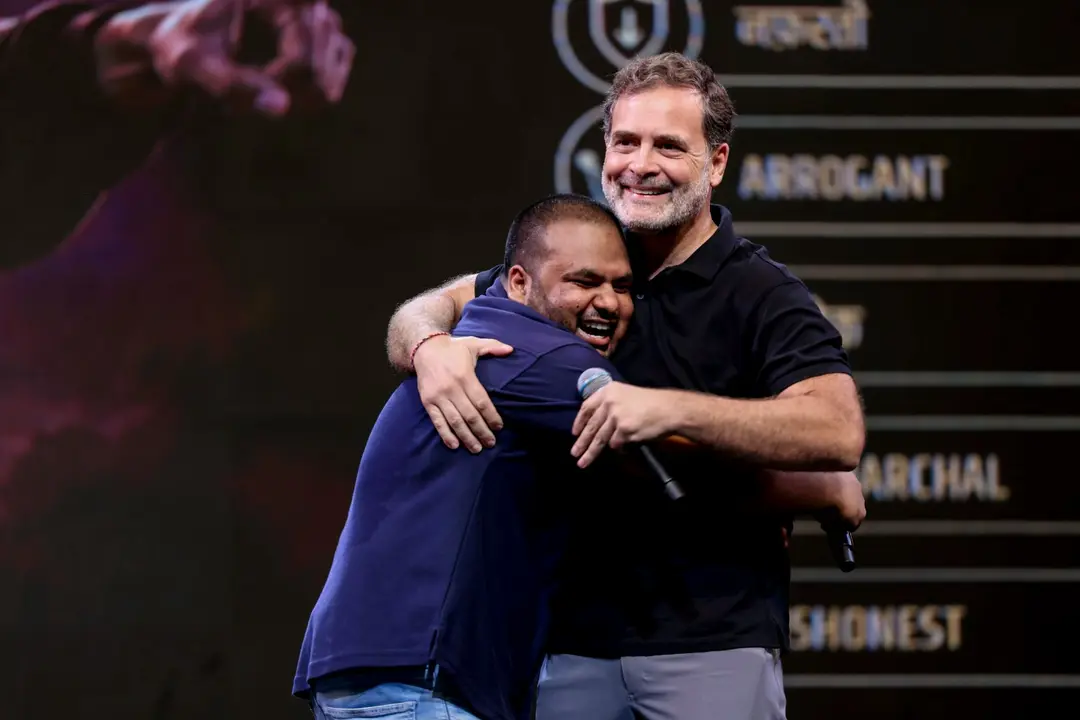
Comedian Pulkit Mani cancels UP shows amid Modi mimicry row
Stand-up comedian Pulkit Mani has announced the cancellation of his Noida, Lucknow and Kanpur shows, citing "repeated threats from goon activists", after mimicking Prime Minister Narendra Modi at Rahul Gandhi's "Chhatron Ki Goonj" event in Indore on September 19. The clip went viral. Union ministers Kiren Rijiju and Piyush Goyal, and Chief Ministers Mohan Yadav and Pushkar Singh Dhami criticised the act. Analyst Vivek Srivastava voiced concern Mani could face "fake FIRs".
Source
Rahul Gandhi · read the original report ↗
Desk check · some claims need care
What the desk checked (5)
- Pulkit Mani cancelled shows in Noida, Lucknow and Kanpur citing 'repeated threats from goon activists' — Attributed in source to Mani's own announcement; no independent confirmation or police record cited.
- Mani mimicked PM Modi at Rahul Gandhi's 'Chhatron Ki Goonj' event in Indore on Saturday, September 19 — Date and event named in source; day-date pairing not independently verifiable here.
- Analyst Vivek Srivastava said he found the act funny and feared Mani could face attacks or 'fake FIRs' — Direct quotes attributed to Srivastava on The Federal's Capital Beat show.
- Union ministers Kiren Rijiju and Piyush Goyal, and CMs Mohan Yadav and Pushkar Singh Dhami criticised the performance — Attributed to named leaders in source; Rijiju's 'party of comedians and jokers' remark quoted, others paraphrased.
- The line 'Maa ko kursi do' referred to a 2024 Kolkata event where Modi asked for a chair for an elderly woman — Presented as Srivastava's interpretation, not as established fact.
Analysts’ view opinion
A stand-up mimicry act has stopped being comedy and become a familiar political battleground between the Congress and the BJP over "respect versus free expression". The scale of the response — Union ministers plus two chief ministers — suggests the BJP wants the issue framed as disrespect to the Prime Minister and to his late mother, putting the Congress on the defensive. The Congress, in turn, is using it to feed its broader narrative that the space to question those in power is shrinking. The cancellation of the shows shifts the conversation from the content of the act to pressure and fear — a turn that is politically more comfortable for the Congress.
- The BJP's play is clear: move the debate from the joke's content to personal disrespect, and hold Rahul Gandhi's platform responsible for it.
- The Congress's play is equally clear: place the act within India's tradition of political satire and democratic expression.
- The involvement of Union ministers alongside the Madhya Pradesh and Uttarakhand chief ministers signals a coordinated rather than stray political reaction.
- The cancellation of three Uttar Pradesh shows strengthens the argument that political pressure can hit an artist's livelihood even without any formal administrative action.
- Viral clips are now campaign assets — such controversies raise a performer's profile while simultaneously raising his personal risk.
What to watch — Watch whether any FIRs or legal action follow against Mani, and whether the Congress converts this into a sustained "shrinking space" campaign line in Uttar Pradesh and beyond.
The story does not establish who issued the threats or whether any party or organisation was behind them; the reason for the cancellations rests on the comedian's own statement.
Deep dive
Research brief · 8 facts · 4 dates · exam-readyThe brief
Context
Stand-up comedian Pulkit Mani mimicked Prime Minister Narendra Modi's public interactions and speech patterns at Congress leader Rahul Gandhi's "Chhatron Ki Goonj" event in Indore on Saturday, September 19. The clip went viral with millions of views and drew sharp criticism from BJP leaders. Mani has since announced the cancellation of his Noida, Lucknow and Kanpur shows, citing "repeated threats from goon activists". The episode has triggered a wider debate on the limits of political satire, pressure on venues and the vulnerability of independent artists.
Key facts
- Pulkit Mani mimicked PM Modi's public interactions and speech patterns at Rahul Gandhi's "Chhatron Ki Goonj" event in Indore on Saturday, September 19.
- The video clip went viral and received millions of views, drawing criticism from BJP leaders.
- Mani cancelled his shows in Noida, Lucknow and Kanpur, citing "repeated threats from goon activists".
- Union Minister Kiren Rijiju described the Congress as a "party of comedians and jokers"; Union Minister Piyush Goyal called the performance cheap political theatre.
- Madhya Pradesh CM Mohan Yadav and Uttarakhand CM Pushkar Singh Dhami said references in the act were disrespectful to Modi's late mother.
- Political analyst Vivek Srivastava, speaking on The Federal's Capital Beat, said the mimicry "was funny" and voiced worry that Mani could face attacks, "fake FIRs" or political retaliation.
- Srivastava said the line "Maa ko kursi do" referred to an actual 2024 public event in Kolkata where Modi asked organisers to give a chair to an elderly woman, not to his mother.
- Congress spokesperson Wing Commander Anuma Acharya (Retd.), who attended the Indore event, said "A healthy democracy must be able to tolerate such attack."
Timeline
- 2024At a public event in Kolkata, PM Modi asked organisers to provide a chair to an elderly woman — the incident later referenced in the skit line "Maa ko kursi do", per Srivastava.
- Saturday, September 19Pulkit Mani mimics PM Modi at Rahul Gandhi's "Chhatron Ki Goonj" event in Indore; the clip goes viral with millions of views.
- After the eventBJP leaders including Kiren Rijiju, Piyush Goyal, CM Mohan Yadav and CM Pushkar Singh Dhami criticise the performance and the Congress-led event.
- SubsequentlyMani announces cancellation of his Noida, Lucknow and Kanpur shows citing "repeated threats from goon activists"; analyst Vivek Srivastava expresses concern on Capital Beat.
Who has a stake
- Pulkit Mani, stand-up comedian — Livelihood and personal safety; cancelled three shows in Uttar Pradesh citing repeated threats, with concerns of harassment or legal action.
- Congress and Rahul Gandhi — Hosted the Indore "Chhatron Ki Goonj" event; defends the act as democratic political expression while facing BJP attacks.
- BJP leaders (Kiren Rijiju, Piyush Goyal, Mohan Yadav, Pushkar Singh Dhami) — Framing the performance as disrespectful and as cheap political theatre by the Congress.
- Independent artists and comedy venues — Vulnerability when venues face political or social pressure, which Srivastava says can hit an artist's livelihood even without formal administrative action.
- Audiences in Noida, Lucknow and Kanpur — Shows cancelled; reduced space for satirical performance.
Why it matters
The episode moves a single stage act into a test of how much satire of those in power India's political climate will tolerate. With shows cancelled over alleged threats rather than any formal order, it highlights how informal pressure on venues and performers can curb expression without state action, and raises the spectre of "fake FIRs" against artists.
UPSC angle
Prelims pointers
- "Chhatron Ki Goonj" — Congress event in Indore addressed by Rahul Gandhi where the mimicry took place on September 19.
- Comedian Pulkit Mani cancelled shows in Noida, Lucknow and Kanpur citing "repeated threats from goon activists".
- Kiren Rijiju and Piyush Goyal are the Union ministers who criticised the event; Rijiju called Congress a "party of comedians and jokers".
- Mohan Yadav is Madhya Pradesh Chief Minister; Pushkar Singh Dhami is Uttarakhand Chief Minister.
- The line "Maa ko kursi do" is traced by analyst Vivek Srivastava to a 2024 Kolkata event where Modi asked for a chair for an elderly woman.
- Congress spokesperson in the debate: Wing Commander Anuma Acharya (Retd.).
Mains framing
A comedian's mimicry of the Prime Minister at a political event has escalated into a national argument about the boundaries of satire and the security of independent performers. The proximate cause is the viral spread of the Indore clip and the political charge that references in the act insulted Modi's late mother — a claim contested by analyst Vivek Srivastava, who traces the \"Maa ko kursi do\" line to a 2024 Kolkata event where Modi asked for a chair for an elderly woman. The consequence is not prosecution but pre-emptive self-silencing: Mani cancelled Noida, Lucknow and Kanpur shows citing \"repeated threats from goon activists\", illustrating Srivastava's point that political or social pressure on venues can damage an artist's livelihood even without formal administrative action, alongside fears of attacks and \"fake FIRs\". Congress spokesperson Anuma Acharya frames the issue as democratic tolerance — whether space remains to \"laugh at those in power, question them and hold up a mirror to them\" — while BJP leaders read the act as cheap political theatre. The way forward, on the source's terms, lies in distinguishing satire aimed at power from personal insult, protecting performers and venues from extra-legal intimidation, and guarding against misuse of criminal complaints against artists.
Key terms
- Chhatron Ki Goonj
- The Congress event in Indore, featuring Rahul Gandhi, where Pulkit Mani performed his mimicry of PM Modi on September 19.
- Political satire / parody
- Humorous mockery of those in power; defended in the story as a historic feature of Indian politics and democratic discourse.
- "Fake FIRs"
- Term used by analyst Vivek Srivastava for baseless police complaints he fears could be filed against the comedian as political retaliation.
- Capital Beat
- The Federal's discussion show on which Vivek Srivastava and Anuma Acharya debated the controversy.
- "Maa ko kursi do"
- A line from the act; per Srivastava it refers to a 2024 Kolkata event where Modi asked organisers to give an elderly woman a chair.
Practice questions
- Does informal intimidation of performers and venues pose a greater threat to free expression than formal legal action? Discuss with reference to the cancellation of Pulkit Mani's shows.
- "A healthy democracy must be able to tolerate such attack." Examine the place of political satire in democratic discourse and the limits, if any, that should apply.
- How can independent artists be protected from political retaliation and misuse of criminal complaints without curbing legitimate grievance? Suggest safeguards.
Grounded only in the source report — figures and dates are the source's, not inferred.