
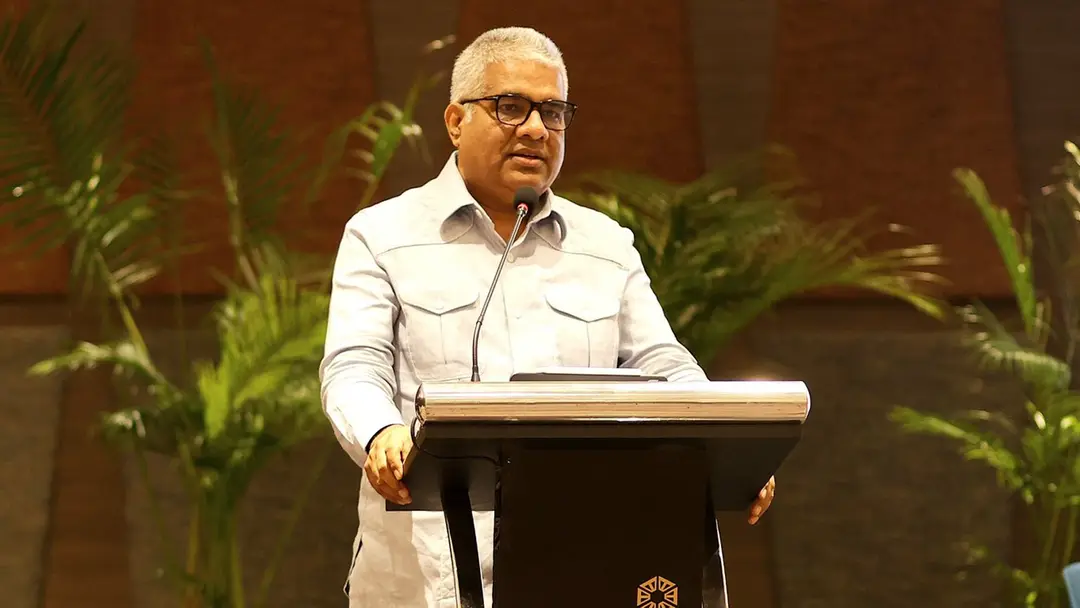
Yadav opens WWF Global Conservation Conference in Jaipur
Union Environment, Forest and Climate Change Minister Bhupender Yadav on Monday inaugurated the WWF Global Conservation Conference in Jaipur. Addressing representatives from more than 100 countries, he called for collective action with the involvement of local communities. Yadav said India's protected areas rose from around 750 to more than 1,000 over the last decade, tiger reserves from 47 to 58, elephant reserves from 30 to 33 and Ramsar sites from 24 to 101. He described the cheetah reintroduction programme as a major success.
Source
Environment — Bhupender Yadav · read the original report ↗
Desk check · compared with the source
What the desk checked (5)
- Bhupender Yadav inaugurated WWF's Global Conservation Conference in Jaipur on Monday with representatives from over 100 countries. — Stated in source as event reporting; participant count attributed to the source text.
- India's protected areas rose from around 750 to more than 1,000 in the last decade. — Figure appears in source, attributed to the minister's address.
- Tiger reserves increased from 47 to 58, elephant reserves from 30 to 33, Ramsar sites from 24 to 101. — Figures appear in source, attributed to the minister; not independently verified.
- The cheetah reintroduction programme is a major conservation success under PM Narendra Modi's leadership. — Evaluative claim attributed to the minister, not an independent assessment.
- Officials including Ramesh Pandey, Arijit Banerjee, Daudi Samba and Ravi Singh attended the inauguration. — Names and designations listed in source; no further sourcing given.
Analysts’ view opinion
Though billed as a conservation event, the political message is unmistakable: before delegates from over 100 countries, the Union government presented a decade of its own tenure in the language of measurable results. Bhupender Yadav's recital of numbers — protected areas, tiger reserves, Ramsar sites — and his framing of the cheetah reintroduction as a success under the Prime Minister's leadership converts administrative data into political credit. Choosing Jaipur as the venue also hands international visibility to the BJP government in Rajasthan and to state-specific initiatives such as the Great Indian Bustard programme and the community-run Oran sacred groves.
- Narrating a domestic governance record on a global stage lets the government bank 'international recognition' as political capital.
- Tying the cheetah programme explicitly to the Prime Minister's leadership turns conservation into a personalised leadership narrative.
- Hosting in Jaipur showcases centre-state BJP alignment and foregrounds Rajasthan-specific projects.
- The emphasis on 'local community involvement' and 'coexistence' can be read as political care to pre-empt friction that conservation restrictions often generate on the ground.
- Invoking constitutional duty and cultural tradition folds environment policy into a broader national-identity framing.
What to watch — Watch whether opposition parties and independent conservationists contest these figures on questions of land use, displacement or forest clearances, and whether the conference's declarations translate into funding or policy decisions.
The story only reports what the minister said; it offers no independent verification of the figures, no assessment of conservation quality, and no reaction from any political quarter.
Deep dive
Research brief · 8 facts · 2 dates · exam-readyThe brief
Context
The World Wide Fund for Nature (WWF) held its Global Conservation Conference in Jaipur, Rajasthan, bringing together representatives from more than 100 countries. Union Environment, Forest and Climate Change Minister Bhupender Yadav inaugurated the event on Monday, using the platform to set out India's record on wildlife, habitat and biodiversity protection and to press for collective global action rooted in community participation. He framed India's species conservation work as resting on modern environmental laws as well as constitutional provisions and cultural traditions, and on India's membership of major international conservation treaties.
Key facts
- Union Minister Bhupender Yadav inaugurated the WWF Global Conservation Conference in Jaipur on Monday.
- Representatives from more than 100 countries attended the conference.
- India's protected areas rose from around 750 to more than 1,000 over the last decade.
- Tiger reserves increased from 47 to 58 in the same period; elephant reserves from 30 to 33.
- Ramsar sites in India increased from 24 to 101.
- Yadav described the cheetah reintroduction programme as a major conservation success under PM Narendra Modi.
- India is a party to CITES, the Convention on Migratory Species, the Convention on Biological Diversity and the Ramsar Convention.
- Pan-India population assessments have been done for tigers, elephants, dolphins, lions and snow leopards.
Timeline
- Over the last decadeProtected areas grew from around 750 to over 1,000; tiger reserves 47 to 58; elephant reserves 30 to 33; Ramsar sites 24 to 101.
- Monday (date not stated in the source)Bhupender Yadav inaugurates the WWF Global Conservation Conference in Jaipur, addressing delegates from over 100 countries.
Who has a stake
- Ministry of Environment, Forest and Climate Change — Leads India's wildlife, habitat and biodiversity policy; represented by Minister Bhupender Yadav and ADG (Wildlife) Ramesh Pandey.
- WWF-International and WWF-India — Convenors of the conference; represented by Chief Conservation Officer Daudi Samba and WWF-India CEO Ravi Singh.
- Government of Rajasthan forest department — Host state; Head of Forest Force and PCCF Arijit Banerjee attended; state hosts the Great Indian Bustard breeding programme and Oran groves.
- Local communities — Central to coexistence-based conservation; community-led protection of Oran sacred groves cited as a model.
- Delegates from over 100 countries — Expected to translate conservation experience into action and apply lessons from approaches that have worked.
- Threatened species (tiger, elephant, rhino, Asiatic lion, GIB, wild water buffalo) — Beneficiaries of recovery, breeding and landscape-level conservation programmes cited by the minister.
Why it matters
India hosting a WWF global conservation meet positions it as a voice in shaping worldwide biodiversity practice, and the figures cited on protected areas, tiger reserves and Ramsar sites become the benchmark against which its record is judged. The emphasis on grasslands, wetlands and community-led models signals a shift beyond a forest-centric view of conservation. For global negotiations under CBD, CITES, CMS and Ramsar, India's experience with species recovery and reintroduction offers a template other countries may borrow.
UPSC angle
Prelims pointers
- WWF Global Conservation Conference 2025 venue: Jaipur, Rajasthan; delegates from over 100 countries.
- India's Ramsar sites rose from 24 to 101; protected areas from about 750 to over 1,000 in a decade.
- Tiger reserves in India: 58 (up from 47); elephant reserves: 33 (up from 30).
- India is party to CITES, CMS, CBD and the Ramsar Convention.
- Great Indian Bustard conservation breeding programme is located in Rajasthan.
- Oran sacred groves: community-protected commons in Rajasthan, linked to land degradation neutrality.
Mains framing
India's conservation narrative, as presented at the WWF Global Conservation Conference in Jaipur, rests on three pillars: expansion of the protected area network (about 750 to over 1,000 sites, 58 tiger reserves, 101 Ramsar sites), science-led monitoring through pan-India population assessments of tigers, elephants, dolphins, lions and snow leopards, and treaty-based international commitments under CITES, CMS, CBD and Ramsar. The minister anchored this in constitutional design, where wildlife protection is both a directive to the State and a duty of citizens, and in cultural traditions of coexistence. The evident gaps the speech itself acknowledges are habitat beyond forests, with grasslands and wetlands needing equal attention for megaherbivores, the one-horned rhinoceros and wild water buffalo, and a species like the Great Indian Bustard surviving on conservation breeding. The way forward flagged is community-centred conservation, exemplified by Oran sacred groves contributing to land degradation neutrality, protection of wildlife corridors and landscape-level planning, and international learning that converts conservation experience into replicable action rather than stopping at stocktaking of achievements.
Key terms
- WWF (World Wide Fund for Nature)
- International conservation organisation whose Global Conservation Conference was held in Jaipur; has an India arm headed by CEO Ravi Singh.
- Ramsar site
- Wetland of international importance designated under the Ramsar Convention; India's count rose from 24 to 101.
- CITES
- International agreement regulating trade in endangered species of wild fauna and flora, to which India is a party.
- CMS and CBD
- Convention on Migratory Species and Convention on Biological Diversity, two global treaties on species and biodiversity that India has joined.
- Great Indian Bustard (GIB)
- Critically threatened grassland bird for which a conservation breeding programme runs in Rajasthan.
- Oran sacred groves
- Community-protected sacred grove commons whose conservation is cited as aiding land degradation neutrality.
Practice questions
- Assess India's protected area expansion over the last decade. Does an increase in the number of reserves and Ramsar sites automatically translate into better biodiversity outcomes?
- Conservation in India has been forest-centric. Examine the case for mainstreaming grasslands and wetlands in wildlife policy, with examples of grassland-dependent species.
- Discuss the role of local communities in wildlife conservation, using community-led models such as the protection of Oran sacred groves.
Grounded only in the source report — figures and dates are the source's, not inferred.