
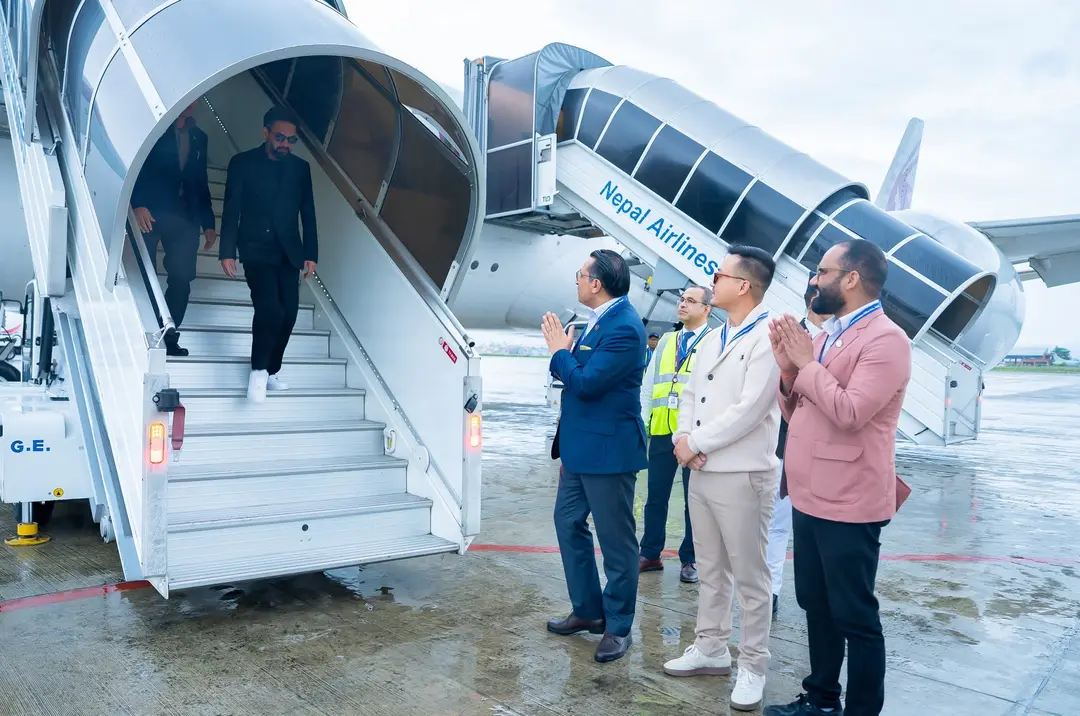
Nepal PM Shah returns home after addressing UN General Assembly
Nepali Prime Minister Balendra Shah returned home on Saturday after addressing the 81st session of the United Nations General Assembly in New York, United States. He landed at Tribhuvan International Airport in the afternoon, travelling from New York on a Qatar Airways flight via Doha. Finance Minister Swarnim Wagle, Home Minister Sudhan Gurung and Tourism Minister Khakak Raj Paudel received him. Shah left for the US on September 22 with a 14-member delegation. On the sidelines he met UN Secretary-General Antonio Guterres and Australian Prime Minister Anthony Albanese.
Source
Nepal · read the original report ↗
Desk check · compared with the source
What the desk checked (5)
- PM Balendra Shah returned to Kathmandu on September 26 after addressing the 81st UNGA session in New York. — Stated in source with date and venue; no named official source given.
- He landed at Tribhuvan International Airport in the afternoon, flying from New York on Qatar Airways via Doha. — Figure/route appears in source; not attributed to any airport or government statement.
- He was received by Finance Minister Swarnim Wagle, Home Minister Sudhan Gurung and Culture, Tourism and Civil Aviation Minister Khakak Raj Paudel. — Names listed in source; internally consistent, no attribution.
- Shah left for the US on September 22 leading a 14-member delegation including Foreign Minister Shisir Khanal and Foreign Secretary Amrit Bahadur Rai. — Delegation size and names appear in source; consistent with the return date.
- On the sidelines he met UN Secretary-General Antonio Guterres and Australian PM Anthony Albanese. — Stated in source without attribution or meeting details.
Analysts’ view opinion
Nepali Prime Minister Balendra Shah's return home after addressing the UN General Assembly reads as routine diplomacy, but strategically it is a case study in how smaller states use multilateral platforms. The composition of the trip — a 14-member delegation including the foreign minister, chief advisor and foreign secretary — suggests it was designed for a sequence of sideline meetings, not just a speech. The meetings with UN Secretary-General Antonio Guterres and Australian Prime Minister Anthony Albanese point to the kind of "third-direction" diplomacy that helps a Himalayan state maintain balance between its large neighbours.
- For a landlocked, small-power state, the UNGA is one of the few venues where voice does not depend on hard power — and Nepal appears to have used it.
- Sending the foreign minister, foreign secretary and the PM's chief advisor together signals an institutional diplomatic push rather than a personal showcase.
- A meeting with Australia's prime minister may hint at Nepal widening ties with an active Indo-Pacific middle power, though the story does not say what was discussed.
- Given Nepal's position between two major Asian powers, it is a general reality that its high-level foreign engagements are closely tracked in those capitals.
- The Guterres meeting would sit naturally alongside Nepal's traditional UN priorities such as peacekeeping contributions and mountain-climate concerns, but the agenda is not stated in the story.
What to watch — Watch whether any concrete follow-up emerges — agreements, reciprocal visit invitations or policy announcements — or whether this remains largely symbolic diplomacy.
The story does not establish what Shah said in his address, what was raised with Guterres or Albanese, or what outcomes resulted, so any strategic read remains inference.
Deep dive
Research brief · 8 facts · 3 dates · exam-readyThe brief
Context
Nepali Prime Minister Balendra Shah travelled to New York to address the 81st session of the United Nations General Assembly (UNGA), the annual high-level gathering where heads of state and government speak. He led a 14-member Nepali delegation that included the Foreign Minister and Foreign Secretary, and used the sidelines of the session for bilateral and multilateral engagements. He returned to Kathmandu on September 26, 2026, landing at Tribhuvan International Airport. The visit reflects Nepal's routine but significant use of the UNGA platform for diplomacy.
Key facts
- Prime Minister Balendra Shah returned to Nepal on September 26, 2026, after addressing the 81st session of the UN General Assembly in New York.
- He flew from New York to Kathmandu on a Qatar Airways flight via Doha, landing at Tribhuvan International Airport in the afternoon.
- Shah departed for the United States on September 22, 2026.
- He led a 14-member Nepali delegation to the General Assembly.
- The delegation included Foreign Minister Shisir Khanal, Chief Advisor to the PM Kumar Byanjankar and Foreign Secretary Amrit Bahadur Rai.
- On arrival he was received by Finance Minister Dr. Swarnim Wagle, Home Affairs Minister Sudhan Gurung and Culture, Tourism and Civil Aviation Minister Khakak Raj Paudel.
- On the sidelines, Shah met UN Secretary-General Antonio Guterres and Australian Prime Minister Anthony Albanese.
- He also attended various briefings and an official reception at the Permanent Mission of Nepal to the United Nations in New York.
Timeline
- September 22, 2026PM Balendra Shah departs for the United States leading a 14-member Nepali delegation to the UNGA.
- During the 81st UNGA session (dates not stated in the source)Shah addresses the General Assembly and meets UN Secretary-General Antonio Guterres and Australian PM Anthony Albanese on the sidelines.
- September 26, 2026Shah returns to Kathmandu, landing at Tribhuvan International Airport; received by three cabinet ministers.
Who has a stake
- Prime Minister Balendra Shah — Represented Nepal at the UNGA and used sideline meetings to project Nepal's positions and build bilateral ties.
- Government of Nepal — Its foreign policy visibility and multilateral engagement at the UN's highest annual forum.
- United Nations / Secretary-General Antonio Guterres — Engagement with a member state's head of government on issues discussed at the session (specifics not stated in the source).
- Australia / PM Anthony Albanese — Bilateral dialogue with Nepal on the sidelines of the Assembly; agenda not stated in the source.
- Permanent Mission of Nepal to the UN, New York — Hosted briefings and an official reception during the PM's visit.
- Nepali delegation members (Foreign Minister Shisir Khanal, Foreign Secretary Amrit Bahadur Rai, Chief Advisor Kumar Byanjankar) — Carried forward Nepal's diplomatic engagements at the session.
Why it matters
The UNGA high-level session is the one annual occasion where small states get the same podium as major powers, making it central to Nepal's diplomatic outreach. Shah's sideline meetings with the UN Secretary-General and Australia's Prime Minister show how the platform doubles as a venue for bilateral diplomacy. For India, the positions and partnerships a neighbouring Himalayan state pursues at the UN are of direct strategic interest.
UPSC angle
Prelims pointers
- The 81st session of the UN General Assembly was held in New York; Nepal's PM Balendra Shah addressed it.
- Antonio Guterres is the Secretary-General of the United Nations, as named in the source.
- Anthony Albanese is the Prime Minister of Australia, as named in the source.
- Tribhuvan International Airport, Kathmandu, is Nepal's international gateway.
- Nepal's delegation was 14 members, including Foreign Minister Shisir Khanal and Foreign Secretary Amrit Bahadur Rai.
- Nepal maintains a Permanent Mission to the United Nations in New York.
Mains framing
The annual UN General Assembly high-level session functions as both a global debate and a compressed diplomatic marketplace, and small or landlocked states such as Nepal derive disproportionate value from it: equal speaking rights, access to the Secretary-General, and low-cost bilateral meetings with leaders who would otherwise be hard to reach. PM Balendra Shah's visit from September 22 to 26, 2026, fits this pattern — an address to the 81st session, a 14-member delegation led by the political and bureaucratic top of the foreign policy establishment, a meeting with Secretary-General Antonio Guterres, a bilateral with Australian PM Anthony Albanese, and briefings hosted by Nepal's Permanent Mission. The source does not record the content of his speech or of these meetings, so any assessment must stay institutional rather than substantive: the takeaway is about the architecture of multilateral diplomacy for smaller states, not about specific commitments. The way forward for such states typically lies in converting UNGA visibility into follow-up — sustained bilateral engagement, technical cooperation and coalition-building with like-minded members — though the source offers no policy detail on Nepal's next steps.
Key terms
- UN General Assembly (UNGA)
- The UN's main deliberative organ where all member states are represented; its annual high-level session hosts world leaders' addresses.
- 81st session of the UNGA
- The session held in New York that PM Balendra Shah addressed before returning home on September 26, 2026.
- Secretary-General of the UN
- The UN's chief administrative officer; Antonio Guterres, whom Shah met on the sidelines.
- Permanent Mission to the UN
- A member state's standing diplomatic office at UN headquarters; Nepal's mission in New York hosted briefings and a reception.
- Sidelines meeting
- A bilateral or small-group meeting held alongside a multilateral conference rather than in its formal sessions.
- Tribhuvan International Airport
- Kathmandu's international airport, where PM Shah landed on return.
Practice questions
- Why does the annual high-level session of the UN General Assembly hold particular importance for small and landlocked states? Illustrate with Nepal's 2026 participation.
- Discuss how 'sidelines diplomacy' at multilateral summits complements formal bilateral diplomacy, using examples from PM Balendra Shah's UNGA visit.
- Examine the significance of Nepal's foreign policy engagements at the United Nations for India's neighbourhood strategy.
Grounded only in the source report — figures and dates are the source's, not inferred.