
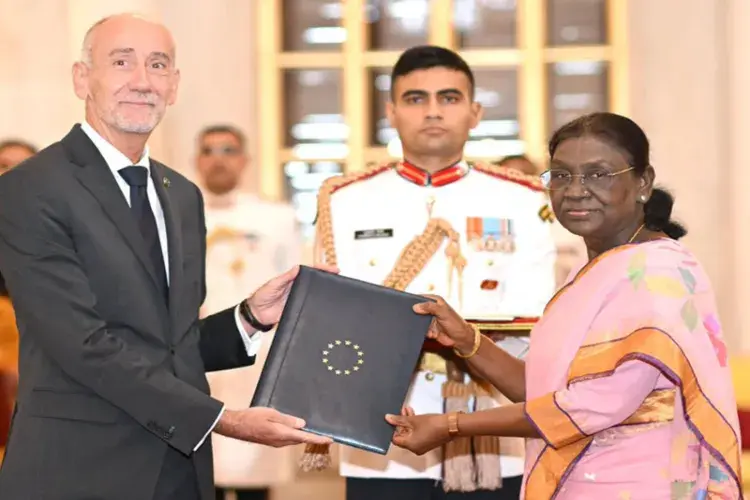
EU envoy Paquet presents credentials to President Murmu
Jean-Eric Paquet assumed office as the European Union's Ambassador to India after presenting his credentials to President Droupadi Murmu at Rashtrapati Bhavan. In a post on X, he cited strong momentum in trade, defence, security and research. Speaking to ANI, Paquet said he hoped to help India use opportunities from the free trade agreement and platforms such as the European Legal Gateway, and planned to visit all 28 states and eight Union Territories in three years. EU-India FTA talks concluded on January 27.
Source
President of India · read the original report ↗
Desk check · compared with the source
What the desk checked (5)
- Jean-Eric Paquet presented credentials to President Droupadi Murmu at Rashtrapati Bhavan, assuming office as EU Ambassador to India. — Attributed to ANI report and the envoy's own post on X quoted in the source.
- Paquet said he hopes to help India use opportunities from the free trade agreement and platforms such as the European Legal Gateway. — Direct quote attributed to Paquet speaking to ANI.
- Paquet said he intends to travel to all 28 states and eight Union Territories over three years, having started in Amritsar and visited Jaisalmer. — Direct quote attributed to Paquet; not independently verifiable.
- The EU and India concluded FTA negotiations on January 27. — Figure/date appears in source; no year specified and no source cited for the claim.
- EU is India's third-largest trading partner with goods trade worth €118 billion in 2025, 11.1% of India's total trade. — Figures appear in source text without attribution to a named agency.
Analysts’ view opinion
Presenting credentials is normally pure protocol. What gives Jean-Eric Paquet's arrival political weight is its timing: he takes charge as the India-EU Free Trade Agreement, whose negotiations concluded on January 27, moves towards being operationalised. His framing — trade, defence, security and research together — signals both sides are trying to shift the relationship from a commercial file to a strategic one, while his stated plan to visit all 28 states and eight Union Territories in three years reads as a deliberate move beyond Delhi-centric diplomacy towards state leaderships and industry.
- An ambassador arriving at the implementation stage of an FTA also arrives into a contest over who gets political credit for its benefits.
- Bundling defence and security with trade suggests an attempt to reframe India-EU ties as strategic rather than purely economic.
- The plan to tour every state and UT gives state governments competing for investment a direct channel — and raises familiar Centre-state coordination questions.
- The emphasis on mobility platforms such as the European Legal Gateway touches skilled migration and visas, politically sensitive and popular subjects in India.
- Stressing rules-based trade amid rising geopolitical tensions functions as a message about diversifying partnerships.
What to watch — Watch the next steps on operationalising the FTA and the domestic political reaction in exposed sectors such as agriculture, dairy and automobiles.
The story does not set out the agreement's contents, its implementation timeline, or how Indian political parties have responded — this is analysis built on a ceremonial event and the ambassador's own remarks.
Deep dive
Research brief · 8 facts · 4 dates · exam-readyThe brief
Context
Jean-Eric Paquet formally took charge as the European Union's Ambassador to India after presenting his credentials to President Droupadi Murmu at Rashtrapati Bhavan on September 25, 2026. Presentation of credentials (letters of credence) to the head of state is the diplomatic step through which an ambassador is accredited and can begin functioning. His arrival coincides with the operationalisation phase of the India-EU Free Trade Agreement, negotiations for which were concluded on January 27. The EU is India's third-largest trading partner.
Key facts
- Jean-Eric Paquet assumed office as EU Ambassador to India after presenting credentials to President Droupadi Murmu at Rashtrapati Bhavan; his X post is dated September 25, 2026.
- In his post on X, Paquet cited "strong momentum across trade, defence, security, R&I" (research and innovation) in EU-India ties.
- Paquet said he hopes to help India use opportunities created by the Free Trade Agreement and other platforms such as the European Legal Gateway for mobility.
- He said he intends to travel to all 28 states and eight Union Territories of India during his three-year tenure.
- Paquet said he began his travels in Amritsar and had just visited Jaisalmer.
- The EU and India concluded negotiations for a Free Trade Agreement on January 27.
- The FTA is described as a deal between the world's second and fourth largest economies, aimed at strengthening economic and political ties.
- The EU is India's third-largest trading partner, with goods trade worth €118 billion in 2025, or 11.1% of India's total trade.
Timeline
- January 27The EU and India conclude negotiations for a Free Trade Agreement.
- 2025EU-India trade in goods stands at €118 billion, or 11.1% of India's total trade.
- September 25, 2026Jean-Eric Paquet presents his credentials to President Droupadi Murmu at Rashtrapati Bhavan and assumes office as EU Ambassador to India.
- Before/around taking chargePaquet travels to Amritsar and then Jaisalmer, beginning his planned tour of all states and UTs.
Who has a stake
- Jean-Eric Paquet, EU Ambassador to India — Tasked with driving EU-India cooperation on trade, defence, security and research, and popularising platforms like the European Legal Gateway.
- President Droupadi Murmu / Rashtrapati Bhavan — The head of state receives ambassadors' credentials, the formal act that accredits a foreign envoy to India.
- European Union — India's third-largest trading partner; seeks to operationalise the FTA and deepen political, economic and technological engagement.
- India (government and exporters) — Gains market access and mobility opportunities from the FTA, with EU goods trade at 11.1% of India's total trade.
- Indian states and Union Territories — Paquet plans outreach to all 28 states and eight UTs, potentially widening sub-national engagement with the EU.
Why it matters
The new envoy arrives just as the India-EU Free Trade Agreement, concluded on January 27, moves towards operationalisation, making the embassy's work central to how Indian businesses and citizens actually use the deal. With the EU accounting for €118 billion, or 11.1%, of India's goods trade in 2025, the partnership is one of India's largest economic relationships. Both sides frame it as a joint commitment to economic openness and rules-based trade amid rising geopolitical tensions.
UPSC angle
Prelims pointers
- Ambassadors present credentials (letters of credence) to the President of India at Rashtrapati Bhavan before assuming office.
- Jean-Eric Paquet is the European Union's Ambassador to India, assuming office on September 25, 2026.
- India-EU FTA negotiations were concluded on January 27.
- The EU is India's third-largest trading partner; goods trade was €118 billion in 2025, 11.1% of India's total trade.
- The FTA is billed as a deal between the world's second and fourth largest economies.
- European Legal Gateway: an EU platform relating to mobility, cited by the envoy as under-used in India.
Mains framing
The arrival of a new EU ambassador in Delhi at the moment the India-EU Free Trade Agreement moves from conclusion of negotiations to operationalisation illustrates how diplomacy has shifted from negotiating texts to delivering outcomes. The drivers are structural: the EU is India's third-largest trading partner with €118 billion in goods trade in 2025, or 11.1% of India's total trade, and both sides — described as the world's second and fourth largest economies — are seeking reliable partners amid rising geopolitical tensions and global economic headwinds, framing their deal as a defence of economic openness and rules-based trade. The envoy's stated agenda widens the frame beyond tariffs to defence, security, research and innovation, and mobility platforms such as the European Legal Gateway, while his plan to visit all 28 states and eight Union Territories in three years signals sub-national outreach as a tool of economic diplomacy. The implication is that the FTA's dividend will depend less on the agreement's text than on awareness and absorptive capacity among Indian exporters, states, researchers and professionals. The way forward, on the source's own logic, lies in making these instruments "better known, understood and used" in India — through information outreach, state-level engagement and institutional follow-through — rather than assuming that market access alone translates into gains.
Key terms
- Credentials (letters of credence)
- Formal documents an ambassador presents to the host country's head of state to be accredited and begin official duties.
- Rashtrapati Bhavan
- Official residence of the President of India, where foreign envoys present their credentials.
- Free Trade Agreement (FTA)
- A pact to liberalise trade between parties; India-EU negotiations were concluded on January 27.
- European Legal Gateway
- An EU platform relating to mobility, which the ambassador said he hopes will be better known and used in India.
- R&I
- Research and Innovation, cited by Paquet as one of the areas of strong momentum in EU-India ties.
- Rules-based trade
- Commerce governed by agreed norms and institutions rather than unilateral measures; cited as a shared India-EU commitment.
Practice questions
- Examine the significance of the India-EU Free Trade Agreement, concluded on January 27, for India's external economic strategy at a time of rising geopolitical tensions.
- "Trade agreements deliver only as much as domestic stakeholders are able to use them." Discuss with reference to India-EU economic engagement and the role of sub-national outreach.
- Describe the constitutional and diplomatic significance of the presentation of credentials to the President of India by a foreign ambassador.
Grounded only in the source report — figures and dates are the source's, not inferred.