
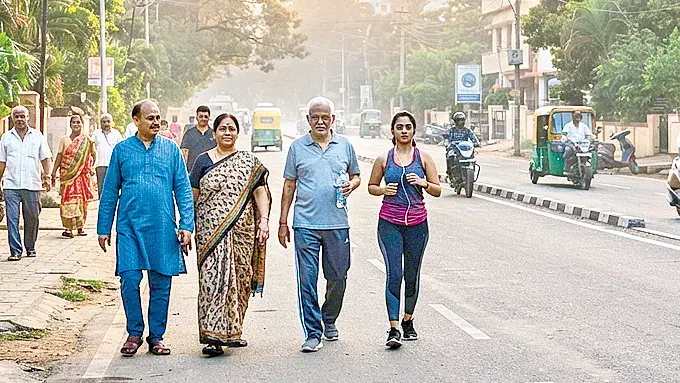
Warangal police warn against morning walks on highways
Police in Warangal have warned that walking on main roads during morning hours, which begin from 4:30 am for many residents, is dangerous. They said drivers who operate vehicles through the night on national and state highways are drowsy in the morning and may not see pedestrians clearly. On September 26, a man walking at Karimabad, Janmabhoomi Junction, under Mills Colony police station limits died on the spot after a two-wheeler hit him; the rider was injured. Six months ago, a lorry hit a man on KU Road, breaking both his legs. Police advise walking in sports grounds, parks, indoor stadiums and on dedicated tracks.
Source
Warangal — స్థానికం · read the original report ↗
Desk check · compared with the source
What the desk checked (5)
- Walking on national and state highways exposes morning walkers in Warangal to injury and death from speeding vehicles. — Attributed to police in the source; no supporting statistics given.
- Many residents begin their morning walk from 4:30 am. — Figure appears in source; no survey or official source cited.
- On September 26, a pedestrian was killed on the spot after a two-wheeler hit him at Karimabad, Janmabhoomi Junction, under Mills Colony police station limits; the rider was injured. — Specific date and location given in source; victim unnamed and no police statement quoted.
- Six months ago, a man heading for a walk on KU Road was hit by a lorry and broke both legs, requiring about a year of rest. — Reported in source without names or attribution; locals said to have taken him to hospital.
- Police advise walking in sports grounds, parks, indoor stadiums and community areas, and avoiding footpaths and dividers. — Advisory attributed to police in the source.
Analysts’ view opinion
On the surface this is a road-safety advisory, but politically it can also be read as a case of an urban infrastructure gap being shifted onto citizens' behaviour. When police say even footpaths are unsafe to walk on, that is an implicit admission that the basic pedestrian facilities a city is supposed to provide are not doing their job — an uncomfortable question for municipal and urban development authorities. At the same time, issuing a warning after a string of accidents is a defensible, duty-bound move by the police.
- Framing the advice around where pedestrians should walk, rather than around traffic enforcement or road design, gives critics an easy opening.
- Calling footpaths and dividers unsafe indirectly exposes the city's pedestrian infrastructure deficit, which lands squarely on municipal governance.
- Pointing people to parks, sports grounds, the indoor stadium and dedicated tracks invites a local debate on whether such facilities exist equally across wards.
- Morning walkers are typically middle-class and older residents — a small constituency in numbers but a vocal and electorally attentive one.
- This remains a city-level police advisory; the story records no policy decision, funding commitment or political response.
What to watch — Watch whether local representatives and municipal officials convert this warning into demands for walking tracks and better footpaths, or whether it stops at a police advisory.
The story establishes no political reaction, no government or opposition position and no official accident data — the political implications here are analysis, not reported fact.
Deep dive
Research brief · 8 facts · 3 dates · exam-readyThe brief
Context
Morning walking is a widespread habit in Warangal, with many residents setting out from their homes as early as 4:30 am and using main roads, including national and state highways, as their walking route. Police in Warangal have issued a public warning that this practice is dangerous because long-distance drivers who have been on the highways through the night are drowsy in the early morning and may not see pedestrians clearly. The warning follows a fatal accident on September 26 and an earlier case in which a lorry crushed a walker's legs on KU Road. Police have listed safer alternatives such as sports grounds, parks, indoor stadiums and dedicated walking tracks.
Key facts
- Many residents in Warangal city begin their morning walk from 4:30 am, often walking along main roads.
- Police say drivers who operate vehicles through the night on national and state highways are drowsy in the morning and may not see pedestrians properly.
- On September 26 morning, a man walking on the road at Karimabad, Janmabhoomi Junction, under Mills Colony police station limits, was hit by a speeding two-wheeler and died on the spot.
- The young two-wheeler rider involved in the September 26 crash was also injured.
- Six months earlier, a man who had left home for a walk on KU Road was hit by a lorry as he was entering the ground; both his legs were broken.
- The KU Road victim was taken to hospital by locals and had to rest for about a year.
- Police advise morning walks in sports grounds, parks, indoor stadiums and Greater community areas, where vehicles do not enter.
- Police say walking on footpaths on either side of the road is not advisable, and walking along the road divider is extremely dangerous.
Timeline
- About six months before the reportA man leaving home for a walk on KU Road is hit by a lorry while entering the ground; both legs broken, hospitalised by locals, about a year of rest needed.
- September 26 (morning)A pedestrian walking on the road at Karimabad, Janmabhoomi Junction (Mills Colony police station limits) is hit by a speeding two-wheeler and dies on the spot; the rider is injured.
- SubsequentlyWarangal police publicly warn against morning walks on main roads and highways and recommend grounds, parks, indoor stadiums and dedicated tracks.
Who has a stake
- Morning walkers in Warangal city — Risk of injury or death while walking on main roads, highways, footpaths or dividers in low-visibility early hours.
- Warangal police / Mills Colony police station — Responsible for road safety advisories, investigating crashes within their limits and preventing repeat pedestrian deaths.
- Night-driving motorists on national and state highways — Drowsiness in the early morning raises their chance of hitting pedestrians and being injured themselves, as happened to the two-wheeler rider.
- Families of victims — Loss of life in the September 26 case; long recovery, with about a year of rest needed in the KU Road lorry case.
- Local bodies managing parks, sports grounds and indoor stadiums — Expected to provide vehicle-free walking spaces and dedicated tracks that police are now urging residents to use.
Why it matters
Pedestrians are among the most vulnerable road users, and this advisory shows how an everyday health habit turns fatal when walking space and vehicle space overlap on highways. Two concrete local cases, one death and one crippling injury, illustrate that early-morning low visibility combined with driver fatigue is a predictable, preventable risk. It also points to a civic gap: walkers take to highways when safe, vehicle-free tracks and grounds are not used or not within reach.
UPSC angle
Prelims pointers
- Warangal police advisory: avoid morning walks on national and state highways; walkers in the city start from 4:30 am.
- September 26: pedestrian killed on the spot at Karimabad, Janmabhoomi Junction, Mills Colony police station limits, Warangal.
- Six months earlier: lorry hit a walker on KU Road, Warangal, breaking both legs; about a year of rest required.
- Police-recommended walking spaces: sports grounds, parks, indoor stadiums, Greater community areas and dedicated tracks.
- Police caution: walking on roadside footpaths is unsafe and walking along the road divider is extremely dangerous.
- Stated cause of risk: drivers who drove through the night on highways are drowsy at dawn and cannot see pedestrians clearly.
Mains framing
The Warangal advisory frames pedestrian safety as a problem of shared road space in the pre-dawn hours: residents begin walking from 4:30 am along main roads and highways, while drivers who have been on national and state highways through the night are drowsy and unable to see walkers clearly in poor light. The result, as police cite, is a pedestrian killed on the spot at Janmabhoomi Junction on September 26 and a walker on KU Road left with both legs broken by a lorry and about a year of recovery. The causes are a mix of behaviour (choosing the carriageway, footpaths or even the divider for exercise), infrastructure (absence or non-use of dedicated walking tracks near residences) and driver fatigue on long-haul night routes. The implications are serious for public health policy, since a habit promoted for wellbeing becomes a road-fatality risk, and for enforcement, which cannot police every stretch of highway at dawn. The way forward suggested within the source is behavioural and spatial: shift walking into vehicle-free sports grounds, parks, indoor stadiums and community areas, use dedicated tracks, and if a road must be crossed, do so before sunrise only to reach the ground, or drive and park outside the ground and walk inside.
Key terms
- National and state highways
- Main inter-city road corridors carrying fast, often night-long vehicle traffic; police say walking on them in the morning is high-risk.
- Mills Colony police station limits
- The Warangal police jurisdiction that includes Karimabad and Janmabhoomi Junction, where the September 26 fatal crash occurred.
- KU Road
- A Warangal road where, six months earlier, a lorry hit a morning walker entering a ground, breaking both his legs.
- Road divider
- The central median separating opposing traffic lanes; police call walking along it extremely dangerous.
- Dedicated walking track
- A specially laid path for walkers, free of vehicles, which police recommend over roads and footpaths.
Practice questions
- Early-morning pedestrian deaths on highways are a preventable category of road fatality. Examine the causes highlighted by the Warangal police advisory and suggest civic measures to reduce such deaths.
- Discuss how urban planning for public health, such as walking tracks, parks and indoor stadiums, can reduce road accident risk, using the Warangal case as an example.
- Driver fatigue on night-long highway journeys is a road safety hazard. What interventions can address it, and what responsibility lies with pedestrians?
Grounded only in the source report — figures and dates are the source's, not inferred.