
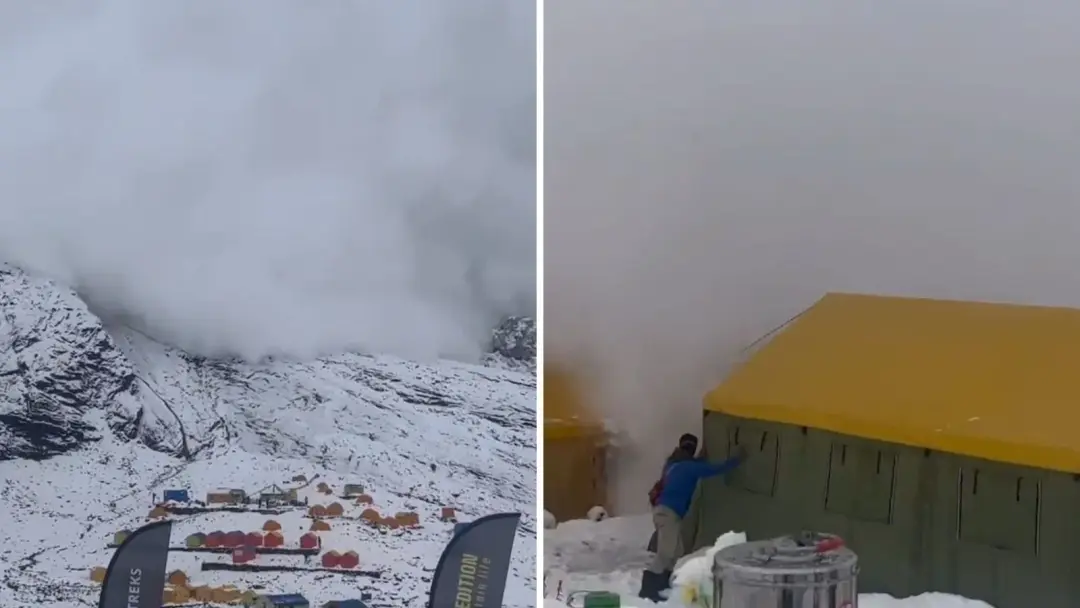
Two climbers killed in avalanche at Mount Manaslu Camp 3
An Indian-German climber, Dhruva Jyoti Guha, and his Nepali Sherpa guide, Fursemba Sherpa, were killed when an avalanche struck their tent at Camp 3 of Mount Manaslu, the world's eighth-highest peak, in Nepal on Saturday night, PTI reported. The pair had moved up from Camp 2 despite adverse weather, and their bodies were found under about seven feet of snow, said Mohan Lamsal of organiser Makalu Adventure. Six other climbers retreated safely. Season fatalities on Manaslu reached four.
Source
Indian Express — India · read the original report ↗
Desk check · compared with the source
What the desk checked (5)
- An Indian-German climber, Dhruva Jyoti Guha, and Nepali guide Fursemba Sherpa died in an avalanche at Camp 3 of Mount Manaslu on Saturday night. — Attributed to Mohan Lamsal, managing director of Makalu Adventure, via PTI.
- Their bodies were found buried under about seven feet of snow. — Figure appears in source, attributed to Lamsal.
- Six other climbers from the expedition retreated from Camp 2 and are safe. — Attributed to Lamsal; no independent confirmation in source.
- The deaths take Manaslu fatalities this season to four, after a Singaporean climber and a Nepali guide died earlier. — Attributed to the expedition organiser.
- Mount Manaslu is 8,163 metres high, the world's eighth-highest peak, in Nepal's Gorkha district. — Descriptive detail stated in source, reported by PTI.
Analysts’ view opinion
This is first and last a mountaineering tragedy, but it touches wider questions of high-altitude risk management and rescue capacity in the Himalaya. Because one of the dead was an Indian-German climber and the other a Nepali Sherpa guide, three national administrative systems are drawn in at once — identification, repatriation of remains, and notification of families. Strategically, rapid high-altitude search-and-rescue capability is tied to Nepal's economic and reputational stakes in expedition tourism, and a season toll that has now reached four on Manaslu adds to that pressure.
- Incidents involving foreign nationals invariably require consular coordination, and here the process will run across Indian, German and Nepali systems.
- The organiser's account — that six climbers turned back from Camp 2 while two pushed higher — raises the perennial question of how much control expedition companies exercise over individual summit decisions.
- Rescue on 8,000-metre peaks depends on weather windows, helicopter reach and ground teams; the organiser's note that the flight to Kathmandu is weather-permitting underlines that hard limit.
- The death of a Sherpa guide revives the long-running debate that risk in Nepal's mountaineering economy falls disproportionately on local staff.
- When multiple fatalities cluster on one peak in a single season, regulatory scrutiny of permits, weather advisories and high-camp management typically increases.
What to watch — Watch the recovery of the bodies from base camp to Kathmandu, the consular response from the countries involved, and whether Nepali authorities signal any review of high-camp safety or permit conditions given this season's toll.
The account rests on the expedition organiser's statement and establishes no independent investigation, no official determination of cause, and no government response.
Deep dive
Research brief · 8 facts · 4 dates · exam-readyThe brief
Context
An avalanche struck Camp 3 of Mount Manaslu, the world's eighth-highest peak at 8,163 metres in Nepal's Gorkha district, killing two members of an expedition organised by Makalu Adventure. The victims were Dhruva Jyoti Guha, an Indian-German climber resident in Germany, and Fursemba Sherpa, an experienced Nepali mountain guide from Makalu. The pair had pushed towards a higher camp from Camp 2 despite bad weather, while six other climbers from the same expedition turned back and survived. Their deaths take the season's toll on Manaslu to four.
Key facts
- An avalanche hit the tent of two climbers at Camp 3 of Mount Manaslu on Saturday night, killing both, according to PTI.
- The dead are Dhruva Jyoti Guha, an Indian-German climber resident in Germany, and Fursemba Sherpa, an experienced Nepali guide from Makalu.
- Their bodies were found buried under around seven feet of snow when the rescue team reached Camp 3.
- Six other climbers of the same expedition company retreated from Camp 2 due to bad weather and are safe.
- The expedition was organised by Makalu Adventure, whose managing director is Mohan Lamsal.
- A rescue team was sent after the two stopped communicating; their last communication came on Saturday night.
- Bodies were being brought to base camp, with a flight to Kathmandu expected on Monday, weather permitting.
- Season fatalities on Manaslu reached four; a Singaporean climber and a Nepali guide died earlier in separate incidents.
Timeline
- Earlier this climbing seasonA Singaporean climber and a Nepali guide died in separate incidents on Mount Manaslu.
- Saturday nightGuha and Fursemba Sherpa moved up from Camp 2 despite adverse weather and were caught in an avalanche at Camp 3; last communication received.
- After contact was lostA rescue team was sent to Camp 3 and found both bodies under about seven feet of snow.
- Monday (expected)Bodies to be flown from base camp to Kathmandu, weather permitting.
Who has a stake
- Families of Dhruva Jyoti Guha and Fursemba Sherpa — Loss of life; repatriation of bodies from base camp to Kathmandu.
- Makalu Adventure (organiser) — Responsibility for expedition safety, rescue coordination and body recovery.
- Nepali Sherpa guides — High occupational risk on 8,000-metre peaks; two Nepali guides among the four deaths this season.
- Six surviving expedition climbers — Retreated from Camp 2 due to bad weather and were reported safe.
- Nepal's mountaineering sector — Reputation and safety record of Manaslu expeditions amid four fatalities this season.
Why it matters
The deaths underline how weather-driven hazards like avalanches make summit-push decisions on 8,000-metre peaks life-or-death, especially when climbers move up despite adverse conditions. They also highlight the disproportionate risk borne by Nepali Sherpa guides, two of whom are among the four people killed on Manaslu this season.
UPSC angle
Prelims pointers
- Mount Manaslu: 8,163 m (26,781 ft), world's eighth-highest mountain.
- Location: Nepal's Gorkha district, Himalayas, about 65 km east of the Annapurna range.
- 'Manaslu' derives from a Sanskrit word meaning 'mountain of the spirit'.
- Camp 3 avalanche killed Indian-German climber Dhruva Jyoti Guha and Nepali guide Fursemba Sherpa.
- Expedition organiser: Makalu Adventure; managing director Mohan Lamsal.
- Manaslu season toll: four, including a Singaporean climber and a Nepali guide killed earlier.
Mains framing
The Manaslu avalanche illustrates the compounding of natural and human factors in high-altitude mountaineering deaths: an avalanche fell above a tent pitched at Camp 3 on the world's eighth-highest peak, but the organiser's account notes the two victims had pushed higher from Camp 2 'in a hurry despite the bad weather condition', while six other climbers of the same expedition chose to retreat and survived. Implications run in three directions: the safety of commercial expeditions and the quality of weather-based decision-making; the occupational vulnerability of Nepali Sherpa guides, who form part of the season's four-death toll on Manaslu alongside a Singaporean climber; and the logistical burden of rescue and repatriation, with bodies recovered from seven feet of snow and evacuation to Kathmandu contingent on weather. A way forward suggested by the facts themselves lies in stricter adherence to weather windows, mandatory communication protocols (the rescue was triggered only after contact ceased), and stronger support and safeguards for guides. The source does not state any regulatory action or policy response.
Key terms
- Mount Manaslu
- 8,163 m peak in Nepal's Gorkha district, the world's eighth-highest mountain; name from Sanskrit for 'mountain of the spirit'.
- Camp 2 / Camp 3
- Staged high-altitude camps on the route to a Himalayan summit, used for acclimatisation and summit pushes.
- Avalanche
- Mass of snow sliding down a slope; here a heavy avalanche fell above the climbers' tent, burying them under about seven feet of snow.
- Sherpa guide
- Nepali high-altitude mountain guide; Fursemba Sherpa was an experienced guide from Nepal's Makalu region.
- Makalu Adventure
- The expedition company that organised the Manaslu climb; its managing director is Mohan Lamsal.
Practice questions
- Discuss the risks faced by Sherpa guides in Himalayan commercial expeditions and the measures needed to improve their safety.
- How do weather-related hazards such as avalanches shape decision-making on 8,000-metre peaks? Illustrate with the Manaslu incident.
- Mount Manaslu is located in which district of Nepal, and what is its height and world ranking by elevation?
Grounded only in the source report — figures and dates are the source's, not inferred.