
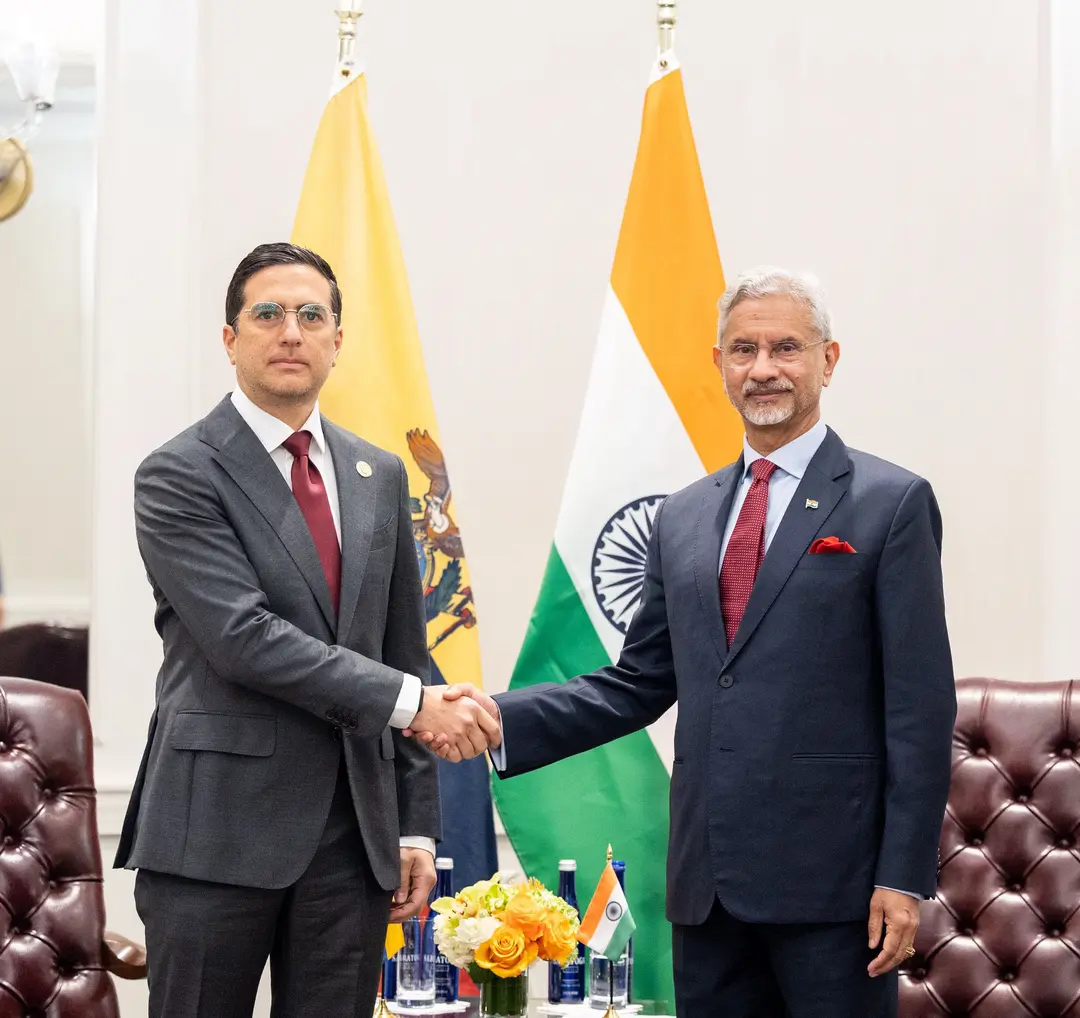
Jaishankar calls first V4+India foreign ministers' meeting historic
India and the four-nation Visegrad Group of Central European countries agreed on Monday to step up political, economic and defence cooperation at their first foreign ministers' meeting, which External Affairs Minister S Jaishankar described as a "new historic occasion". Held on the margins of the 81st UN General Assembly session, the talks with the Czech Republic, Hungary, Poland and Slovakia agreed on annual ministerial meetings and an Annual Business Forum. The Ukraine conflict and Gulf developments were also discussed.
Source
External Affairs — S. Jaishankar · read the original report ↗
Desk check · compared with the source
What the desk checked (5)
- First V4+India foreign ministers' meeting was held on the margins of the 81st UN General Assembly session in New York on Monday. — Stated in source as fact; date given only as 'Monday', no independent sourcing cited.
- Jaishankar called it 'a new historic occasion' and a 'very productive' meeting. — Direct quotes attributed to Jaishankar in remarks to reporters after the meeting.
- The sides agreed to annual foreign ministers' meetings and an Annual Business Forum. — Attributed to Jaishankar's remarks and his post on X.
- V4 comprises the Czech Republic, Hungary, Poland and Slovakia; ministers named were Radek Sikorski, Anita Orban, Juraj Blanar and Petr Macinka. — Names and titles appear in source; spellings reproduced as given without external check.
- Talks covered defence, technology, space, connectivity, mobility, the Ukraine conflict and Gulf developments. — Figure-free descriptive claim attributed to the minister's briefing.
Analysts’ view opinion
The launch of a V4+India format marks a strategic turn in how Delhi engages Europe: working the Brussels channel while simultaneously plugging into sub-regional groupings directly. Because India has long-standing defence-industrial links with Central European states dating to the Soviet era, the agreement to "reinvigorate" defence cooperation is more than boilerplate — it lands at a moment when European arms-production capacity is expanding after the Ukraine war. The open question is durability, given the well-known divergences among V4 capitals on Russia and Ukraine.
- Held on the margins of the UN General Assembly, the meeting illustrates India's multi-track European diplomacy — deepening ties with the EU while cultivating sub-regional blocs in parallel.
- Annual ministerial meetings and an Annual Business Forum give the format institutional machinery, which is what usually separates a lasting platform from a one-off photo opportunity.
- The reference to refreshing a "strong history" in defence points to practical avenues such as spares and upgrades for legacy Soviet-origin systems, and potentially joint production.
- The V4 are industrial economies with real technology and innovation depth, offering India another entry point in Europe for technology, space and research partnerships.
- Ukraine and the Gulf were discussed but no joint position was announced, suggesting India is using this channel for practical cooperation rather than geopolitical signalling.
What to watch — Watch whether the first annual ministerial and business forum are actually scheduled, and whether defence talk converts into concrete agreements or joint production rather than stalling at the discussion stage.
The story establishes no specific defence deal, timeline, trade figure or shared position on Ukraine — for now this remains a statement of intent.
Deep dive
Research brief · 8 facts · 3 dates · exam-readyThe brief
Context
The Visegrad Group (V4) is a cultural and political alliance of four Central European countries — the Czech Republic, Hungary, Poland and Slovakia — that seeks to advance cooperation in military, economic, cultural and energy affairs. On Monday, India held its first-ever foreign ministers' meeting with the V4, in a new "V4+India" format, on the margins of the 81st session of the UN General Assembly in New York. External Affairs Minister S Jaishankar called it a "new historic occasion", and the five countries agreed to deepen political, economic and defence cooperation. The meeting comes as India's relationship with the European Union itself is deepening, according to Jaishankar.
Key facts
- The Visegrad Group (V4) comprises the Czech Republic, Hungary, Poland and Slovakia, and aims at cooperation in military, economic, cultural and energy affairs.
- The first foreign ministers' meeting in the V4+India format was held on Monday on the margins of the 81st session of the UN General Assembly in New York.
- Jaishankar described the meeting as "a new historic occasion" and "very, very productive".
- Participants: Jaishankar, Poland's Deputy PM and FM Radek Sikorski, Hungary's Deputy PM and FM Anita Orban, Slovak FM Juraj Blanar and Czech FM Petr Macinka.
- There was "consensus" that the foreign ministers of the five nations would meet annually.
- The group agreed to create an Annual Business Forum as a special economic initiative.
- Agreed areas: technology, innovation, research and education partnerships; reinvigorated defence cooperation; cultural and people-to-people ties; support for multilateralism.
- Discussions also covered space, connectivity, people-to-people mobility, the Ukraine conflict and developments in the Gulf.
Timeline
- Monday (during the 81st UN General Assembly session)First meeting of the foreign ministers of the Visegrad Group and India held in New York, on the UNGA margins.
- After the meeting, same dayJaishankar briefs reporters and posts on X listing the agreed areas of cooperation.
- Going forward (annual)Foreign ministers of the five nations to meet annually; an Annual Business Forum to be created.
Who has a stake
- India / Ministry of External Affairs — Expanding engagement with Central Europe as a bloc, alongside its deepening relationship with the European Union.
- Visegrad Group (Czech Republic, Hungary, Poland, Slovakia) — Industrial economies with innovation and technology talent seeking wider partnerships; how the V4 come together is "for them to decide", said Jaishankar.
- S Jaishankar, External Affairs Minister — Led India's side; framed the format as historic and productive.
- V4 foreign ministers (Sikorski, Orban, Blanar, Macinka) — Committed their countries to annual ministerial meetings and cooperation across defence, technology and culture.
- Business communities of India and V4 states — Direct beneficiaries of the proposed Annual Business Forum and deeper economic cooperation.
- European Union — The V4+India track runs alongside India's deepening EU relationship, of which the four are members.
Why it matters
The V4+India format gives New Delhi a structured, plurilateral channel to Central Europe at a time when its wider engagement with the European Union is deepening. Commitments to annual ministerial meetings, an Annual Business Forum and renewed defence cooperation institutionalise ties with four industrial economies that India sees as strong in innovation and technology. The agenda also stretched to global crises — the Ukraine conflict and Gulf developments — and to joint support for multilateralism.
UPSC angle
Prelims pointers
- Visegrad Group (V4): Czech Republic, Hungary, Poland, Slovakia — cooperation in military, economic, cultural and energy affairs.
- First V4+India foreign ministers' meeting held on the margins of the 81st UN General Assembly session, in New York.
- Two institutional outcomes: annual meetings of foreign ministers and an Annual Business Forum.
- India was represented by External Affairs Minister S Jaishankar; Poland by Deputy PM and FM Radek Sikorski.
- Agreed cooperation areas include defence, technology, innovation, research, education, culture, people-to-people ties and multilateralism.
- Global issues discussed: the Ukraine conflict and developments in the Gulf.
Mains framing
India's first foreign ministers' meeting with the Visegrad Group marks a shift from purely bilateral diplomacy with individual European states towards engaging sub-regional groupings within the EU. The drivers are visible in the source itself: India's relationship with the European Union is deepening, the four V4 states are industrial economies with innovation and technology talent, and India has, in Jaishankar's words, a "very strong history" of defence cooperation with all four that it now wants to "refresh". The outcomes are institutional rather than transactional — annual ministerial meetings to give the format political regularity, an Annual Business Forum to anchor commerce, and agreed tracks on technology, innovation, research and education, space, connectivity, people-to-people mobility and cultural ties, plus a shared commitment to multilateralism. The presence of the Ukraine conflict and Gulf developments on the agenda shows the format is also a venue for convergence-testing on hard security questions where Indian and Central European perspectives may differ. The way forward, on the evidence of the source, lies in converting the declared consensus into calendared meetings and a functioning business forum, while respecting that how the V4 come together is, as Jaishankar put it, "for them to decide".
Key terms
- Visegrad Group (V4)
- Cultural and political alliance of the Czech Republic, Hungary, Poland and Slovakia for cooperation in military, economic, cultural and energy affairs.
- V4+India format
- New five-nation dialogue mechanism bringing India together with the four Visegrad countries; first foreign ministers' meeting held Monday.
- Annual Business Forum
- Special economic initiative agreed at the meeting to deepen India–V4 commercial cooperation.
- Margins of the UNGA
- Side meetings held alongside the UN General Assembly session — here the 81st session — used for intensive diplomacy.
- Multilateralism
- Cooperation through international institutions and rules, which the five countries agreed to work together to support.
Practice questions
- What is the Visegrad Group, and what does the launch of the V4+India format add to India's existing engagement with the European Union?
- Discuss the significance of sub-regional groupings such as the V4 in India's Europe policy, with reference to the outcomes of the first V4+India foreign ministers' meeting.
- The V4+India meeting discussed both cooperation and global crises such as the Ukraine conflict and Gulf developments. Examine how such plurilateral formats help India manage divergent positions on security issues.
Grounded only in the source report — figures and dates are the source's, not inferred.