
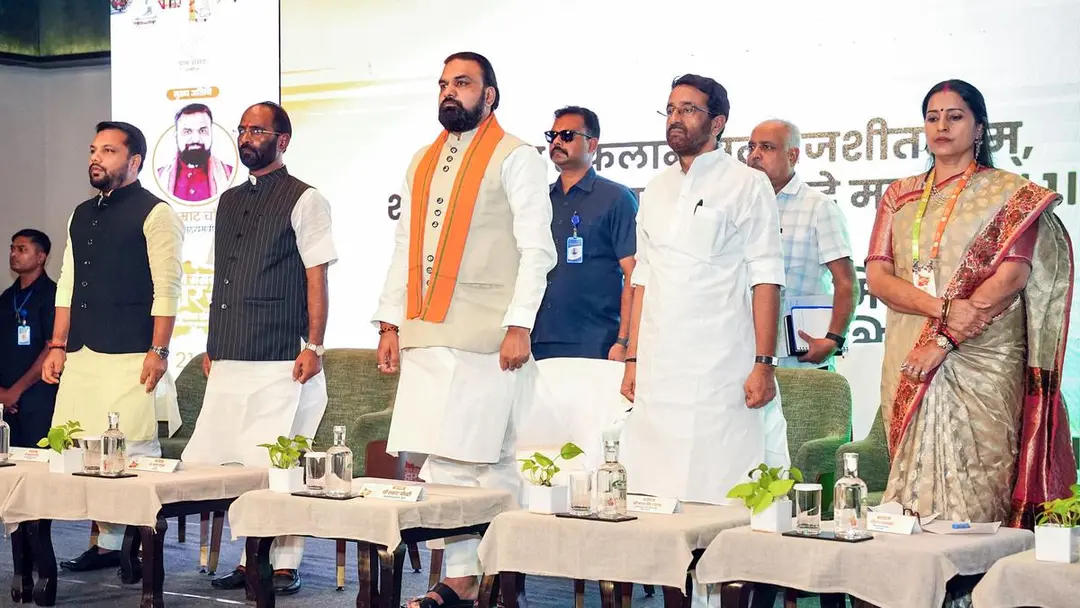
Bihar panchayat polls only after delimitation, says Samrat Choudhary
Bihar Chief Minister Samrat Choudhary said on Monday that the next Panchayat election will be held only after the delimitation process is completed. Speaking at the 'Gram Sansad – Bihar Chapter' event in Patna, he said the State Election Commission has begun the process, and delimitation for urban local bodies would follow next year. He said a Panchayat would be set up for about 7,500 people, an engineering cell created in the Panchayati Raj Department, and one crore jobs provided before 2030.
Source
The Hindu — National · read the original report ↗
Desk check · compared with the source
What the desk checked (5)
- Bihar's next Panchayat election will be held only after the delimitation process is completed. — Directly attributed to Chief Minister Samrat Choudhary, including a verbatim quote in the source.
- The State Election Commission has initiated the delimitation process for Panchayats; urban local body delimitation is planned next year. — Quoted statement by Choudhary; no independent confirmation from the State Election Commission in the source.
- A Panchayat would be established for a population of approximately 7,500 and an engineering cell set up in the Panchayati Raj Department. — Attributed to Choudhary as an assertion; no official order or timeline cited.
- About ₹18,000 crore flows out of the state through the Bihar Student Credit Card scheme. — Figure appears in source as a direct quote from Choudhary; basis of the calculation not given.
- The government aims to provide jobs and employment to one crore people before 2030. — Stated target attributed to Choudhary; no supporting data in source.
Analysts’ view opinion
Tying the next Panchayat election to the completion of delimitation looks administrative, but its political meaning is plain: the map of village-level power will be redrawn on the government's timetable. If the norm of roughly one Panchayat per 7,500 people is implemented, the number of Panchayats, their boundaries and reservation arithmetic could shift — creating winners and losers among sitting Mukhiyas and Sarpanchs. That Chief Minister Samrat Choudhary chose a gathering of Mukhiyas and Panch-Sarpanchs to say this, while promising an engineering cell in the Panchayati Raj Department and inviting suggestions on new revenue sources, reads as an effort to keep that vast local-representative network on the government's side.
- Linking the poll to delimitation effectively makes the timing of local elections dependent on the pace of the government–State Election Commission process, which is exactly the kind of gap opposition parties tend to frame as deliberate delay.
- The proposed one-Panchayat-per-7,500-population norm could change boundaries and the number of seats, putting seat security of current incumbents in question — a natural friction point.
- Clearly demarcating Panchayat and urban local body boundaries also decides which body controls which funds and schemes, potentially sharpening rural–urban competition for resources.
- Ruling out extra taxes while asking Panchayats to suggest new revenue sources reflects the delicate balance between popular appeal and fiscal reality at the local level.
- Announcing targets of one crore jobs by 2030 and a prosperous Bihar by 2037 before grassroots representatives suggests a strategy of turning that network into a carrier of the government's development narrative.
What to watch — Watch whether a firm timeline for delimitation is announced, whether polls can be held before the current Panchayat representatives' terms lapse, and how Mukhiya associations and opposition parties respond.
The story does not establish when delimitation will finish, whether elections will actually be postponed, or which party stands to gain — nor does it carry any opposition reaction.
Deep dive
Research brief · 8 facts · 7 dates · exam-readyThe brief
Context
Bihar Chief Minister Samrat Choudhary, addressing the 'Gram Sansad – Bihar Chapter: Mukhiya Samvad' event in Patna on September 21, 2026, announced that the State's next Panchayat election will be held only after the State Election Commission completes delimitation of Panchayats. Delimitation of urban local bodies is to follow next year, to clearly demarcate boundaries between rural Panchayat areas and urban local body areas. The event brought together Mukhiyas and Sarpanchs for discussions on rural development, the role of Panchayats and making villages self-reliant. Choudhary also outlined plans on Panchayat size, technical support and employment targets.
Key facts
- Bihar CM Samrat Choudhary said on September 21, 2026 that the next Panchayat election will be held only after delimitation is completed.
- The State Election Commission has already initiated the delimitation process for Panchayats.
- Delimitation for urban local bodies is to be ensured next year, to demarcate Panchayat and urban local body boundaries.
- Work would be undertaken to establish a Panchayat for a population of approximately 7,500.
- An engineering cell is to be set up within the Panchayati Raj Department for technical support to development works.
- Under the 'Seva Sankalp Evam Kayakalp Abhiyan', 10 development schemes are being worked on in every Panchayat, including maintenance, painting and upgrading of health centres, community halls and Anganwadi centres.
- Choudhary said around ₹18,000 crore flows out of Bihar through the 'Bihar Student Credit Card' scheme.
- The State government aims to provide government jobs and employment to one crore people before 2030.
Timeline
- September 21, 2026 (Monday)CM Samrat Choudhary inaugurates 'Gram Sansad – Bihar Chapter: Mukhiya Samvad' in Patna and says Panchayat polls will follow delimitation.
- Ongoing (as stated on September 21, 2026)State Election Commission has initiated the delimitation process for Panchayats.
- September 22, 2026Report published.
- Next year (as per CM)Delimitation measures to be ensured for urban local bodies.
- Before 2030Target of providing government jobs and employment to one crore people.
- 2037Goal of a prosperous, empowered Bihar.
- 2047Goal of a 'Developed India', for which Panchayat representatives' cooperation was sought.
Who has a stake
- Bihar Chief Minister Samrat Choudhary — Announced the delimitation-first sequencing of Panchayat polls and set targets on jobs, education and Panchayat restructuring.
- Bihar State Election Commission — Conducting the Panchayat delimitation process that will determine when the next Panchayat election can be held.
- Three-tier Panchayat representatives, Mukhiyas and Sarpanchs — Their constituencies, boundaries and terms depend on delimitation; asked to suggest infrastructure improvements and new revenue sources.
- Bihar State Mukhiya Sangh (State President Mithilesh Rai) and Bihar State Panch-Sarpanch Sangh (State President Amod Nirala) — Represent elected rural functionaries affected by delimitation and Panchayat reorganisation.
- Gram Sansad (Founder-General Secretary Brajesh Sharma; National President Sanjay Mayukh) — Platform convening Mukhiyas; asked to suggest new Panchayat-level revenue sources.
- Panchayati Raj Department — To house the new engineering cell providing technical support for Panchayat development works.
- Bihar students and higher education institutions — Expansion of government and private universities to retain students and the ₹18,000 crore outflow via the Student Credit Card scheme.
- Urban local bodies — Their boundaries are to be delimited next year, separating them from Panchayat areas.
Why it matters
Delimitation of Panchayats decides how many seats exist, where boundaries lie and who votes where, so tying the next rural polls to its completion directly affects the timing of grassroots democracy in Bihar. Reorganising Panchayats around a population of roughly 7,500 and separating rural from urban local body areas could redraw local political units across the State. It also links local governance capacity — funds, revenue sources and technical support — to the State's larger jobs and education targets.
UPSC angle
Prelims pointers
- Bihar's next Panchayat election to be held only after delimitation; process initiated by the State Election Commission.
- Panchayats in Bihar function on a three-tier structure, with Mukhiya as Village Head.
- Proposed norm: one Panchayat for a population of about 7,500.
- 'Seva Sankalp Evam Kayakalp Abhiyan': 10 development schemes in every Panchayat, covering health centres, community halls and Anganwadi centres.
- Bihar Student Credit Card scheme: about ₹18,000 crore said to flow out of the State under it.
- Stated targets: one crore jobs before 2030; empowered Bihar by 2037; Developed India by 2047.
Mains framing
Bihar's decision to hold the next Panchayat election only after delimitation highlights the tension between timely local elections and rational reorganisation of local units. The stated rationale is administrative clarity — creating Panchayats of roughly 7,500 population and demarcating rural Panchayat areas from urban local body areas, with urban delimitation to follow next year — which addresses the overlap created by expanding towns. But delay in elections risks weakening the continuity of elected grassroots representation, and reorganisation must be paired with capacity: the government proposes an engineering cell in the Panchayati Raj Department for technical support and has asked Gram Sansad and three-tier representatives to suggest new Panchayat-level revenue sources, while ruling out additional taxes on common people. The Chief Minister frames Panchayats as the most vital unit of democracy and links their role to service delivery — waste management, drinking water, electricity and roads — and to the 'Seva Sankalp Evam Kayakalp Abhiyan' covering 10 schemes per Panchayat. The way forward, on the source's own terms, lies in completing delimitation transparently and swiftly, strengthening Panchayat finances and technical capacity, and integrating local bodies into wider goals such as one crore jobs before 2030 and retaining students within Bihar through expanded higher education.
Key terms
- Delimitation
- Process of redrawing boundaries and seats of electoral units; here, for Bihar's Panchayats and, next year, urban local bodies.
- State Election Commission
- Body conducting local body elections in the State; it has begun Bihar's Panchayat delimitation process.
- Three-tier Panchayat
- Rural local self-government structure of village, intermediate and district levels whose representatives were addressed at the event.
- Mukhiya
- Village head of a Gram Panchayat, responsible for area development and resolving public grievances.
- Seva Sankalp Evam Kayakalp Abhiyan
- Bihar campaign under which 10 development schemes per Panchayat are taken up, including upgrading health centres, community halls and Anganwadi centres.
- Bihar Student Credit Card
- State scheme for financing higher education; CM said about ₹18,000 crore flows out of Bihar through it.
Practice questions
- Should local body elections be deferred until delimitation is completed? Discuss with reference to Bihar's decision to hold Panchayat polls only after delimitation.
- Examine how delimitation of Panchayats and urban local bodies can address the rural-urban boundary overlap, using the Bihar example.
- Strengthening Panchayats requires own revenue sources and technical capacity, not only more schemes. Critically analyse in the light of Bihar's proposed engineering cell in the Panchayati Raj Department.
Grounded only in the source report — figures and dates are the source's, not inferred.