
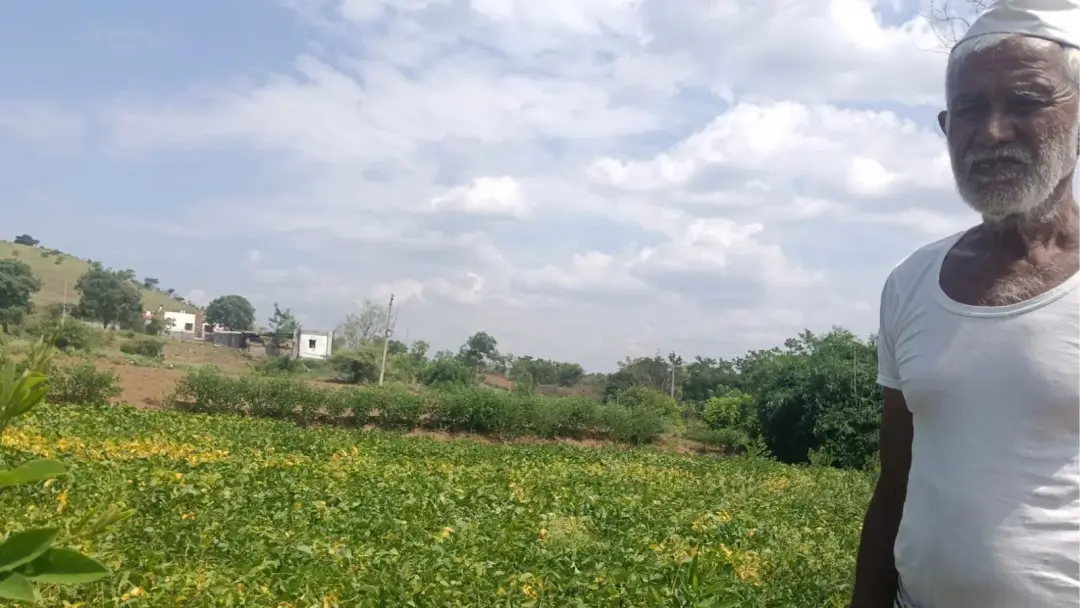
Ralegan Siddhi stays green as drought hits Ahilyanagar farms
Maharashtra has declared drought in 265 of its 358 tehsils after recording an 18 per cent rainfall deficit this year. Officials said Ahilyanagar district saw a 30-35 per cent rain deficit and a dry spell of nearly 51 days, with a 73 per cent deficit in August and 32.7 mm of rain in September against an average of 147 mm. Some farmers destroyed standing crops. Ralegan Siddhi remains green due to Anna Hazare's water conservation model.
Source
Indian Express — Cities · read the original report ↗
Desk check · compared with the source
What the desk checked (5)
- Maharashtra declared drought in 265 of 358 tehsils amid an 18 per cent rainfall deficit this year. — Figures appear in source, attributed to the state government's declaration last week; no document cited.
- Ahilyanagar district recorded a 30-35 per cent rain deficit and a dry spell of nearly 51 days. — Attributed to unnamed district officials in the source.
- August saw a 73 per cent rainfall deficit and September brought 32.7 mm against a 147 mm average. — Figures appear in source, attributed to an unnamed official.
- Ralegan Siddhi remains relatively insulated from drought due to Anna Hazare's watershed conservation model since the 1970s. — Attributed to Anna Hazare, sarpanch Jaysing Mapari and local farmers; observational, not independently measured in the source.
- Farmer Balasaheb Awati borrowed Rs 10 lakh and lost crops on 18 acres; Macchindra Borude lost a Rs 15,000 bajra investment. — Self-reported by the named farmers in the source; no records cited.
Analysts’ view opinion
This is less a weather story than a rural balance-sheet story. With an 18 per cent statewide rainfall deficit and 265 of 358 tehsils declared drought-hit, the loss is broad enough to be a state-level economic problem, not a district one. When a kharif crop fails, the farmer takes a double hit — this season's income vanishes while last season's borrowing still has to be serviced. Ralegan Siddhi's contrast makes one economic point: spending early on water conservation may be cheaper than paying compensation later.
- From a smallholder who lost an investment of Rs 15,000 to a farmer with 18 acres carrying Rs 10 lakh of debt, the scale differs but the cash-flow stoppage is identical.
- Farmers running a rotavator through standing crops is not only distress — it is a cost calculation that further inputs are money thrown away.
- A second consecutive bad year, after last year's wet drought, means household buffers are already thin, and that weakness passes on to seed, fertiliser, equipment and general rural spending.
- Compensation has been announced, but farmers say last year's money has still not arrived — payment delayed is effectively payment denied, because loan instalments do not wait.
- Simultaneous damage to onion, soyabean, maize, tur and bajra can tighten local supply and add price volatility, though the story itself does not establish any price impact.
What to watch — Watch how quickly compensation actually reaches farmers' accounts, whether there is enough soil moisture for rabi sowing, and how long borewell and stored water hold out — these will decide the rural economy over the coming months.
The story does not establish the total value of crop losses, the size or timing of compensation, any loan-restructuring measures, or actual effects on prices and migration — and villagers themselves warn Ralegan Siddhi's advantage could erode without more rain.
Deep dive
Research brief · 8 facts · 8 dates · exam-readyThe brief
Context
Maharashtra has declared drought in 265 of its 358 tehsils — about three-fourths of the state — after recording an 18 per cent rainfall deficit this year. In Ahilyanagar district, 14 talukas are drought-hit, with a 30-35 per cent rain deficit and a dry spell of nearly 51 days that ruined much of the Kharif crop; some farmers in Parner taluka destroyed their standing bajra with rotavators. Against this backdrop, Ralegan Siddhi — the village transformed by social activist Anna Hazare's watershed conservation work since the 1970s — remains green, with percolation tanks and farm ponds holding water because of check dams and nala bunds that recharged groundwater.
Key facts
- Maharashtra declared drought in 265 of its 358 tehsils — about three-fourths of the state — after an 18 per cent rainfall deficit this year.
- Ahilyanagar district recorded a rain deficit of 30 to 35 per cent and an extended dry spell of nearly 51 days, ruining much of the Kharif crop.
- District-wise monthly pattern: about 39 per cent deficit in June, good rain in parts in July, 73 per cent deficit in August.
- September, which typically averages the highest rainfall at 147 mm in the district, yielded only 32.7 mm.
- Fourteen talukas in Ahilyanagar were declared drought-hit; Parner taluka alone has 131 villages.
- Farmer Macchindra Borude of Punawadi lost a bajra crop in which he had invested Rs 15,000; Vilas Borude ran a rotavator through his standing bajra.
- Balasaheb Awati, 55, of Parner lost soyabean, onion, tur, maize and bajra across 18 acres after borrowing Rs 10 lakh; his wells at 70-80 feet are running dry.
- Awati said his village has a population of 13,000 and more than 3,000 farmer households facing similar distress.
Timeline
- 1972Maharashtra hit by what residents call the worst drought in its history; Ralegan Siddhi villagers such as Baban Awati migrated to Gujarat for work.
- Since the 1970sAnna Hazare implements a watershed conservation model in Ralegan Siddhi — check dams, nala bunds, percolation tanks.
- Last yearCrops in Parner failed due to 'wet drought'; farmers say promised state compensation has still not been paid.
- June (this year)Ahilyanagar records a rain deficit of nearly 39 per cent.
- July (this year)Some parts of the district receive good rainfall, triggering Kharif sowing of cotton, soyabean, bajra, maize, pulses, paddy and ragi.
- August (this year)District records a 73 per cent rainfall deficit.
- September (this year)Only 32.7 mm rain against a 147 mm average; farmers destroy standing crops.
- Last week (before publication)State government declares drought in 265 of 358 tehsils and promises compensation.
Who has a stake
- Kharif farmers of Parner and Ahilyanagar — Total or near-total crop loss in bajra, soyabean, onion, tur, maize and pulses, with loans of up to Rs 10 lakh to repay and no season income.
- Maharashtra government — Has declared drought in 265 tehsils and promised compensation; faces credibility loss as last year's wet-drought dues remain unpaid.
- Anna Hazare and Ralegan Siddhi villagers — Their watershed model is cited as proof that proactive conservation insulates villages; Hazare warns the situation could still worsen.
- Ralegan Siddhi gram panchayat (sarpanch Jaysing Mapari) — Credits check dams and nala bunds for water security; says one more heavy spell would make the village drought-free.
- District administration officials — Assessing crop damage, deficit figures and groundwater depletion to guide relief.
- Lenders and rural credit system — Rising risk of farm loan defaults as debt-laden farmers lose an entire Kharif season.
Why it matters
Drought in three-fourths of Maharashtra's tehsils means a failed Kharif season for millions of rain-dependent farmers, deepening debt and distress when last year's compensation is still pending. The contrast with Ralegan Siddhi shows that decentralised watershed works — check dams, nala bunds, percolation tanks — can buffer the same rainfall shortfall, making water conservation a question of preparedness rather than relief.
UPSC angle
Prelims pointers
- Maharashtra declared drought in 265 of 358 tehsils; statewide rainfall deficit 18 per cent.
- Ahilyanagar district: 30-35 per cent rain deficit, 51-day dry spell, 14 talukas drought-hit.
- August deficit in Ahilyanagar: 73 per cent; September rain 32.7 mm against a 147 mm average.
- Ralegan Siddhi (Ahilyanagar) is associated with Anna Hazare's watershed conservation model since the 1970s.
- Key water-harvesting structures named: check dams, nala bunds (embankments), percolation tanks, farm ponds.
- Kharif crops sown in the district: cotton, soyabean, bajra, maize, black gram, green gram, pigeon pea, paddy, finger millet (ragi).
Mains framing
Maharashtra's declaration of drought in 265 of 358 tehsils after an 18 per cent rainfall deficit illustrates how monsoon variability, not just total rainfall, drives agrarian distress: in Ahilyanagar, good July rain induced Kharif sowing of soyabean, bajra, maize and pulses, only for an 73 per cent August deficit and a 51-day dry spell to destroy the standing crop, with September delivering 32.7 mm against a 147 mm norm. The consequences are layered — depleted groundwater and wells at 70-80 feet running dry, farmers running rotavators through immature bajra to cut losses, and debt of up to Rs 10 lakh with no harvest to service it, compounded by unpaid compensation from last year's 'wet drought'. Ralegan Siddhi's relative insulation suggests the way forward lies in what Anna Hazare calls proactive, scientific and integrated water planning: identifying catchment areas, building check dams and nala bunds, recharging aquifers and storing every drop before drought arrives, rather than reactive relief. Even there, caution is warranted — villagers note it rained only three days this monsoon and are unsure how long borewell water will last, indicating that watershed works reduce but do not eliminate vulnerability. Timely, credible payment of compensation and crop-loss assessment remain essential to prevent drought from turning into a debt crisis.
Key terms
- Tehsil / taluka
- Sub-district administrative unit; drought is declared tehsil-wise — 265 of Maharashtra's 358 tehsils this year.
- Wet drought
- Crop failure caused by excessive or untimely rainfall, which farmers in Parner say destroyed last year's crop.
- Nala bund
- A small embankment built across a stream or drainage line to slow runoff and let water percolate into the ground.
- Percolation tank
- A storage structure designed to let collected rainwater seep underground and recharge the groundwater table.
- Check dam
- A small barrier across a watercourse to capture rainwater and raise local groundwater levels.
- Kharif season
- The monsoon cropping season; crops here include cotton, soyabean, bajra, maize, pulses, paddy and ragi.
Practice questions
- Maharashtra declared drought in 265 of its 358 tehsils despite an overall rainfall deficit of only 18 per cent. Discuss how intra-seasonal rainfall variability, rather than annual totals, determines agrarian distress in India.
- Ralegan Siddhi remained green while neighbouring villages in the same district lost their Kharif crop. Examine the role of decentralised watershed development in building drought resilience, and its limits.
- Critically evaluate India's shift from reactive drought relief to proactive water conservation planning, using the Ahilyanagar experience as an illustration.
Grounded only in the source report — figures and dates are the source's, not inferred.