
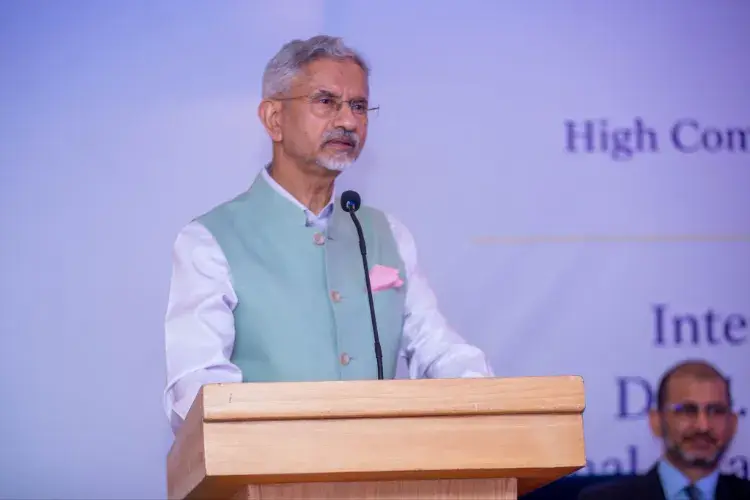
India-Africa partnership to last generations, says Jaishankar in Ghana
External Affairs Minister S Jaishankar, on a visit to Ghana, described India and Africa as long-term partners. "We carry Africa in our hearts and will build a partnership not just for today but for generations to come," he said, urging joint work on supply chain resilience, strategic autonomy and Global South cooperation. He met Ghanaian Foreign Minister Sam Okudzeto Ablakwa and President John Dramani Mahama, and two memoranda of understanding were exchanged. His three-nation tour also covers Cote d'Ivoire and Ethiopia.
Source
External Affairs — S. Jaishankar · read the original report ↗
Desk check · compared with the source
What the desk checked (5)
- Jaishankar said India will build a partnership with Africa 'not just for today but for generations to come'. — Quoted from his social media post of Tuesday, as stated in source.
- Ghana is the first leg of Jaishankar's three-nation Africa tour, also covering Cote d'Ivoire and Ethiopia. — Stated in source; no separate attribution given.
- India-Ghana ties were elevated to a Comprehensive Partnership during PM Modi's state visit. — Attributed to Ghanaian Foreign Minister Sam Okudzeto Ablakwa's post on X.
- Modi visited Ghana in July 2025, the first Indian prime ministerial visit in three decades. — Figure appears in source without attribution; note the source dates Jaishankar's post October 6, 2026.
- Two MoUs were exchanged — ZSI with University of Ghana, and ICAR with CSIR-Crops Research Institute. — Stated in source as exchanged in the presence of the two foreign ministers.
Analysts’ view opinion
Jaishankar's Ghana stop is less about the two modest MoUs signed than about positioning India as a long-horizon partner in a continent where several major powers are competing for influence. The vocabulary he used — supply chain resilience, strategic autonomy, the Global South's right to industrialise, 'partnerships should expand our options, not restrict them' — is explicitly the language of hedging against dependence on any single external power, and it is pitched at African governments making similar calculations. With Ghana set to chair the African Union in 2027 and a founding member of ECOWAS, the timing suggests New Delhi is investing early in multilateral gatekeepers rather than chasing one-off deals.
- By framing national security as supply chain resilience, technological capability and the ability to produce essential goods, Jaishankar links defence policy to industrial and resource access — a framing that makes Africa strategically, not just commercially, relevant to India.
- The explicit mention of defence alongside trade, pharmaceuticals and technology in the talks with Ghana's foreign minister signals India is willing to compete in a domain usually dominated by larger arms suppliers, though the story gives no detail on scale or content.
- Ghana's incoming African Union chairmanship in 2027 and India's push to deepen engagement with the AU and ECOWAS point to a bloc-level strategy aimed at building durable diplomatic majorities in the Global South.
- Invoking the African Union's G20 inclusion during India's presidency is a credibility play: India is presenting a delivered outcome rather than only a promise, which matters in a crowded field of courtiers on the continent.
- The 'strategic autonomy' pitch cuts both ways — it is an offer of a non-exclusive partnership, but it also means African states will keep balancing India against other partners, limiting how much exclusivity New Delhi can expect.
What to watch — Watch whether the Cote d'Ivoire and Ethiopia legs produce anything more concrete than capacity-building MoUs — particularly on defence, energy or critical minerals — and how India's AU and ECOWAS engagement firms up ahead of Ghana's 2027 chairmanship.
The story records intent, atmospherics and two academic-and-agricultural MoUs; it establishes no financial commitments, no defence agreements and no evidence of how far the stated ambitions have actually been operationalised.
Deep dive
Research brief · 8 facts · 3 dates · exam-readyThe brief
Context
External Affairs Minister S. Jaishankar began a three-nation Africa tour in Ghana, also covering Cote d'Ivoire and Ethiopia. The visit builds on Prime Minister Narendra Modi's July 2025 trip to Accra, which elevated India-Ghana ties to a Comprehensive Partnership and was the first Indian prime ministerial visit to Ghana in three decades. In Accra, Jaishankar met Foreign Minister Sam Okudzeto Ablakwa and President John Dramani Mahama, addressed Ghana's Foreign Service Institute and the Indian community, and oversaw the exchange of two MoUs. The outreach reflects India's wider push to deepen engagement with Africa as an economic, resource and Global South partner.
Key facts
- Jaishankar said on Tuesday: "We carry Africa in our hearts and will build a partnership not just for today but for generations to come."</n>
- Ghana is the first leg of Jaishankar's three-nation Africa tour, which also includes Cote d'Ivoire and Ethiopia.
- Two MoUs were exchanged: Zoological Survey of India with the University of Ghana, and ICAR, New Delhi, with CSIR-Crops Research Institute, Ghana.
- Ghana is a founding member of ECOWAS, a 15-member West African regional bloc for economic, social and political integration.
- Ablakwa said India-Ghana relations were elevated to a Comprehensive Partnership during PM Modi's state visit last year.
- PM Modi visited Ghana in July 2025 — his first bilateral visit there and the first Indian prime ministerial visit in three decades.
- Ghana is set to assume the chairmanship of the African Union in 2027.
- Jaishankar cited the African Union's inclusion in the G20 during India's presidency as proof of India's Global South commitment.
Timeline
- July 2025PM Narendra Modi makes his first bilateral visit to Ghana — the first Indian prime ministerial visit in three decades; ties elevated to Comprehensive Partnership.
- October 6, 2026 (Tuesday)Jaishankar arrives in Ghana on the first leg of his three-nation Africa tour; meets FM Ablakwa and President Mahama, addresses the Foreign Service Institute and the Indian community; two MoUs exchanged.
- 2027Ghana is set to assume the chairmanship of the African Union.
Who has a stake
- India (Ministry of External Affairs) — Expanding Africa outreach in trade, investment, development, pharmaceuticals, defence and technology, and consolidating leadership of the Global South.
- Ghana — Deepening a Comprehensive Partnership with India ahead of assuming the African Union chairmanship in 2027; gains in agriculture research, capacity building and development.
- President John Dramani Mahama and FM Sam Okudzeto Ablakwa — Translating post-Modi-visit momentum into concrete cooperation; Ablakwa calls both sides "high-grade strategic partners".
- African Union and ECOWAS — India seeks deeper multilateral engagement with both; AU's G20 inclusion came during India's presidency.
- Indian diaspora in Ghana — Described by Jaishankar as contributing to "special bonds"; acts as a bridge in people-to-people ties.
- Research institutions (ZSI, ICAR, University of Ghana, CSIR-Crops Research Institute) — Direct beneficiaries of the two MoUs on academics, scientific research, agricultural research and capacity building.
Why it matters
Africa is central to India's search for resilient supply chains in fuel, food, fertiliser and finance, and to its claim to speak for the Global South. Ghana's upcoming African Union chairmanship in 2027 makes Accra a strategically timed stop, and institutional MoUs give substance to a relationship otherwise framed in declarations. The visit also signals India's preference for strategic autonomy — partnerships that, in Jaishankar's words, "expand our options, not restrict them".
UPSC angle
Prelims pointers
- ECOWAS: Economic Community of West African States, a 15-member bloc; Ghana is a founding member.
- India-Ghana ties elevated to Comprehensive Partnership during PM Modi's July 2025 state visit.
- Ghana to chair the African Union in 2027.
- African Union was admitted to the G20 during India's G20 presidency.
- MoUs exchanged: Zoological Survey of India–University of Ghana; ICAR–CSIR-Crops Research Institute, Ghana.
- Jaishankar's three-nation Africa tour: Ghana, Cote d'Ivoire, Ethiopia (seat of the African Union).
Mains framing
India's Africa policy is being recast from aid-era goodwill to a structured partnership resting on trade, investment, development cooperation, pharmaceuticals, defence, technology and digital public infrastructure — and Jaishankar's Ghana visit illustrates the method. The drivers are visible in his own framing: national security now hinges on supply chain resilience, technological capability and the ability to produce essential goods, with resilience sought specifically in fuel, food, fertiliser and finance; Africa supplies resources, markets and diplomatic weight, while India offers digital experience, agricultural research and capacity building. The multilateral layer matters as much as the bilateral — engagement with the African Union and ECOWAS, the AU's G20 entry during India's presidency, and Ghana's 2027 AU chairmanship all serve a Global South agenda that includes the right to industrialise. The stated doctrinal anchor is strategic autonomy: managing competition without confrontation, promoting cooperation even where interests diverge, and keeping partnerships option-expanding rather than restrictive. The way forward implied by the source lies in institutionalisation — research and academic MoUs, skilling young populations into productive citizens, sharing an accessible digital ecosystem — so that high-level visits convert into durable, deliverable cooperation.
Key terms
- ECOWAS
- Economic Community of West African States, a 15-member regional bloc for economic, social and political integration in West Africa; Ghana is a founding member.
- Comprehensive Partnership
- The upgraded level of India-Ghana bilateral relations, agreed during PM Modi's state visit last year.
- Strategic autonomy
- Foreign policy approach Jaishankar described as ensuring partnerships "expand our options, not restrict them".
- Supply chain resilience
- Securing reliable access to essentials — cited by Jaishankar as fuel, food, fertiliser and finance — as part of national security.
- Global South
- Grouping of developing countries whose voice India says it champions, citing the African Union's G20 inclusion during its presidency.
- ICAR
- Indian Council of Agricultural Research, New Delhi, which signed an MoU with Ghana's CSIR-Crops Research Institute on agricultural research and education.
Practice questions
- Examine how supply chain resilience and strategic autonomy have become central organising principles of India's engagement with Africa.
- Ghana will chair the African Union in 2027. Discuss the significance of regional bodies such as the AU and ECOWAS in India's Africa outreach.
- "India's Global South leadership rests on institutional delivery rather than declarations." Critically evaluate with reference to recent India-Africa cooperation.
Grounded only in the source report — figures and dates are the source's, not inferred.