
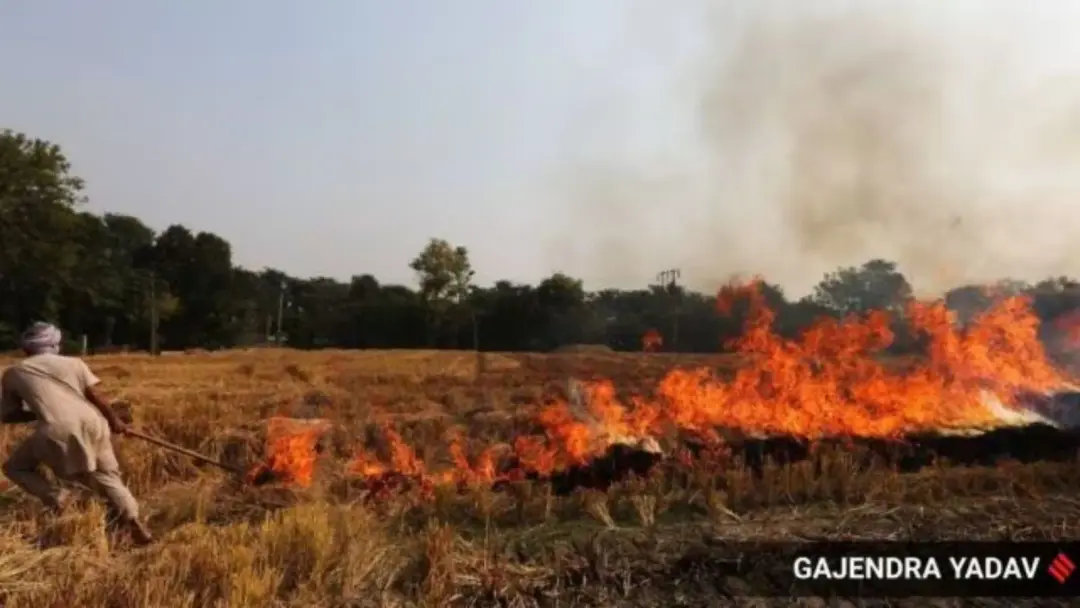
Centre drafts 15-month 'red entry' rule for stubble burning
The Centre has tightened the 'red entry' system to penalise farmers burning crop stubble, a key contributor to Delhi-NCR winter pollution. Under draft Rules published on September 16, such farmers' land will carry a red entry in revenue records valid for 15 months, extendable by another 15 months for repeat incidents or unpaid environmental compensation. Red entries can make loans and mortgages difficult. A two-month window has been given for objections. Farm unions oppose the system.
Source
Indian Express — Cities · read the original report ↗
Desk check · compared with the source
What the desk checked (5)
- Draft Rules mark land of farmers found burning stubble with a red entry in revenue records for up to 15 months, extendable by another 15 months for repeat incidents or non-payment of compensation. — Attributed in source to the draft Commission for Air Quality Management rules published on September 16; figures appear in source.
- Stubble burning contributes up to 35 per cent of Delhi-NCR pollutants on some days. — Figure appears in source without attribution to a specific study or agency.
- The Centre has given a two-month window for objections and suggestions to the draft. — Stated in source; attributed to the draft process, no document number cited.
- Bharatiya Kisan Union (Dakaunda)'s Jagmohan Singh said pollution cannot be solved by force and farmers need financial assistance. — Direct quote attributed by name and organisation in the source.
- A February 2025 parliamentary standing committee report headed by MP Milind Deora recommended an incentive-based red entry removal system. — Attributed to a named committee and report in the source; report text not independently seen.
Analysts’ view opinion
Framed as an environmental rule, this is politically one of the more sensitive levers the Centre could pull. It lets the government show urban Delhi-NCR voters that it is acting on winter smog, while simultaneously creating a fresh flashpoint in the farm politics of Punjab, Haryana and western UP. Because a red entry bites directly into loans and mortgages, farm unions have been handed an easy mobilising issue. The two-month objection window means the changes are unlikely to apply before the coming paddy harvest ends — and that timing is itself the politically significant detail.
- By specifying the red entry's validity without changing the compensation amounts, the Centre can defend the move as adding 'clarity' even as it effectively hardens the penalty.
- A penalty that touches credit, mortgages and scheme benefits is far more potent politically than a fine, which is why unions like the Bharatiya Kisan Union (Dakaunda) are already opposed.
- The story notes the impact has varied by state, meaning the Centre writes the rule but state administrations absorb much of the political friction at the ground level.
- Unions' claim that past protests and petitions got red entries removed suggests local political pressure could dilute enforcement in practice.
- The parliamentary standing committee's recommendation for an incentive-based removal route gives space to voices inside the governing coalition arguing for carrots over sticks.
What to watch — Watch how loudly Punjab and Haryana farm bodies escalate during the two-month objection window, and whether incentive-based relief makes it into the final Rules.
The story records that the Environment Ministry has not yet responded on the rationale for the 15-month validity, and it does not establish whether the draft will survive unchanged or how individual parties will formally react.
Deep dive
Research brief · 8 facts · 4 dates · exam-readyThe brief
Context
Every winter, Delhi-NCR's air quality collapses, and burning of paddy crop residue in Punjab, Haryana, Delhi and Uttar Pradesh — done to clear fields before wheat sowing between mid-September and early December — is a major contributor. Since 2023, Rules framed under the Commission for Air Quality Management (CAQM) framework have imposed environmental compensation on farmers who burn stubble, along with a "red entry" in land revenue records that can obstruct loans, subsidies and mortgages. The Union Ministry of Environment, Forest and Climate Change has now published a fresh draft of these Rules on September 16, specifying for the first time how long a red entry stays valid. Farm unions have consistently opposed the red entry system as coercive.
Key facts
- Draft Rules published on September 16 fix the validity of a red entry in revenue records at 15 months from the date of the stubble-burning incident.
- The red entry period can extend by another 15 months if there are subsequent burning incidents on the land or if imposed environmental compensation is not paid.
- A red entry expires if no subsequent stubble-burning incident is found, or if the environmental compensation imposed has been deposited.
- The draft is titled Commission for Air Quality Management in National Capital Region and Adjoining Areas (Imposition, Collection and Utilization of Environmental Compensation for Stubble Burning) Rules, 2026.
- Stubble burning contributes up to 35 per cent of pollutants in Delhi-NCR air on some days.
- The Centre has given a two-month window for objections and suggestions; changes are unlikely to take effect until the end of the upcoming paddy harvest season.
- The land-holding-based quantum of compensation has not been changed in the new draft.
- In Kurukshetra district (Haryana), authorities said red-entry farmers will be banned on the Meri Fasal Mera Byora portal for two years, losing benefits of all agricultural schemes.
Timeline
- 2023Rules on imposition, collection and utilisation of environmental compensation for stubble burning first notified, including red entry provisions.
- February 2025Parliamentary standing committee on subordinate legislation, headed by Shiv Sena MP Milind Deora, recommends an incentive-based red entry removal system.
- September 16Environment Ministry publishes new draft Rules specifying 15-month validity of red entries and revised use of compensation funds.
- Two months from publicationWindow open for objections and suggestions to the draft Rules.
Who has a stake
- Farmers in Punjab, Haryana, Delhi and Uttar Pradesh — Face environmental compensation and red entries in revenue records that hinder loans, subsidies and mortgaging of land.
- Ministry of Environment, Forest and Climate Change — Author of the draft Rules; sought to add clarity to red entry validity; yet to respond on rationale and repercussions.
- Commission for Air Quality Management in NCR and Adjoining Areas — Statutory body under whose Rules the compensation and red entry regime operates.
- Farm unions, including Bharatiya Kisan Union (Dakaunda) — Oppose red entries; demand financial assistance for paddy stubble management instead of coercion.
- Delhi-NCR residents — Bear the health burden of winter pollution to which stubble burning contributes up to 35 per cent on some days.
- Parliamentary standing committee on subordinate legislation — Recommended incentive-based early removal of red entries for farmers adopting sustainable practices.
Why it matters
The 15-month red entry ties a farmer's access to credit, mortgage and scheme benefits to compliance on stubble burning, making land records an instrument of environmental enforcement. With stubble burning contributing up to 35 per cent of Delhi-NCR pollutants on some days, the Centre is betting on deterrence, while farm unions argue that only financial support for residue management, not penalties, can change practice.
UPSC angle
Prelims pointers
- Draft Rules: Commission for Air Quality Management in NCR and Adjoining Areas (Imposition, Collection and Utilization of Environmental Compensation for Stubble Burning) Rules, 2026.
- Red entry validity fixed at 15 months, extendable by another 15 months for repeat burning or unpaid compensation.
- Parent Rules on environmental compensation for stubble burning were first notified in 2023.
- Stubble burning contributes up to 35 per cent of Delhi-NCR pollutants on some days; wheat sowing runs mid-September to early December.
- Meri Fasal Mera Byora is the Haryana portal on which red entries are recorded; Kurukshetra bars such farmers for two years.
- February 2025: Standing committee on subordinate legislation under Milind Deora suggested incentive-based red entry removal.
Mains framing
The Centre's draft 2026 Rules mark a shift from open-ended stigma to a time-bound penalty by capping a stubble-burning red entry at 15 months, extendable for repeat offences or unpaid environmental compensation. The design assumes that linking land revenue records to credit, mortgage and scheme eligibility will deter burning, which contributes up to 35 per cent of Delhi-NCR pollutants on some days. But the evidence from the field is mixed: Punjab's farm unions report grievances over loans, subsidies and mortgaging, Haryana districts like Kurukshetra add two-year exclusion from the Meri Fasal Mera Byora portal, and unions have earlier succeeded in getting entries removed through protest and petition, raising questions of enforceability and equity for small holders whose only low-cost option is fire. The draft's reworked utilisation clause — channelling compensation into crop diversification, biomass utilisation, R&D in crop residue management and subsidies for residue management technology — points to the more durable route, as does the parliamentary committee's February 2025 recommendation for incentive-based early removal of red entries. A balanced way forward would pair time-bound penalties with assured, timely financial and machinery support, so that compliance becomes affordable rather than merely compulsory.
Key terms
- Red entry
- An adverse notation in land revenue records against a farmer's land, which can obstruct loans, subsidies and mortgaging.
- Environmental compensation
- Monetary penalty imposed on farmers for burning crop residue, calculated on the basis of land holding under the 2023 Rules.
- CAQM
- Commission for Air Quality Management in the National Capital Region and Adjoining Areas, under whose Rules the stubble-burning penalties are framed.
- Meri Fasal Mera Byora
- Haryana government portal for farmer and crop registration; red entries there can cut off access to agricultural scheme benefits.
- Crop residue burning
- Setting paddy stubble on fire to clear fields quickly before wheat sowing; a major seasonal source of Delhi-NCR pollution.
- Standing committee on subordinate legislation
- Parliamentary committee that scrutinises rules framed by the executive; headed by Milind Deora, it reported on red entries in February 2025.
Practice questions
- Critically examine the use of land revenue records ('red entry') as an instrument of environmental enforcement against stubble burning. Does deterrence work without adequate farmer support?
- Discuss the institutional framework for tackling Delhi-NCR winter air pollution, with reference to the Commission for Air Quality Management and the environmental compensation Rules for stubble burning.
- 'Penalties alone cannot end crop residue burning.' Evaluate this statement in light of the draft 2026 Rules and the parliamentary committee's recommendation for an incentive-based approach.
Grounded only in the source report — figures and dates are the source's, not inferred.