
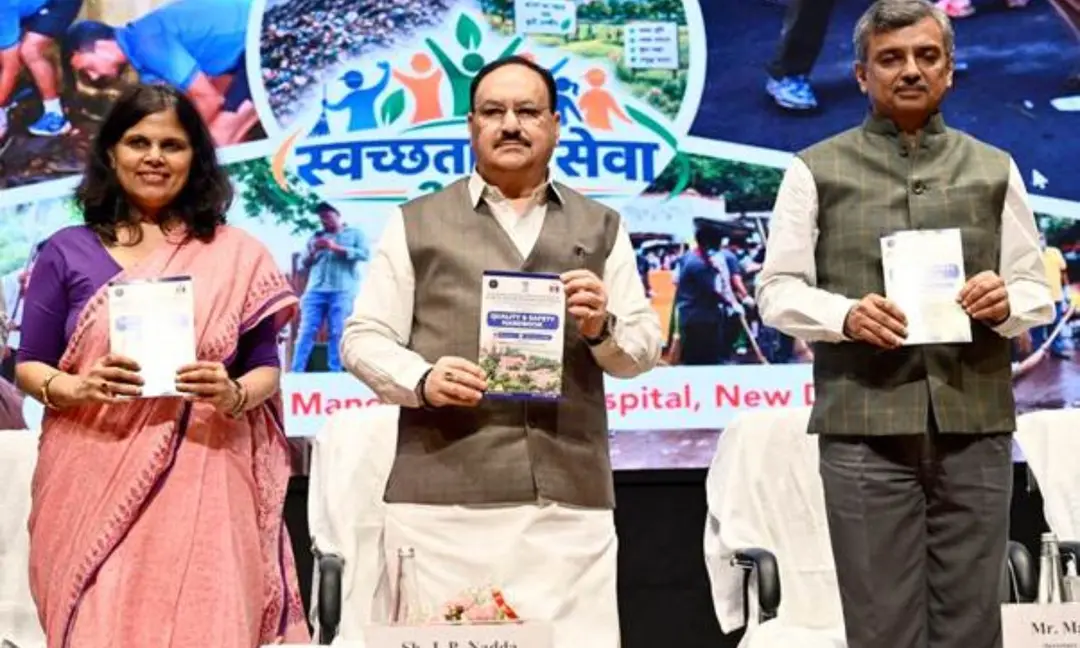
Nadda stresses safe, continuous care for NCD patients
Union Health Minister JP Nadda addressed a World Patient Safety Day 2026 event at ABVIMS and Dr Ram Manohar Lohia Hospital, New Delhi, where the theme was 'Safe care for noncommunicable diseases'. He said 60,000 government health facilities are NQAS-certified, with a target of about 2 lakh, and that 11.5 crore beneficiaries have received treatment worth around Rs 1.6 lakh crore under Ayushman Bharat. A hospital Quality and Safety Handbook was released.
Source
Health — J. P. Nadda · read the original report ↗
Desk check · compared with the source
What the desk checked (5)
- World Patient Safety Day 2026 theme is 'Safe care for noncommunicable diseases' with slogan 'Safe care for life!' — Stated in source describing the event; no external verification possible.
- 60,000 government health facilities are NQAS-certified, with a target of about 2 lakh institutions — Figure attributed to Union Minister JP Nadda in the source.
- About 11.5 crore beneficiaries treated under Ayushman Bharat, treatment worth around Rs 1.6 lakh crore — Attributed to Nadda; figures appear in source, unverified independently.
- Out-of-pocket health expenditure share fell from about 62% in 2014 to about 43% — Attributed to Nadda; no underlying data source cited.
- More than 20,000 Jan Aushadhi Kendras operating, cumulative savings about Rs 45,000 crore — Attributed to Nadda; source cites PIB as the origin of the remarks.
Analysts’ view opinion
The speech signals a shift in India's health policy framing — from simply delivering treatment to delivering safe, quality-assured treatment, a natural pivot as the non-communicable disease burden grows. The design rests on three pillars working together: financial protection via Ayushman Bharat, price relief via Jan Aushadhi, and quality certification via NQAS. The real test is the stated ambition of taking NQAS certification from 60,000 facilities to around 2 lakh — certification must translate into staffing, training and audit capacity rather than becoming a paperwork exercise.
- Choosing 'safe care for NCDs' as the theme is itself a policy admission that a one-off treatment model is inadequate and continuous, coordinated chronic care is needed.
- Scaling NQAS — introduced in 2015 — from 60,000 to roughly 2 lakh facilities is more than a threefold expansion, and assessor capacity, re-certification and continuous monitoring will decide whether it is meaningful.
- The 11.5 crore beneficiaries and ₹1.6 lakh crore of treatment under Ayushman Bharat are utilisation figures that show the reach of financial protection, but do not by themselves demonstrate the quality or safety of that care — which is precisely why the quality push matters.
- The claim that out-of-pocket spending fell from about 62 per cent in 2014 to around 43 per cent is the clearest benchmark against past policy, yet it also concedes that nearly half the burden still sits with households.
- Linking hospital cleanliness and infection control to patient safety is analytically sound, but officials at the same event acknowledging cleanliness remains a significant challenge points to the implementation gap.
What to watch — Watch for whether a timeline, funding line and assessment or re-audit mechanism is attached to the 2 lakh NQAS target, and whether follow-up data emerges on how many people screened for NCDs actually enter treatment.
The story rests on government figures cited in a commemorative-day speech; it does not establish a deadline or budget for the certification target, nor offer independent evidence that patient-safety outcomes have measurably improved.
Deep dive
Research brief · 8 facts · 5 dates · exam-readyThe brief
Context
World Patient Safety Day is observed on 17 September; the 2026 theme is "Safe care for noncommunicable diseases" with the slogan "Safe care for life!". Union Health Minister JP Nadda addressed the observance at Atal Bihari Vajpayee Institute of Medical Sciences (ABVIMS) and Dr Ram Manohar Lohia Hospital, New Delhi, linking patient safety to quality assurance, hospital hygiene and infection prevention. The event also saw the release of the hospital's Quality & Safety Handbook and interactions with beneficiaries of PMJAY and the Jan Aushadhi Pariyojana. Nadda used the platform to present the Government's record on quality certification, financial protection and affordable medicines.
Key facts
- World Patient Safety Day 2026 theme: 'Safe care for noncommunicable diseases'; slogan: 'Safe care for life!' — observed on 17 September.
- National Quality Assurance Standards (NQAS) certification was introduced in 2015; 60,000 government health facilities are now NQAS-certified, with a target of around 2 lakh institutions.
- Ayushman Bharat provides health coverage of up to Rs 5 lakh per family per year for secondary and tertiary care.
- Approximately 11.5 crore beneficiaries have received treatment under Ayushman Bharat, worth around Rs 1.6 lakh crore.
- More than 20,000 Jan Aushadhi Kendras have been set up under PMBJP, with expansion planned to around 25,000 outlets; cumulative citizen savings estimated at about Rs 45,000 crore.
- Out-of-pocket expenditure as a share of total health expenditure has declined from around 62 per cent in 2014 to around 43 per cent.
- Around 11 crore toilets were created over the past decade, contributing to a significant decline in diarrhoeal disease, per Nadda.
- Under the Swasth Nari, Sashakt Parivar campaign launched last year, more than 17 lakh health camps were held with participation of over 11 crore people, said Punya Salila Srivastava.
Timeline
- 2014Out-of-pocket expenditure stood at around 62 per cent of total health expenditure (baseline cited by the Minister).
- 2015National Quality Assurance Standards (NQAS) certification introduced to set nationally recognised standards for healthcare institutions.
- Past decadeAround 11 crore toilets created under the Swachhata movement; Ayushman Bharat and PMBJP scaled up.
- Last yearSwasth Nari, Sashakt Parivar campaign launched; over 17 lakh health camps organised with 11 crore-plus participants.
- 17 September (World Patient Safety Day 2026)Nadda addresses the event at ABVIMS & Dr RML Hospital; Quality & Safety Handbook released; he interacts with PMJAY and Jan Aushadhi beneficiaries.
Who has a stake
- Union Ministry of Health & Family Welfare (JP Nadda; Secretary Punya Salila Srivastava) — Driving patient safety, NQAS certification expansion and financial protection through Ayushman Bharat.
- ABVIMS & Dr Ram Manohar Lohia Hospital, New Delhi — Host institution; NABH-accredited; released the Quality & Safety Handbook and runs audits, training and monitoring.
- Patients with noncommunicable diseases — Need safe, coordinated and continuous care, correct diagnosis, infection prevention and screening-based early detection.
- Healthcare workers — doctors, nurses, paramedics, technicians, administrative staff — Collective responsibility for hand hygiene, waste disposal, infection-control protocols and patient-centric conduct.
- Patients' attendants and hospital visitors — Asked to actively participate in hospital cleanliness and infection prevention, per Punya Salila Srivastava.
- Department of Pharmaceuticals (Secretary Manoj Joshi) — Access to affordable generics via PMBJP and AMRIT Pharmacies to cut treatment costs for vulnerable groups.
Why it matters
NCDs such as diabetes, hypertension and cancers require lifelong, coordinated care, where lapses in diagnosis, follow-up or infection control can be as harmful as the disease itself. By tying patient safety to NQAS certification, hospital hygiene and reduced out-of-pocket spending, the government frames safety as a system-wide quality and affordability issue rather than a hospital-level formality.
UPSC angle
Prelims pointers
- World Patient Safety Day is observed on 17 September; 2026 theme 'Safe care for noncommunicable diseases', slogan 'Safe care for life!'
- NQAS certification launched in 2015; 60,000 government facilities certified, target around 2 lakh.
- Ayushman Bharat (AB-PMJAY): cover of Rs 5 lakh per family per year for secondary and tertiary care.
- PMBJP: over 20,000 Jan Aushadhi Kendras; target around 25,000; estimated savings about Rs 45,000 crore.
- Out-of-pocket health expenditure share: about 62% (2014) to about 43% now.
- Other initiatives named: Ayushman Arogya Mandirs, PM National Dialysis Programme, PM-ABHIM, eSanjeevani, Ayushman Vay Vandana, AMRIT Pharmacies.
Mains framing
India's disease burden has shifted decisively towards noncommunicable diseases, which demand not one-time treatment but safe, coordinated and continuous care — a model that exposes weaknesses in diagnosis, follow-up, infection control and hospital hygiene. The government's response, as articulated at World Patient Safety Day 2026, works on three tracks: institutionalising quality through NQAS certification (60,000 facilities certified, target around 2 lakh) and NABH accreditation; reducing catastrophic expenditure through Ayushman Bharat (11.5 crore beneficiaries, Rs 1.6 lakh crore of treatment; cover of Rs 5 lakh per family per year) and affordable generics through PMBJP (20,000-plus Jan Aushadhi Kendras, about Rs 45,000 crore savings); and strengthening prevention through digitally tracked vaccination and mass screening for diabetes, hypertension and oral, cervical and breast cancers. Officials themselves flagged that hospital cleanliness remains a significant challenge, and that speed of care must not override safety protocols. The way forward, on the source's own logic, lies in scaling certification to the remaining facilities, embedding practical guidance such as hospital Quality & Safety Handbooks into daily practice, sustaining audits, training and monitoring, and treating hygiene and infection prevention as a shared duty of staff, patients and attendants — while continuing to compress out-of-pocket expenditure from the current level of about 43 per cent.
Key terms
- NQAS (National Quality Assurance Standards)
- Certification introduced in 2015 to assess and assure the quality of public healthcare institutions against nationally recognised standards.
- NABH accreditation
- Hospital accreditation reflecting adherence to established patient-safety and treatment-quality standards; held by ABVIMS & Dr RML Hospital.
- AB-PMJAY (Ayushman Bharat-Pradhan Mantri Jan Arogya Yojana)
- Health assurance scheme giving eligible families up to Rs 5 lakh a year for secondary and tertiary care; among the world's largest coverage programmes.
- PMBJP / Jan Aushadhi Kendras
- Pradhan Mantri Bhartiya Janaushadhi Pariyojana; outlets selling quality generic medicines at affordable prices, over 20,000 in operation.
- Out-of-pocket expenditure (OOPE)
- Direct health spending borne by households; its share fell from about 62% in 2014 to about 43%.
- Quality & Safety Handbook
- Handbook released by ABVIMS & Dr RML Hospital giving staff standardised operational guidance on patient-safety and quality practices.
Practice questions
- Noncommunicable diseases require 'safe, coordinated and continuous care'. Examine how quality-assurance mechanisms such as NQAS and hospital accreditation can address patient-safety gaps in India's public health system.
- India's out-of-pocket health expenditure has fallen from about 62 per cent in 2014 to about 43 per cent. Discuss the role of Ayushman Bharat and the Jan Aushadhi Pariyojana in this decline and the challenges that remain.
- 'A clean hospital is not merely a well-maintained hospital, but also a safer hospital.' Critically analyse the link between hospital hygiene, infection prevention and patient safety in India.
Grounded only in the source report — figures and dates are the source's, not inferred.